AP Bio Unit 1
 Call Kai
 Learn
Learn Practice Test
 Spaced Repetition
 Match
Match Flashcards
 Knowt Play
1/44

There's no tags or description
Looks like no tags are added yet.
Name | Mastery | Learn | Test | Matching | Spaced | Call with Kai | Chat |
|---|
No analytics yet
Send a link to your students to track their progress
45 Terms
matter
takes up space; has mass
C, H, O, N make up 96% living matter
atoms
smallest unit of any periodic table element
3 components of an atom
neutrons, protons, electrons
neutrons
neutral, in center/nucleus of atom, have atomic weight ~1
protons
positive charge, in center/nucleus of atom, have atomic weight ~1
electrons
negative charge, found in electron cloud/orbitals, no critical mass
orbitals
areas of space around nucleus
lower orbital # = closer to nucleus
valence electrons
# of electrons in outermost orbital
1st orbital can hold 2 electrons (1 pair), all other hold 8 (4 pairs)
# of valence electrons impact how many bonds/types of bonds an atom can make (atoms want full outer ring to be stable)
atomic mass
proton # + neutron #
atomic number
proton #
isotope
element w/ unusual # of neutrons
atomic weight different from normal weight of that element
ex: carbon 13 (1 extra neutron)
molecules
made of more than one atom bonded together
bonding
an attraction b/t 2 atoms/molecules
covalent bonds
electrons are shared b/t atoms in molecule; found in outer orbital of both atoms
polar vs. nonpolar
polar covalent bond: electrons are not shared evenly, pulled farther from nucleus of one atom & closer to the other
result: polar molecule w/ uneven distribution of charge
ionic bonds
electron(s) are transferred between atoms, resulting in the formation of ions that are attracted to each other
cations & anions
cation vs. anion
cation: positive ion, has lost 1 or more electrons
anion: negative ion, has gained 1 more electrons
hydrogen bonds
weak attractive force b/t 2 polar molecules
water formula/structure
H2O (bent, 2 hydrogens, 1 oxygen)
water polarity
oxygen is more electronegative, pulls shared electrons closer so it has a more negative side
hydrogens are less electronegative, the shared electrons are pulled away from them and are are more positive
water properties: cohesion
hydrogen bonding b/t molecules of the same substance
water molecules are attracted to each other, allowing for surface tension and water droplet formation
water properties: adhesion
hydrogen bonding b/t molecules of different substances
a. water molecules are attracted to other polar or ionic molecules
b. with cohesion allows for capillary action, movement of water through plants
specific heat
amount of heat that needs to be applied to a substance to raise the temperature 1 degree
water properties: high specific heat
water has high specific heat, requiring lots of applied heat to raise temp.
prevents body temp. of organisms from (made mostly of water) from fluctuating rapidly
prevents temp. of planet from changing rapidly (oceans=major heat sink)
structure of ice vs. liquid
as water cools and freezes the hydrogen bonds become more stable and molecules space out to maximize the number of hydrogen bonds they can form, so ice is less dense than liquid water
solid vs. liquid: non-water substances
as substances cool the molecule movements slow down, most substances increase in density because molecules are bouncing off each other less
ice floats
ice floats on water, bodies of water float from the surface down
leaves liquid below ice layer
ice insulates water below; organisms survive winter under ice
water pH
in any aqueous solution at 25°, the concentration of hydrogen ions multiplied by the concentration of hydroxide ions is = 10-14
pH = -log[H⁺]
If given pH then [H+] = 10(-pH)
pH continued
Water can (but rarely does) dissociate evenly into H+ and OH- so its pH = 7 (neutral)
Important for enzymes/proteins, many work in an ideal pH range close to neutral and will denature if in an extreme pH (acidic or basic)
carbon properties
6 protons, 6 neutrons, 6 electrons
4 valence electrons, can form 4 single bonds, up to 2 double bonds, or one triple bond (plus one single bond to another atom)
Found in all organic molecules
monomer
smallest unit of a macromolecule
polymer
made of multiple monomers linked together
Condensation/Dehydration Synthesis Reaction
links two monomers (or a monomer and a polymer) together by removing a Hydrogen (H) from one and a hydroxide (OH) from the other
the two larger molecules bond in the area that is now available and the Hydrogen and Hydroxide bond to form a molecule of water
Hydrolysis Reaction
Breaking down a polymer and water, a water molecule breaks down to form a hydrogen and hydroxide and a bond between two monomers in a polymer breaks
the hydrogen bonds to one of the larger molecules and the hydroxide to the other
functional groups
hydroxyl
carbonyl
carboxyl
amino
sulfhydryl
phosphate
methyl
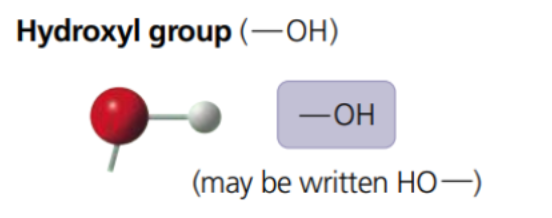
hydroxyl
formula: OH
properties: polar, can bond to a hydrogen ion to form water, found in alcohols (compound names ending in -ol)
carbonyl
Formula/Structure: - CO (with 2 open bonds off carbon)
Properties: compounds are called Ketones if carbonyl is in the middle of a skeleton, compounds are called aldehydes if carbonyl is at the end of a carbon skeleton

carboxyl
Formula/Structure: - COOH or -CO2H
Properties: tends to ionize, acidic (releases a H+)

amino
Formula/Structure: - NH2
Properties: acts as a base (can pick up a H+), found in all amino acids

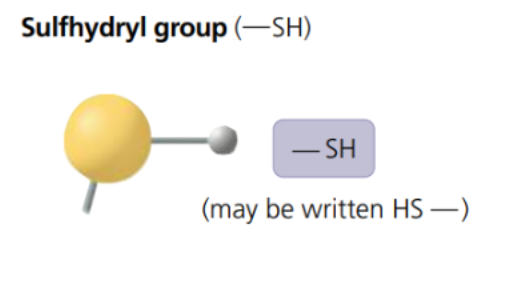
Sulfhydryl
Formula/Structure: - SH
Properties: forms disulfide bridges in proteins (tertiary structure) between cysteines (Amino Acids)
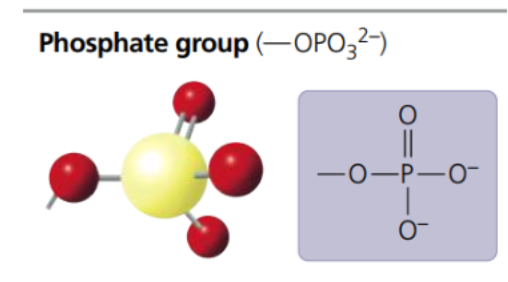
phosphate
Formula/Structure: - OPO32-
Properties: found in nucleic acids (including ATP), repel each other producing lots of stored energy in ATP (energy is released when bond between a phosphate and ADP is broken)
methyl
Formula/Structure: - CH3
Properties: can affect gene expression when on DNA or proteins bound to DNA

isomers
Molecules that have the same chemical formula
structural isomers
differ structurally in the arrangement of covalent bonds
cis-trans isomers
found in molecules that have a double bond between carbons
Cis = atoms attached to carbons involved in double bond are on the same side
Trans = atoms attached to carbons involved in double bond are on opposing sides