POLS 1101: Lecture 7
 Call Kai
 Learn
Learn Practice Test
 Spaced Repetition
 Match
Match Flashcards
 Knowt Play
1/34

Earn XP
Description and Tags
Federalism
Name | Mastery | Learn | Test | Matching | Spaced | Call with Kai | Chat |
|---|
No analytics yet
Send a link to your students to track their progress
35 Terms
Federalism
Power is divided between national and state governments
Federalism means that both the national and state governments have constitutionally recognized powers, rather than states simply exercising authority delegated to them by the national government

Characteristics of federalism
Two levels of government
Constitutional division of power
Independent state authority
Guarantee Clause (Article IV, Section 4)
Overlapping responsibilities
Unitary Systems
All power is held by the central government
Local governments are only given power by central/national government
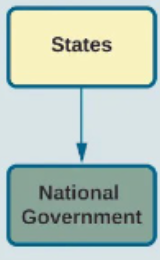
Confederal Systems
Alliance of sovereign states
Limited authority given to the central or national government

Police Powers
State powers
health, safety, morals, and general welfare
National (Enumerated) Powers
Regulate interstate & foreign commerce
Conduct foreign policy
Raise & maintain armed forces
Coin money
Establish naturalization rule
State (Reserved) Powers
• Establish local governments
• Regulate intrastate commerce
• Issue Certain licenses
• Police Powers
Concurrent (Shared) Powers
Make & enforce laws
Establish courts
Levy taxes
Borrow money
Build infrastructure
Restrictions on shared powers
Suspension of Habeas corpus
Bill of Attainder
Ex post facto law
Restrictions on state powers
Cannot engage in foreign policy (treaties, tariffs) Cannot print currency
14th Amendment: Most Bill of Rights protections gradually applied to the states through selective incorporation
Full Faith and Credit Claus
Restrictions on federal powers
Tax exports from the states
Change state boundaries
Violate bill of rights
Necessary and Proper Clause
Elastic clause
Necessary and Proper Clause
Congress can make laws deemed “necessary and proper” to implement enumerated powers
Supremacy Clause
Federal laws are the "supreme Law of the Land“
Federal law prevails when there is a conflict between federal and state law
Dual Federalism
National and state governments operate in separate, distinct spheres
Authority clearly divided, little overlap
Powers neatly separated

Cooperative Federalism
National and state governments share powers and responsibilities
Jurisdictional boundaries blurred; powers intertwined
Federal funding + state implementation = cooperative governance

McCulloch v. Maryland (1819)
Strengthened implied federal power
Congress can use implied powers (bank constitutional)
States cannot tax federal property (Supremacy Clause)
Commerce Clause & Gibbons v. Ogden (1824)
Federal authority extended to navigation as part of “interstate commerce”
Federal law trumped New York’s steamboat monopoly
Nullification Doctrine
States claimed the authority to reject unconstitutional federal law
Virginia & Kentucky Resolutions (1798)
Advance the idea that states could challenge unconstitutional federal laws
Hartford Convention (1814–15)
New England Federalists protested federal policies and proposed constitutional changes
Nullification Crisis (1832–33)
South Carolina claimed authority to nullify federal tariffs
Secession Crisis (1860–61)
Southern states asserted a right to leave the Union
National Labor Relations Board (NLRB) v Jones & Laughlin Steel Corporation (1937)
Expanded federal authority under the Commerce Clause
West Coast Hotel Co. v. Parrish (1937)
Ended the Lochner Era and permitted the restriction of liberty of contract
Switch in Time that Saved Nine”
Wickard v. Filburn (1942)
Broadened federal regulation to intrastate commerce
Heart of Atlanta Motel v. United States (1964)
Upheld federal prohibition of racial discrimination in public accommodations under the Commerce Clause
New Federalism
Sought greater state flexibility and devolutio
“Style of federalism emphasizing the decentralization of power from the federal government back to the states, often called the ‘devolution revolution’” (OpenStax 4e)
Goal: restore state authority, reduce federal control
Emerged under Nixon (1969–74) and expanded under Reagan (1981–89)
United States v. Lopez (1995)
First major limit on Commerce Clause power in decades
Categorical Grants
Specific purpose, strict criteria
Block Grants
Broader use, state discretion
General Revenue Sharing
Minimal restrictions
Unfunded Mandates
Obligations without full federal funding
Competitive Federalism
interaction between the federal government and the states in which both levels of government compete for influence over policy
Venue Shopping
“interest groups select the level and branch of government they calculate will be most receptive to their policy goals” (OpenStax)
New Deal
Accelerated the expansion of federal power