M1 Infection Prevention - Module 3
 Call Kai
 Learn
Learn Practice Test
 Spaced Repetition
 Match
Match Flashcards
 Knowt Play
1/18

Earn XP
Description and Tags
Infection Control Exam 1
Name | Mastery | Learn | Test | Matching | Spaced | Call with Kai | Chat |
|---|
No analytics yet
Send a link to your students to track their progress
19 Terms
HCP
Healthcare Personnel
HCP may acquire transient microorganisms during: (4)
HCP may acquire transient microorganisms during:
contact with a patient’s intact skin (e.g., when taking a pulse or blood pressure)
contact with nonintact skin and mucous membranes
direct contact with blood and other potentially infectious material (OPIM)
contact with contaminated instruments, equipment, and environmental surfaces
The transmission of healthcare-associated pathogens from one patient to another via the hands of HCP must meet 4 criteria:
Organisms present on the patient’s skin or mucous membranes, or on contaminated instruments, equipment, and environmental surfaces must be transferred to the hands of HCP.
The organisms transferred must then be capable to survive for at least several minutes on the hands of HCP.
Hand hygiene by HCP must be inadequate or omitted entirely, or the agent used for hand hygiene is inappropriate.
The contaminated hands of HCP must come in direct contact with another patient, or with an inanimate object that will come into direct contact with the patient.
Antiseptic agents
Antiseptic agents in hand hygiene products used in healthcare settings should (1) have a broad spectrum, (2) be fast acting, reduce the number of microorganisms on intact skin to an initial baseline level
Compared to normal soap, healthcare soap
What is handwashing in healthcare?
Handwashing is cleaning hands with plain soap and water to remove dirt, soil, organic material, and loosely attached microorganisms.
When is handwashing with soap and water required?
Handwashing is required when:
Hands are visibly contaminated with blood or OPIM
Before eating
After using the restroom
After caring for patients with Clostridioides difficile
After possible exposure to Bacillus anthracis
Before surgical hand antisepsis (as part of a two-step process)
Why is proper hand drying important after handwashing?
Wet hands spread more microorganisms than dry hands. Single-use towels are preferred because they dry hands more effectively than air dryers or reusable cloth towels.
Are hand wipes a replacement for hand antisepsis?
Antimicrobial wipes may be used as an alternative to routine handwashing, but they do not replace hand antisepsis or surgical hand antisepsis.
How to properly wash your hands
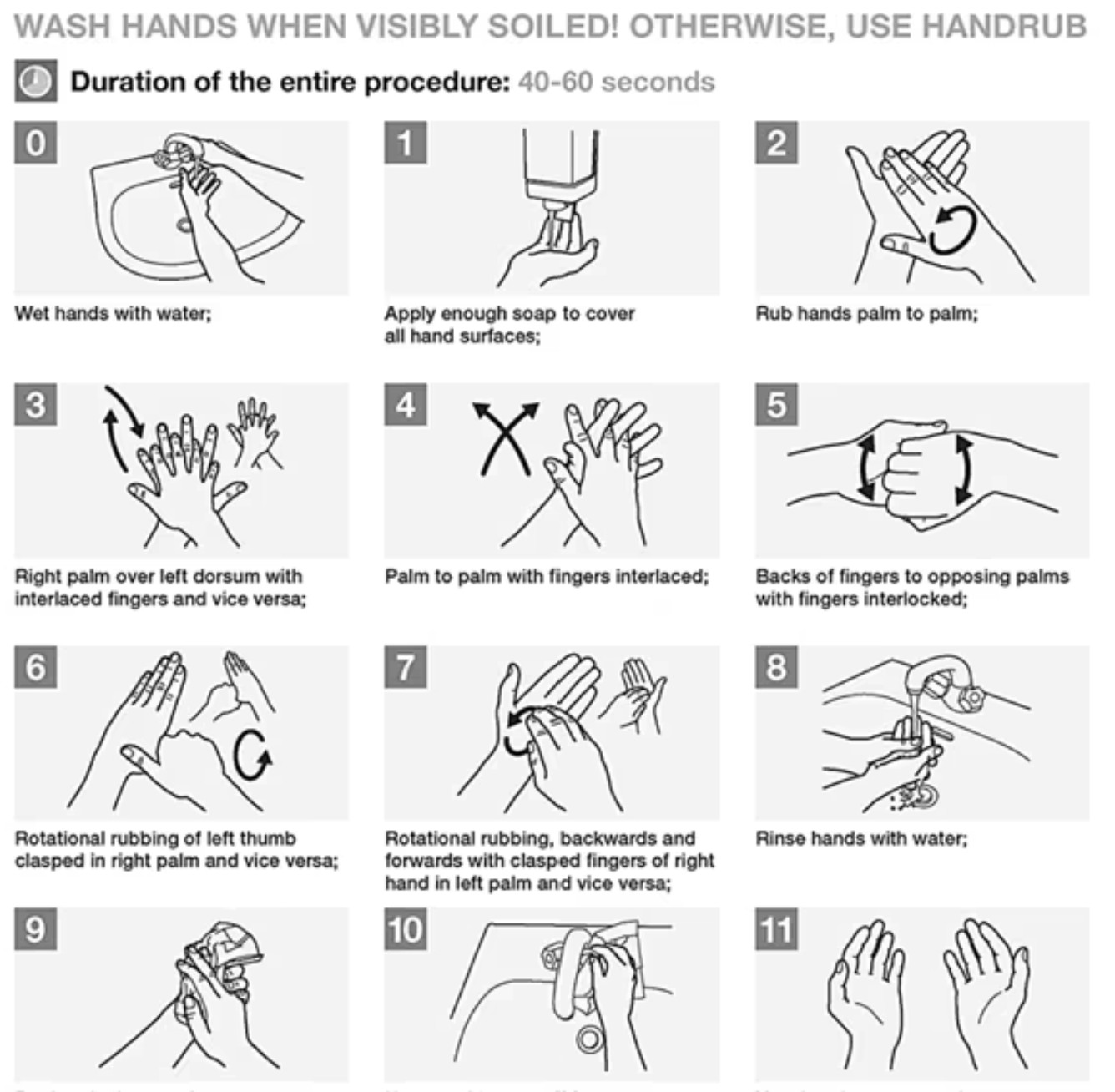
Antiseptic Handwash
Povidone iodine, 5 to 10% formulations, is considered safe and effective for use in handwash
Is Antiseptic Handwash just as good as hand washing
Yes but only because it is more likely that someone does it
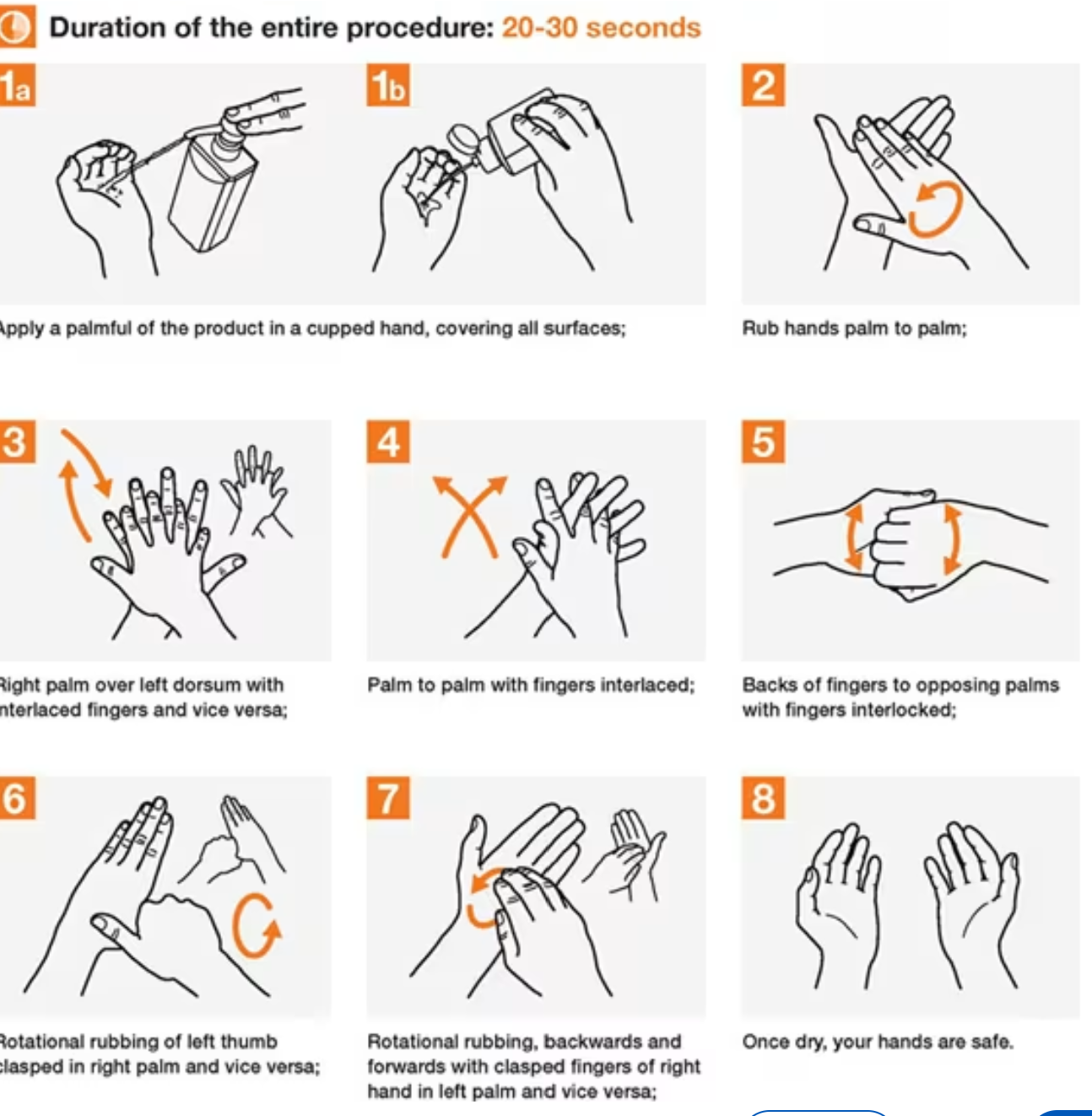
Antiseptic Handrub
Uses a waterless antiseptic agent (usually 60–95% ethanol) applied to hands.
Alcohol works by denaturing microbial proteins to destroy microorganisms.
Removes transient microorganisms and reduces resident skin flora.
Two-stage surgical hand antisepsis
Stage I steps:
Remove rings, watches, and bracelets before beginning surgical hand antisepsis.
Remove debris from underneath fingernails using a nail on the other hand.
Natural nails should be kept short (tips < 0.5 cm long).
Artificial fingernails or extenders should not be worn
Wet hands and forearms with warm running water.
Apply plain soap to hands and forearms.
Wash hands and forearms by rubbing vigorously (frictional scrub) - see Figure 1.
Usually 40 to 60 seconds.
Rinse hands and forearms with warm running water.
Dry hands and forearms thoroughly with a single-use towel.
Use towel to turn off the faucet.
Stage II steps:
Apply enough alcohol-based product to the palm of one hand to cover all surfaces (hands/forearms).
Rub hands and forearms vigorously (frictional scrub) until dry – see Figure 2.
Usually 20 to 30 seconds
When hands and forearms are dry, don sterile surgical gloves.
Option 2 - Surgical antiseptic handwash
Steps:
Remove rings, watches, and bracelets before beginning the surgical hand antisepsis.
Remove debris from underneath fingernails using a nail on the other hand.
Natural nails should be kept short (tips < 0.5 cm long).
Artificial fingernails or extenders should not be worn.
Wet hands and forearms with warm running water.
Apply a 5 to 10% povidone iodine formulation to hands and forearms.
Wash the hands and forearm by rubbing vigorously (frictional scrub) – see Figure 1.
Usually 2 to 5 minutes.
Rinse hands and forearms with warm running water.
Dry hands and forearms thoroughly with a single use towel.
Use towel to turn off faucet.
When hands and forearms are dry, don sterile surgical gloves.
What factors should be considered when selecting hand-hygiene products?
Choose products based on effectiveness, safety, dispenser reliability, and skin tolerance (not just cost).
Alcohol-based handrubs are generally more cost-effective than antimicrobial soap and water; containers should be flame-resistant.
Avoid contamination by not refilling (“topping off”) partially empty dispensers and provide products compatible with gloves and skin-care products.
Irritant Contact Dermatitis
ICD is the most common reaction from frequent hand-hygiene product use and causes dryness, itching, burning, redness, scaling, and cracking of the skin.
It results from damage to the skin barrier caused by detergents, excessive scrubbing, hot water, harsh towels, glove friction, and low humidity.
Alcohol-based handrubs are among the safest antiseptics and are usually less irritating; avoid washing hands after every use unless needed (typically after 5–10 applications).
Allergic Contact Dermatitis
ACD is a T cell-mediated delayed hypersensitivity reaction (Type IV) caused by ingredients in hand-hygiene products.
Most commonly triggered by fragrances and preservatives; less commonly by emulsifiers or iodophors.
Symptoms include rash, redness, itching, and possible oozing blisters that may spread beyond the area of contact.
Strategies to Improve Hand Hygiene Practices
1) HCP demonstrate knowledge
2) HCP demonstrate competence
3) Institution enables staff
4) Institution verifies competency of HCP and provides feed back
Why is an alcohol-based handrub preferred for routine hand hygiene when hands are not visibly soiled?
Most effective method for reducing bacteria, viruses, and fungi on hands.
Faster, easier to access, and causes less skin irritation than soap and water with repeated use.
Improves hand hygiene compliance and is preferred at the point of care.