1.1 History of Learning Theory
 Call Kai
 Learn
Learn Practice Test
 Spaced Repetition
 Match
Match Flashcards
 Knowt Play
1/35

There's no tags or description
Looks like no tags are added yet.
Name | Mastery | Learn | Test | Matching | Spaced | Call with Kai | Chat |
|---|
No analytics yet
Send a link to your students to track their progress
36 Terms
Learning
the acquisition of information through experience
need not to be conscious
memory
the retention of learned information over time
both learning & memory are forms of _________
plasticity
plasticity
a consequence of development, injury, or experience
learning and memory are different
memory focuses on retention
learning is the process
Plato: Nativism
the Doctrine of Anamnesis: all learning is recollection
therefore → all information is innate
answers How do we come to know?
student of Socrates
~427BCE-~347BCE
Aristotle: Early Empiricism
all knowledge acquired, comes from experience
student of Plato, disagreed w/ him
384BCE-322BCE
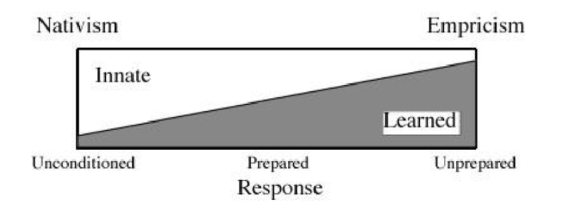
the Innate Debate has taken many forms
Doctrine of Anamnesis vs. Tabula Rasa
Nativism vs. Empiricism
Nature vs. Nurture
Most recent philosophical developments
Descartes (1588-1679): Dualism
unextended substance: non-physical
soul(mind), free will
does not abide by scientific rules
extended substance: physical
body
abides by scientific rules
implications of Dualism
some parts of human behavior can be studied
reflexology
infrahuman species should be fully understandable
Materialists (e.g., Julien Offra de La Mettrie, 1709-1751)
argued that our mind may be “machine”
suggest we can derive the laws of the mind
Llyod Morgan’s canon (1894)
argued that “In no case may we interpret an action as the outcome of the exercise of a higher psychical faculty, if it can be interpreted as the outcome of the exercise of one which stands lower on the psychological scale.”
Aristotle’s 3 Laws of Association (and the Law of Frequency)
Law of Similarity
Law of Contrast
Law of Continuity
Law of Frequency
Law of Similarity
the experience or recall of one object will elicit the recall of things similar to that object
Law of Contrast
the experience or recall of one object will elicit the recall of opposite things
Law of Contiguity
the experience or recall of one object will elicit the recall of things that were originally experienced alongside the object
Law of Frequency
the more frequently two things are experienced together, the more likely it will be that the experience or recall of one will stimulate the recall of the second
John Locke (1632-170)
all knowledge is acquired
Tabula Rasa - blank slate
knowledge is built up through the association of ideas
“Let us then suppose the mind to be, as we say, white paper, void of all characters, without any ideas: - How comes it to be furnished? Whence comes it by that vast store which the busy and boundless fancy of man has painted on it with an almost endless variety? Whence has it all the materials of reason and knowledge? To this I answer, in one word, from experience. In that all our knowledge is founded; and from that it ultimately derives itself.”
Associationists
Principles of Association
David Hartley (1705-1757)
contiguity, repetition
James Mill (1773-1836)
mental mechanics
emotional vividness (salience)
John Stuart Mill (1806-1873)
mental chemistry
Charles Darwin (1809-1882) & Evolution
Natural Selection
traits that enable a species’ survival & reproductive success become more common in a population over the generations.
variation exists within populations
variations can be heritable
organisms produce more offspring than can survive
individuals with adaptive traits are more likely to survive
over time, advantageous traits become more common in a population
Functionalism
behaviors follow the rules of natural selection
further, learning follows the rules of natural selection
learning is hereditary as well
Structuralism
Limits of “Armchair Psychology”
prior to the founding of psychology as as discipline, most theorists were not experimentalists
Edward Titchener (1868-1927)
a student of Wilhem Wundt
“Father of Psychology”
systematic introspection
all thoughts can be broken down into basic elements called sensations
categorized sensations
4 properties: intensity, quality, duration & extent
Ivan Pavlov (1849-1936)
Nobel prize in Physiology or Medicine 1904
“ in recognition for his work on the physiology of digestion…”
Pavlovian Conditioning
unconditional stimulus (US)
unconditional response (UR)
conditional stimulus (CS)
conditional response (CR)
Introspection by analogy (George Romanes)
“a technique for studying animal behavior by assuming that the same mental process that occurs in the observer’s mind also occurs in the animal’s mind.”
potentially problematic
Edward Thorndike (1384-1949)
opposed anthropomorphic interpretations proposed that animals learn through trial and error
Thorndike’s Law of Effect
“if a response in the presence of a stimulus is followed by a satisfying [appetitive] event, the association between the stimulus and the response is strengthened. If the response is followed by an annoying [aversive] event, the association is weakened.
Thorndike’s Law of Effect II
assumptions
learning is S-R in nature
avoids mentalistic terms
role of reinforcement
S-R S-R S-R S-R S-R S-R S-R reinforcement
learning depends on response-outcome (R-O) relationship
distinction between:
Pavlovian conditioning (S-R)
instrumental learning (R-O)
big takeaway of edward thorndike
early ideas of reinforcement & punishment learning
John Watson (1878-1958)
extreme empiricism
“give me a dozen healthy infants, well-formed, and my own specified world to bring them up in, and I’ll guarantee to take any one at random and train him to become any type of specialist I might select.”
behaviorism
Watson rejected the structuralists’ method of introspection
emphasized publicly verifiable data
stimuli (S) and responses (R)
sought to formulate behavioral laws to predict and control behavior
posited that learning is S-R in nature
thus can be studied in infrahuman species (ex.rats)
famous experiment: Little Albert
Clark Hull
Animal performance =/= learning
behavior motivated by drives
food/water, etc
learning can occur without performance in the absence of motivation
behavior can be predicted mathematical
mathematical-deductive theory of behavior
sEr = (V*D*K*J*sHr) - (sIr + Ir +sOr + sLr)
sEr = excitatory potential
the likelihood that an organism will respond to a stimulus
factors increasing sEr
factors decreasing sEr
V = stimulus intensity dynamism
some stimuli will have greater influence on behavior
ex. conditional taste aversion
D = drive strength
ex. a hungrier animal will be more motivated to perform than a satiated animal
K = incentive motivation
magnitude of the goal
ex. an animal will be more motivated by a pile of food than by a single pelet
J = incentive delay
the delay before the animal is allowed to seek the goal
ex. an animal will be more motivated if it has been denied the ability to seek the goal for a longer time
(sIr + Ir +sOr + sLr)
sHr = habit strength
depends on contiguity and reinforcement
reinforcement = drive (d) reduction
sHr rises to asymptote
sIr = conditioned inhibition
an S-R link that interferes with performing the target response
formed as Ir fades
Ir = reactive inhibition
analogous to fatigue
drive state
fades w/ time
sOr = random error
impossible to fully eliminate confounding variables
ex. a loud train passes by the lab where a rat is being trained. the animal hears the train whistle and freezes
sLr = reaction threshold
the smallest amount of reinforcement that will produce learning
Summary from Hull
behavior can sometimes be modeled mathematically (even if his model didn’t work well)
performance =/= learning
Tolman Reacted Against the S-R View
drew on Gestalt Psychology
argued that animals could form associations between neutral stimuli (Latent Learning)
S-S relationships
S1-R-S2 expectancies
assumed reinforcement affects performance
learning occurs when contiguity is present
cognitive inference
if S1→R→S2 and S2→S-* THEN S1→R→S*
Tinklepaugh’s Experiment
comparison organisms encode the reinforcement
Tolman’s Mazes
Tolman placed rats in a maze that contained in a series of binary choice points
three groups:
food reward