U.S. Constitution, Federal Government, and Early American History
 Studied by 0 people
 Call with Kai
 Learn
Learn Practice Test
 Spaced Repetition
 Match
Match Flashcards
 Knowt Play
1/22

There's no tags or description
Looks like no tags are added yet.
Name | Mastery | Learn | Test | Matching | Spaced | Call with Kai |
|---|
No study sessions yet.
23 Terms
What were some of the chief issues with the Articles of Confederation as a governing document?
no taxing power, no executive/judicial branches, no national army, and states acting like separate nations, causing debt and disunity
How did the Constitution address some of the chief weaknesses of the Articles of Confederation?
creating three branches, granting Congress the authority to tax, establishing a single executive (President) to enforce laws, and creating a federal court system
How do separation of powers and checks and balances affect the U.S. Government?
prevent tyranny by dividing authority, each branch can limit the others ,vetoes, impeachment, judicial review, , protecting liberty
What are the rights, liberties, and responsibilities of U.S. citizens?
free speech, voting, fair trial, obeying laws, paying taxes, participating in democracy, respecting others, community involvement
How is the Constitution a living document?
because it's designed to be adaptable and relevant to changing times, not just through formal amendments
How did the Framers use compromise to ensure that the Constitution would reflect different points?
creating solutions for major disagreements, most notably the Great Compromise (Connecticut Compromise) for legislative representation (bicameral legislature with House by population, Senate by equal state) and the Three-Fifths Compromise (counting enslaved people as 3/5ths for representation/taxation)
What were 2 chief areas of disagreement at the Constitutional Convention?
representation in Congress (large states wanted it by population, small states wanted equal representation, resolved by the Great Compromise) and the existence/power of slavery (how to count enslaved people for representation and the slave trade, resolved by the Three-Fifths Compromise)
What were some of the chief disagreements between Hamilton and Jefferson?**********
Hamilton advocated for a strong, centralized national government to ensure stability and unity, fearing anarchy and disorder.
Jefferson championed states' rights and a limited federal government, fearing that centralized power would lead to tyranny
Explain the parts of Hamilton's financial plan.
establishing national credit, creating a national bank, funding manufacturing through protective tariffs and excise taxes (like on whiskey), and assuming state debts
Explain two reasons for why Jefferson objected to Hamilton's plan.
Thomas Jefferson objected to Alexander Hamilton's financial plan primarily because he believed it favored the wealthy and the North at the expense of the common farmer and the South, and because he viewed the creation of a national bank as unconstitutional
Analyze the contributions of THREE of the following in helping establish a stable government after the adoption of the Constitution: John Adams, Alexander Hamilton, Thomas Jefferson
Alexander Hamilton: nation's first Secretary of the Treasury, Hamilton designed a financial system that created economic stability and credit for the new federal government.
Thomas Jefferson: focused on individual liberties, territorial expansion, peaceful transition of power
John Adams: Serving as the first Vice President and second President, helped define the role of the executive branch and established important constitutional precedents.
What were some of the biggest issues facing the country during the Washington and Adams administrations?
Establishing Federal Authority: The government had to prove it could enforce its own laws, most notably during the Whiskey Rebellion (1794), where Washington used military force to suppress a tax revolt.
National Economic Stability: The new nation struggled with massive Revolutionary War debt.
Alien and Sedition Acts (1798), which restricted free speech and targeted political opponents, sparking a major crisis over civil liberties
How did early political crises in the Washington and Adams presidencies shape the government of the United States?
Whiskey Rebellion (1791-1794): The federal government imposed an excise tax on whiskey to pay off war debt. Tensions with France escalated after the US ratified the Jay Treaty with Great Britain. Alien and Sedation Act made it harder for immigrants to become U.S. citizens and criminalized publishing false and negative writing against the government.
How did the Lewis and Clark expedition members fulfill the charge given by President Thomas Jefferson? How did the expedition fulfill Jefferson's overall goals during his presidency?
- mapping the Louisiana Purchase
- documenting new species
- establishing trade/diplomacy with Native Americans
- asserting U.S. presence
Why did the purchase of Louisiana seem to be a contradiction to Thomas Jefferson's interpretation of the Constitution?
The purchase of the Louisiana Territory contradicted Thomas Jefferson's interpretation of the Constitution because he was a strict constructionist, meaning he believed the federal government could only exercise powers explicitly granted in the document. The Constitution did not contain any specific provision authorizing the President or the government to acquire foreign territory
Which title best explains the Jacksonian Era: "King Andrew" or "The Common Man's President"? Fully describe and effectively utilize at least 2 specific examples from his presidency.
The "common man" saw a president who shared their values and fought for their interests, but that fight often involved the "King Andrew" style of exercising raw, centralized executive power to achieve those goals. The Indian Removal Act: This is a key example of Jackson prioritizing the will of a specific group of "common men"—white settlers and land speculators who desired Native American lands—over both the rights of minorities and established legal precedents. Many thought he was for the people because of his beliefs, but if he follows his beliefs with being unfair and over using his veto power for that time then I think it was fair for the people to call him "King Andrew" during that time period.
Describe 3 separate actions taken by the federal government that led to westward expansion during the early 1800s. Completely explain each event and how it affected the United States as well.
Answers On Next Three Cards
The Louisiana Purchase (1803)
Action: President Thomas Jefferson negotiated the purchase of the vast Louisiana Territory from France, effectively doubling the size of the United States overnight.
Impact: This removed European colonial threats, provided immense land for farming and settlement, secured control of the Mississippi River and New Orleans port, and fueled the ideology of Manifest Destiny, propelling America westward across the continent.
The Indian Removal Act (1830)
Action: Championed by President Andrew Jackson, this act authorized the federal government to negotiate treaties to forcibly relocate Native American tribes (like the Cherokee, Creek, Choctaw) from their southeastern homelands to lands west of the Mississippi River, leading to the tragic "Trail of Tears".
Impact: It opened millions of acres of valuable Native American land for white settlement and agriculture, but at the cost of immense suffering, death, and the destruction of Indigenous cultures and sovereignty, creating lasting injustices.
What are some of the ways in which the growth of manufacturing affected northern society?
The growth of manufacturing transformed Northern society by spurring massive urbanization, creating new social classes (wealthy industrialists, middle class, large working class), increasing immigration, changing family structures as women and children entered the workforce, and fundamentally altering work life through factory systems
What are 3 of the most significant causes of the Civil War?
Slavery: The fundamental issue, with the South's economy and social structure dependent on enslaved labor, clashing with the growing abolitionist movement and moral opposition in the North.
Economic & Social Differences: The industrial North and agrarian South had vastly different economies and societies, leading to conflicting interests in tariffs, labor, and westward expansion, with slavery fueling the Southern model.
States' Rights vs. Federal Authority: Southern states argued for broader state power to protect slavery and their way of life, opposing federal intervention in these matters, while the North generally favored stronger federal laws.
Describe how sectionalism caused conflict in the antebellum era.
Sectionalism fueled antebellum conflict by dividing the U.S. into North (industrial, anti-slavery) and South (agrarian, pro-slavery), clashing over economic policies (tariffs), states' rights (federal power vs. local control), and especially westward expansion
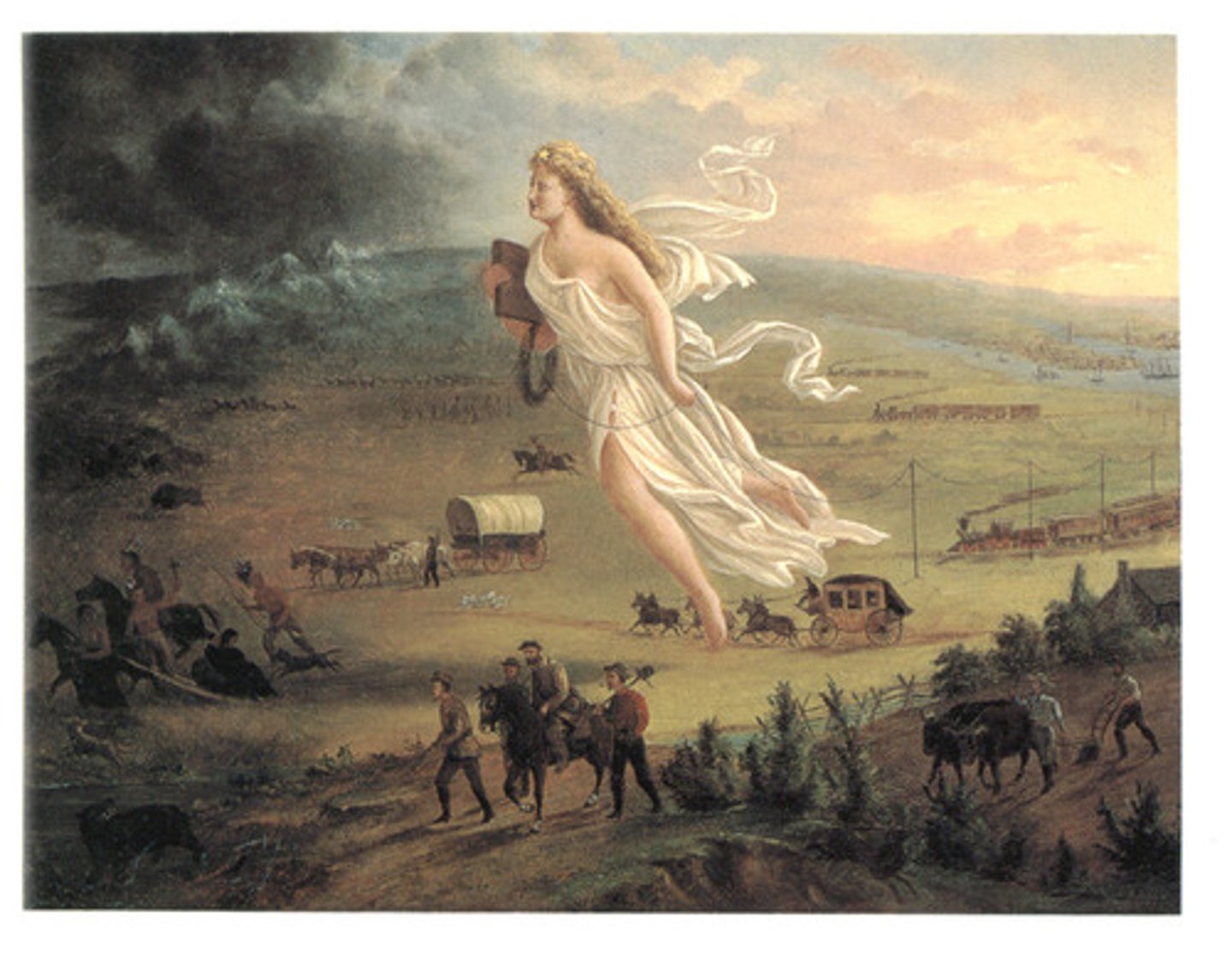
Explain the point of view reflected in the image regarding TWO (2) of the following in separate paragraphs:
Migration and American Indians
Manifest Destiny photos, like John Gast's American Progress, visually connect to migration by depicting the divinely ordained, inevitable westward movement of white American settlers, using symbols like guiding angels
Inevitability of Progress: By placing Native Americans at the "dark" Western edge, the artist suggests they represent a "vanishing race" that must give way to the "enlightened" Euro-American civilization moving in from the bright East.