Gait, Part 1
 Call Kai
 Learn
Learn Practice Test
 Spaced Repetition
 Match
Match Flashcards
 Knowt Play
1/44

Earn XP
Description and Tags
EBVM Quiz 3
Name | Mastery | Learn | Test | Matching | Spaced | Call with Kai | Chat |
|---|
No analytics yet
Send a link to your students to track their progress
45 Terms
What is gait?
the pattern of an animal’s limb movement and coordination during locomotion
list the factors of gait:
vision
proprioception (spatial awareness)
balance
coordination
strength
musculoskeletal biomechanics
pain
what are the components of strength?
stride length and symmetry
stance and swing phases
joint movements
weight distribution
list the types of gait
walk
amble
pace
trot
canter
gallop
define the gait: walk
2 or 3 feet on the ground at any given time. only canine gait in which there are ever 3 feet on the ground
define the gait: amble
faster form of the walk (not preferred). very inefficient gait. rear end sways side to side
when is the ‘amble’ gait used?
only used for short period when transitioning from walk to trot or from trot to walk
define the gait: pace
abnormal gait for most dog breeds. (Komondor is an exception)
inefficient gait. Ipsilateral limbs move forward together with other 2 limbs bearing weight. There is a moment when body is suspended in the air. only 2 feet on the ground at any given time.
why is ‘pace’ an inefficient gait?
center of gravity shifts side to side
why is ‘amble’ an inefficient gait?
rear end sways side to side, wasted horizontal energy
define the gait: trot
most efficient gait. often gait of choice for gait evaluation. diagonal limbs move forward together while other 2 limbs bear weight. moment when body is suspended in the air. only 2 limbs together on the ground at any given time
define the gait: canter
allows very sharp turns with greater drive from the rear.
there are 2 types of canter. list and define them.
rotary or cross canter
predominant canter in dogs (90%)
different lead limbs in front and rear
transverse canter
predominant canter in horses
same side leads in front and rear
define the gait: gallop
spine flexes, bringing rear feet forward. spine extends, bringing front feet forward.
there are 2 types of gallop. list and define them.
rotary gallop
predominant gallop in dogs
different lead limbs in front and rear
transverse gallop
predominant gallop in horses
same side lead limbs in front and rear
list the types of gait abnormalities
lameness
ataxia
paresis
weakness
hypermetria
circumduction
define lameness
limping to avoid placing full weight on the affected limb (know that there’s a lameness scale from 0-5)
what is a clinical sign of thoracic limb lameness in a horse?
head nod/bob: head will swing upward when the lame limb hits the floor, head drops back down when the sound thoracic limb hits the floor
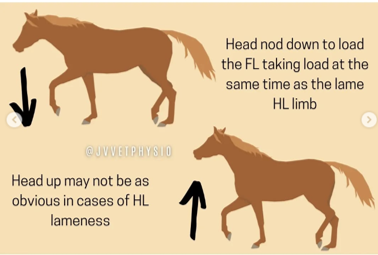
what is a clinical sign of pelvic limb lameness in a horse?
pelvic hike: pelvic drops down when sound limb hits the floor, pelvis swings upward when lame limb hit the floor

define ataxia
“incoordination”, clumsy or “drunken” gait. foot placement is unpredictable. often due to loss of spatial awareness of the trunk and/or limbs
what are causes of ataxia?
brain disease, spinal cord disease, vestibular dysfunction, drugs/toxins
define paresis
“reduced voluntary motor”
what are causes of paresis?
upper motor neuron dysfunction
lower motor neuron dysfunction
brain disease
spinal cord disease
what is paresis of one limb called?
monoparesis
what is paresis of one side called?
hemiparesis
what is paresis of pelvic limb only called?
paraparesis
what is paresis of all limb called?
tetraparesis
define weakness
“reduced strength”. short-strided gait that allows more even distribution of weight. similar to a little old lady shuffling around her house in her slippers
what are causes of weakness?
lower motor neuron dysfunction
neuromuscular disease
neuropathy
myopathy
junctionopathy
systemic illness
define the gait: hypermetria
“high stepping gait”. overexaggerated flexion of the limbs
what are causes of hypermetria?
cerebellar disease, stringhalt (horses), behavior (rare)
define the gait: circumduction
“swinging of the limb with a wide circular arc”
reduced limb flexion, requires trunk to swing side to side
what are causes of circumduction?
joint pain
arthrodesis
chronic upper motor neuron disease
musculoskeletal disease
infraspinatus tendon contraction
gracilis or semitendinosis myopathy
neuromuscular disease
myotonia or pseudomyotonia
tetanus
list some specific abnormal gaits
2-engine gait
radial gait
femoral gait
sciatic gait
what are causes of 2-engine gait?
C6-T2 myelopathy (LMN weakness of the TLs, UMN paresis of the PLs)
causes of radial gait?
radial nerve dysfunction, C8-T2 myelopathy, pain
causes of femoral gait?
femoral nerve dysfunction, L4-L6 myelopathy, pain
causes of sciatic gait?
sciatic nerve dysfunction, L6-Si myelopathy, pain, diabetes (cats)
a patient is unable to walk without assistance due to reduced voluntary motor function of the pelvic limbs. identify the gait.
a patient exhibits a dropped elbow and is knuckling on the right thoracic limb. the patient is able to advance the limb but unable to bear weight. identify the gait.
what is a possible cause of ataxia?
what is a possible cause of weakness?
what is a possible cause of hypermetria?
what is the cause of a 2-engine gait?
what is a possible cause of a sciatic gait in a cat?