Common Organic Functional Groups Found in Biochemistry
 Call Kai
 Learn
Learn Practice Test
 Spaced Repetition
 Match
Match Flashcards
 Knowt Play
1/16

There's no tags or description
Looks like no tags are added yet.
Name | Mastery | Learn | Test | Matching | Spaced | Call with Kai | Chat |
|---|
No analytics yet
Send a link to your students to track their progress
17 Terms
Functional groups
Functional groups are fragments of a molecule, such as a hydroxyl or carbonyl group.
Oxygen-containing groups
Hydroxyl
Carbonyl (aldehydes and ketones)
Carboxyl
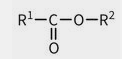
Ester

Hydroxyl
Hydroxyl groups are common to all classes of biological molecules. They participate in numerous reactions including esterifications, dehydrations, and oxidations.

Carbonyl
Carboxyl groups are weak acids. They are common functional groups and participate in the formation of several other groups, including esters and amides.

Ester
Esters are the result of a hydroxyl and carboxylic acid reacting with one another. Esters are commonly found in many lipids
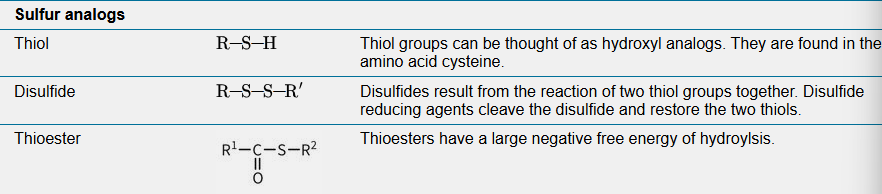
Sulfur analogs
Thiol
Disulfide
Thioester
Thiol
Thiol groups can be thought of as hydroxyl analogs. They are found in the amino acid cysteine.

Disulfide
Disulfides result from the reaction of two thiol groups together. Disulfide reducing agents cleave the disulfide and restore the two thiols.

Thioester
Thioesters have a large negative free energy of hydroylsis.

Nitrogen analogs
Amino
Amide

Amino
Amino groups are common to all classes of biological molecules. The lone pair of electrons on the amino group can acquire a proton resulting in a positively charged amino group.

Amide
Amides are formed through the reaction of an amine and a carboxylic acid. Peptides are the amide linkages found in proteins, but other amide bonds are found throughout biochemistry

Phosphorous-containing groups
Phosphates
Phosphoesters
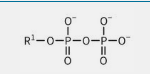
Phosphanhydrides

Phosphates
Phosphate, also known as inorganic phosphate, Pi, is commonly found in all biological systems.

Phosphoesters
Phosphoesters are the result of the addition of a phosphate group to a hydroxyl group.

Phosphanhydrides
Phosphanhydrides are commonly found in nucleoside triphosphates like ATP and have a large negative free energy of hydrolysis.
Enol
Enols are tautomers of carbonyl groups. In biochemistry they are often trapped as phosphoenolates.
