42 Disorders of the Hypothalamus and Pituitary Gland
 Call Kai
 Learn
Learn Practice Test
 Spaced Repetition
 Match
Match Flashcards
 Knowt Play
1/55

There's no tags or description
Looks like no tags are added yet.
Name | Mastery | Learn | Test | Matching | Spaced | Call with Kai | Chat |
|---|
No analytics yet
Send a link to your students to track their progress
56 Terms
Hypothalamus makes GHRH and SomatoSTATIN. These both act on the Anterior Pituitary. Somatostatin inhibits the Anterior Pituitary and stops release of growth hormone. GHRH stimulates the Anterior Pituitary to release growth hormone. If the Hypothalamus releases GHRH and the Anterior Pituitary can release growth hormone, they travel to the target tissues. SomatoMEDINS are then made by the liver, which travel back to the Anterior Pituitary AND Hypothalamus to stop more growth hormone from being released.
Describe the pathway of the hypothalamus all the way to growth hormone and target tissues plus feedback mechanisms
Excessive growth hormone
What hormone is the issue with Acromegaly?
Thru direct and indirect anabolic effects
Growth hormone PROMOTES growth in what mechanisms?
Indirect is mediated by somatomedins
Which anabolic mechanism (how it promotes growth) of growth hormone is mediated by somatomedins?
Direct is NOT mediated by somatomedins
Which anabolic mechanism of growth hormone is NOT mediated by somatomedins?
IGF 1 which is *Somatomedin C*
IGF 2 which is Somatomedin A
Somatomedins are Insulin-like growth factors which are produced in the liver and mediate indirect anabolism. What are they? (name the types)
a. increase gluconeogenesis
b. decrease glucose uptake in muscle
e. insulin resistance
f. increased ketone formation and lipolysis in adipose tissue
Select which of the following are true of CATABOLIC effects of growth hormone?
a. increase gluconeogenesis
b. decrease glucose uptake in muscle
c. increased protein synthesis in liver
d. increased organ size and function
e. insulin resistance
f. increased ketone formation and lipolysis in adipose tissue
b. increased lean muscle mass and linear bone growth
d. increased organ size and function
Select which of the following are true of INDIRECT anabolic effects of growth hormone?
a. increase gluconeogenesis
b. increased lean muscle mass and linear bone growth
c. increased protein synthesis in liver
d. increased organ size and function
e. insulin resistance
f. increased ketone formation and lipolysis in adipose tissue
c. increased protein synthesis in liver
Select which of the following are true of DIRECT anabolic effects of growth hormone?
a. increase gluconeogenesis
b. increased lean muscle mass and linear bone growth
c. increased protein synthesis in liver
d. increased organ size and function
e. insulin resistance
f. increased ketone formation and lipolysis in adipose tissue
Cats (male, mixed breeds over 8 years old)
Acromegaly is more common in *cats or dogs*
Acromegaly
This problem in cats is caused by chronic, excessive secretion of GH often from functional adenomas in the pituitary gland
acromegaly
This problem in dogs is caused by prolonged exposure to progestogens
acromegaly
What is this?
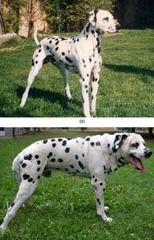
Acromegaly
What is this, where the animal has an increase in body size, and enlargement of the abdomen and head?
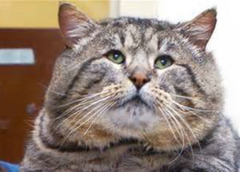
Acromegaly
What is this, where the animal has an increase in body size and enlargement of the abdomen and head?
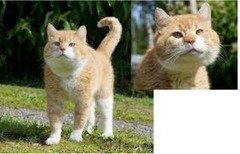
ORGANOMEGALY = cardiomegaly overall leading to hypertrophic cardiomyopathy. Liver is also often enlarged
What problem does acromegaly have the ability to cause on the animal body?
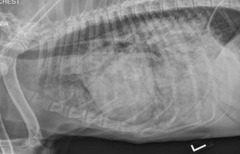
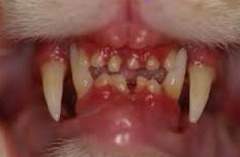
Prognathia inferior = increased interdental space because the jaw is so giant
What problem does acromegaly have the ability to cause on the animal body?
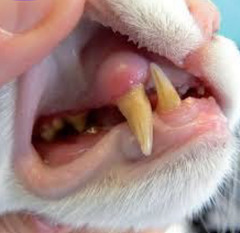
Prognathia inferior = underbite from protrusion of mandible
What problem does acromegaly have the ability to cause on the animal body?
Because one of the catabolic effects of growth hormone is insulin resistance, which leads to diabetes mellitus
note: growth hormone antagonizes insulin because it promotes the breakdown of fat which is used for energy instead of glucose, so cells are less responsive to insulin's signal to take up glucose
Why do you basically not diagnose acromegaly until a cat also has diabetes?
Hyperglycemia, Glycosuria, and elevated cholesterol. ALT and ALP will be elevated
note: remember the cats often already have diabetes, so it makes sense there is too much sugar with the insulin resistance. high cholesterol is essentially hyperlipidemia. ALT and ALP inc. probably from the organomegaly and liver damage
What are the most common laboratory findings with acromegaly?
Identify conformational alterations typical of acromegaly and a stable or increasing body weight in a cat with insulin resistant Diabetes Mellitus
How do you diagnose acromegaly?
Acromegaly
What is diagnosed thru identification of conformational alterations and a stable or increasing body weight in a cat with insulin resistant Diabetes Mellitus?
Removal of pituitary tumor (remember in cats acromegaly commonly caused by functional adenoma of pituitary gland)
What can definitively treat acromegaly?
Pasireotide
What is the somatostatin analog which can be used to medically manage acromegaly?
SHORT: manage diabetes, guarded to good
LONG: poor, mortality often from poorly regulated diabetes and organ failure (remember the organomegaly problem)
Compare the short and long term prognosis for acromegaly?
Congenital deficiency of growth hormone
What hormone is causing the problem with pituitary dwawfism?
Dog
Is pituitary dwarfism more commonly a *cat or dog* problem?
Pituitary dwarfism
Lack of growth, endocrine alopecia, and skin hyperpigmentation sound like which problem?
1. renal disease (kidney)
2. hepatic disease (liver)
3. endocrine disease (diabetes insipidus and mellitus, hyperthyroid, hyperparathyroid, hyper AND hypoadrenocorticism, hyperaldosteronism)
4. miscellaneous (grab bag): electrolytes, endotoxins, drugs
5. psychogenic polydipsia (crazy lab syndrome)
Name some of the more common differentials for PU/PD (increased urination and drinking)
Glucocorticoids (inhibits ADH), barbiturates/phenobarbital (inhibits ADH), diuretics, thyroxine, salt
Name a few drugs that can cause PU/PD
Antidiuretic hormone = decreases urine production
note: so if glucocorticoids and barbiturates inhibit ADH, they are inhibiting the thing that decreases urine production, causing PU/PD
What is ADH or vasopressin?
Renal medullary solute washout
This means there is a loss of solutes like sodium and urea in the medulla of the kidney, causing loss of hypertonicity (the gradient that draws water out of the tubules/urine into the body) and an impaired ability to concentrate urine
Defective synthesis/insufficient secretion of ADH by the hypothalamus/posterior pituitary
What hormone is the problem with central diabetes insipidus?
Defective responsiveness of the kidneys to ADH in tubules
What hormone is the problem with nephrogenic diabetes inspidus?
You need it to release when there is decreased extracellular fluid volume so that you can increase blood pressure or volume, so it will reduce the amount of urine to promote water resorption. It also constricts arterioles to inc. blood pressure
Why do you need ADH or vasopressin?
c. ADH
d. Oxytocin
Select the hormones released by the posterior pituitary:
a. TSH
b. FSH
c. ADH
d. Oxytocin
e. ACTH
f. Growth hormone
a. TSH
b. FSH
e. ACTH
f. Growth hormone
Select the hormones released by the anterior pituitary:
a. TSH
b. FSH
c. ADH
d. Oxytocin
e. ACTH
f. Growth hormone
Secondary
There are two causes of nephrogenic diabetes insipidus. Primary (familial) and secondary (acquired). Which is more common?
Renal disease, pyelonephritis, hepatic insufficiency, hypercalcemia, hyperthyroid, hyperadrenocorticism
Secondary (acquired) is the more common cause of nephrogenic diabetes insipidus. Name a few causes which must be ruled out before you can determine primary (familial) cause?
YOUNGER
Primary (familial) nephrogenic diabetes insipidus is more common in *younger or older* animals?
PU/PD
Name the most common clinical sign of diabetes insipidus in animals
1.00 is normal water = more dilute urine
What does it mean if urine specific gravity is close to 1.00?
DO NOT perform them until all other causes of PU/PD have been ruled out (chronic renal failure, hyperadrenocorticism)
Response to desmopressin, modified water deprivation test, and random plasma osmolality are specific diagnostic tests for diabetes insipidus. BUT you cannot do them until WHAT?
To differentiate central and nephrogenic forms of diabetes insipidus and psychogenic polydipsia
Why would you do response to desmopressin, modified water deprivation test, and random plasma osmolality?
1. response to desmopressin
2. modified water deprivation test
3. random plasma osmolality
Name the 3 diabetes insipidus specific diagnostic tests
This means it was central diabetes insipidus
note: this is because you are giving a synthetic ADH, and the body is responding because in central diabetes insipidus the body is not creating enough
After ruling out other causes of PU/PD, you decide to observe response to desmopressin. The owner says there is a decrease in PU/PD and you see increase in urine specific gravity to over 1.030. What does this mean?
This means it is nephrogenic diabetes insipidus
note: this is because you are giving a synthetic ADH, and the body is NOT responding because in nephrogenic diabetes insipidus the body is creating enough, but the kidney's can't respond
After ruling out other causes of PU/PD, you decide to observe response to desmopressin. The owner says PU/PD is the same and you don't see change in urine specific gravity. What does this mean?
STEP 1: a. gradual water deprivation by owner 3-5 days prior b. in hospital measure urine specific gravity, BUN, hydration. monitor closely every 2-4 hours. END when patient either concentrates over 1.030 or loses 5% of body weight
STEP 2: response to exogenous ADH (desmopressin)
There are two phases to the water deprivation test for diabetes insipidus testing. What are they? What does this test involve?
If patient:
A. concentrates urine over 1.030 = this means it was psychogenic
B. loses 5% of body weight = this means the patient has failed the test and the problem must be central or nephrogenic diabetes insipidus
In STEP 1 of the water deprivation test, you end the test when the patient either A. concentrates urine over 1.030 OR B. loses 5% of body weight. Why are these the parameters and what do they mean?
Administer desmopressin.
IF CENTRAL DI: animal will concentrate urine in response to desmopressin
IF NEPHROGENIC DI: animal will NOT respond or concentrate urine
In STEP 2 of the water deprivation test, you have to determine whether the problem is central or nephrogenic diabetes insipidus. How do you do this? What do the results tell you?
No treatment, just give access to water. Can try thiazide diuretics, low Na diet, or DDAVP (desmopressin) drug
What is the treatment for central Diabetes insipidus in animals?
Water restrict and limit, find out what stress triggers are which are leading them to drink too much water
How can you treat a dog with psychogenic polydipsia?
c. hyposthenuria
= below 1.008
DI and psychogenic polydipsia cause:
a. hypersthenuria
b. isosthenuria
c. hyposthenuria
b. isosthenuria
= 1.008-1.012
Renal issues cause:
a. hypersthenuria
b. isosthenuria
c. hyposthenuria
1.030
What is adequate USG concentration in dogs?
1.035 (but may even be over 1.050)
What is adequate USG concentration in cats?