Business Finance Chapter 3
 Call Kai
 Learn
Learn Practice Test
 Spaced Repetition
 Match
Match Flashcards
 Knowt Play
1/46

Earn XP
Description and Tags
We will concentrate only on the financial statements section of Chapter 3, which includes the balance sheet, income statement, statement of common equity (retained earnings), and statement of cash flows. We will not be covering the sections on cash flows (free cash flows) and taxes.
Name | Mastery | Learn | Test | Matching | Spaced | Call with Kai | Chat |
|---|
No analytics yet
Send a link to your students to track their progress
47 Terms
Last year Rattner Robotics had $5 million in operating income (EBIT). Its depreciation expense was $1 million, its interest expense was $1 million, and its corporate tax rate was 40%. At year-end, it had $14 million in current assets, $3 million in accounts payable, $1 million in accruals, $2 million in notes payable, and $15 million in net plant and equipment. Rattner uses only debt and common equity to fund its operations. (In other words, Rattner has no preferred stock on its balance sheet.) Rattner had no other current liabilities. Assume that Rattner’s only noncash item was depreciation.
1) What was the company’s net income?
Operating income (EBIT) = $5,000,000
EBT=EBIT−Interest Expense
EBT=5,000,000−1,000,000=4,000,000
Tax rate = 40%
Taxes=EBT×40%=4,000,000×0.40=1,600,000
Net Income=EBT−Taxes=4,000,000−1,600,000=2,400,000
$2,400,000 Net Income
Last year Rattner Robotics had $5 million in operating income (EBIT). Its depreciation expense was $1 million, its interest expense was $1 million, and its corporate tax rate was 40%. At year-end, it had $14 million in current assets, $3 million in accounts payable, $1 million in accruals, $2 million in notes payable, and $15 million in net plant and equipment. Rattner uses only debt and common equity to fund its operations. (In other words, Rattner has no preferred stock on its balance sheet.) Rattner had no other current liabilities. Assume that Rattner’s only noncash item was depreciation.
2) What was its net working capital (NWC)?
NWC = Current Assets − Current Liabilities
Current assets = $14,000,000
Notes Payable = $2,000,000
Accounts payable = $3,000,000
Accruals = $1,000,000
Operating Current Liabilities=3,000,000+1,000,000+2,000,000=6,000,000
NWC=14,000,000−6,000,000=8,000,000
Last year Rattner Robotics had $5 million in operating income (EBIT). Its depreciation expense was $1 million, its interest expense was $1 million, and its corporate tax rate was 40%. At year-end, it had $14 million in current assets, $3 million in accounts payable, $1 million in accruals, $2 million in notes payable, and $15 million in net plant and equipment. Rattner uses only debt and common equity to fund its operations. (In other words, Rattner has no preferred stock on its balance sheet.) Rattner had no other current liabilities. Assume that Rattner’s only noncash item was depreciation.
3) What was its net operating working capital (NOWC)?
NOWC=Operating Current Assets−Operating Current Liabilities
Operating Current Assets = Current assets excluding cash and short-term investments (non-operating items).
Operating Current Liabilities = Accounts payable + Accruals (exclude notes payable, since that’s financing).
Operating current assets = $14,000,000
Accounts payable = $3,000,000
Accruals = $1,000,000
Operating Current Liabilities=3,000,000+1,000,000=4,000,000
NOWC=14,000,000−4,000,000=10,000,000
INCOME STATEMENT Little Books Inc. recently reported $3 million of net income. Its EBIT was $6 million, and its tax rate was 40%. What was its interest expense?
$1,000,000
STATEMENT OF STOCKHOLDERS’ EQUITY In its most recent financial statements, Newhouse Inc. reported $50 million of net income and $810 million of retained earnings. The previous retained earnings were $780 million. How much in dividends were paid to shareholders during the year? Assume that all dividends declared were actually paid.
$20 million
STATEMENT OF CASH FLOWS W.C. Cycling had $55,000 in cash at year-end 2014 and $25,000 in cash at year-end 2015. The firm invested in property, plant, and equipment totaling $250,000. Cash flow from financing activities totaled +$170,000.
1) What was the cash flow from operating activities?
1) $50,000
STATEMENT OF CASH FLOWS W.C. Cycling had $55,000 in cash at year-end 2014 and $25,000 in cash at year-end 2015. The firm invested in property, plant, and equipment totaling $250,000. Cash flow from financing activities totaled +$170,000.
2) If accruals increased by $25,000, receivables and inventories increased by $100,000, and depreciation and amortization totaled $10,000, what was the firm’s net income?
2) $115,000
Which of the following best describes shareholders' equity?
Option A
Equity = what the initial stockholders paid when they bought company shares + the earnings that the company has retained over the years
Option B
Equity = liabilities - assets
Option C
Equity = assets + liabilities
Option D
Equity = paid-in capital - retained earnings
Option A
Emery Mining Inc. recently reported $150,000 of sales, $75,500 of operating costs other than depreciation, and $10,200 of depreciation. The company had $16,500 of outstanding bonds that carry a 7.25% interest rate, and its federal-plus-state income tax rate was 35%. How much was the firm's EBIT?
Option A
$41,017.44
Option B
$74,500.00
Option C
$63,103.75
Option D
$64,300.00
Option D
EBIT = Sales - Operating Costs - Depreciation
EBIT = 150,000 - 75,500 - 10,200
EBIT = 64,300
During 2014, Bascom Bakery paid out $33,525 of common dividends. It ended the year with $197,500 of retained earnings versus the prior year's retained earnings of $159,600. How much net income did the firm earn during the year?
Option A
$82,683
Option B
$78,746
Option C
$86,818
Option D
$74,996
Option E
$71,425
Option E
RE end = RE begin. + NI - Dividends
NI = RE end - RE begin. + Dividends
NI = 71,425
Question 4
Identify which type of activity is described by the following statement:
Fitzi Chemical Co. earns revenue from its cash receipts from royalties.
Option A
Not enough information
Option B
Financing activity
Option C
Operating activity
Option D
Investing activity
Option C
The ______ accounts for all revenues and expenses over an accounting period.
Option A
Income statement
Option B
Balance sheet
Option C
Annual report
Option D
Statement of cash flows
Option A
Brown Office Supplies recently reported $15,500 of sales, $8,250 of operating costs other than depreciation, and $1,750 of depreciation. It had $9,000 of bonds outstanding that carry a 7.0% interest rate, and its federal-plus-state income tax rate was 40%. How much was the firm's interest expense?
Option A
$9000
Option B
$630
Option C
$385
Option D
$1085
Option B
Interest Expense = Bonds Outstanding x Interest Rate
Interest Exepnse = 9,000 × 0.07 = 630
Which major financial statement answers the following question:
Does the firm generate enough funds to support anticipated investment, or does additional outside capital need to be raised?
Option A
Balance sheet
Option B
Annual report
Option C
Income statement
Option D
Statement of cash flows
Option D
Brown Office Supplies recently reported $15,500 of sales, $8,250 of operating costs other than depreciation, and $1,750 of depreciation. It had $9,000 of bonds outstanding that carry a 7.0% interest rate, and its federal-plus-state income tax rate was 40%. How much was the firm's earnings before taxes (EBT)?
Option A
$4,870
Option B
$4,627
Option C
$5,114
Option D
$5,638
Option E
$5,369
Option A
Interest Expense = 9,000 × 0.07 = 630
EBT = Sales - Operating Costs - Depreciation - Interest Expense
EBT = 4,870
Which major financial statement answers the following question:
Can the firm meet all its short-term obligations using its current assets?
Option A
Statement of cash flows
Option B
Statement of retained earnings
Option C
Income statement
Option D
Balance sheet
Option D
Which of the following statements is CORRECT?
Option A
If a company's statements were prepared in accordance with generally accepted accounting principals (GAAP), the market value of the sock equals the book value of the stock as reported on the balance sheet.
Option B
The assets section of a typical company's balance sheet begins with cash, then lists the assets in order in which they will probably be converted to cash, with the longest living assets listed last.
Option C
The balance sheet for a given year tells us how much money the company earned during the year.
Option D
The balance sheet for a given year is designed to give us an idea of what happened to the firm during that year.
Option B
Which of the following is not a primary source of raising money or capital for the firm?
Option A
Assets
Option B
Bonds
Option C
Common stock
Option D
Preferred stock
Option A
Analysts who follow Howe Industries recently noted that, relative to the previous year, the company's net cash provided from operations increased, yet cash as reported on the balance sheet decreased. Which of the following factors could explain this situation?
Option A
The company issued new long-term debt.
Option B
The company sold a division and received cash in return.
Option C
The company made large investments in fixed assets.
Option D
The company issued new common stock.
Option C
Question 13
Identify which type of activity is described by the following statement:
Yum Co. uses cash to repurchase 10% of its common stock.
Option A
Investing activity
Option B
Operating activity
Option C
Financing activity
Option D
Not enough information
Option C
Which of the following items is NOT normally considered to be a current asset?
Option A
Inventory.
Option B
Accounts receivable.
Option C
Short-term, highly-liquid, marketable securities.
Option D
Bonds.
Option E
Cash.
Option D
Gross profit is equal to
Option A
sales minus selling and administrative expenses.
Option B
sales minus cost of goods sold and depreciation expense.
Option C
sales minus cost of goods sold.
Option D
sales minus cost of goods sold and selling and administrative expenses.
Option C

Assume that Cold Goose Metal Works Inc. has 50 million shares of common stock outstanding. Calculate the missing blanks of the balance sheet before answering the following question.
Is the following statement true or false, and why?
Statement 3: The book value per share of Cold Goose's stock in Year 2 was $750.00.
Option A
True, because the per-share book value is calculated by dividing the company's total assets by the number of outstanding shares of common stock.
Option B
True, because the per-share book value is calculated by dividing the company's total common equity by the number of outstanding shares of common stock.
Option C
False, because the per-share book value is calculated by dividing the company's total debt by the number of outstanding shares of common stock.
Option D
False, because the per-share book value is calculated by dividing the company's total assets by the number of outstanding shares of common stock.
Option B
Book value per share = 37,500,000 (common equity) / 5,000,000 (shares outstanding) = $7.50
Bauer Software's current balance sheet shows total common equity of $5,125,000. The company has 530,000 shares of stock outstanding, and they sell at a price of $27.50 per share. By how much do the firm's market and book values per share differ?
Option A
$19.66
Option B
$21.67
Option C
$18.72
Option D
$20.64
Option E
$17.83
Option E
Book value per share = total common equity / shares outstanding
Book value per share = 5,125,000 / 530,000 = 9.669
Difference = market price - book value per share
Difference = 27.50 - 9.669 = 17.83
An item which may be converted to cash within one year or one operating cycle of the firm is classified as a
Option A
current asset.
Option B
current liability.
Option C
long-term liability.
Option D
long-term asset.
Option A
The _____ on the balance sheet shows where the funds of a company come from, and the ______ on the balance sheet shows where the funds of a company go.
Option A
liabilities and assets; equity
Option B
assets; liabities and equity
Option C
liabities; assets and equity
Option D
liabilities and equity; assets
Option D
Which of the following statements is CORRECT?
Option A
The balance sheet gives us a picture of the firm's financial position at a point in time.
Option B
The statement of cash flows tells us how much cash the firm must pay out in interest during the year.
Option C
The income statement gives us a picture of the firm's financial position at a point in time.
Option D
The four most important financial statements provided in the annual report are the balance sheet, income statement, cash budget, and the statement of stockholder's equity.
Option A
Which account represents the cumulative earnings of the firm since the firm started, minus dividends paid?
Option A
Paid-in capital
Option B
Accumulated depreciation
Option C
Common stock
Option D
Retained earnings
Option D
Question 22
The _____ has three segments that when analyzed together give an idea of what the company owns and what it owes.
Option A
Annual report
Option B
Balance sheet
Option C
Statement of cash flows
Option D
Statement of retained earnings
Option B

Wu Systems has the following balance sheet. How much net operating working capital does the firm have?
Option A
$675
Option B
$750
Option C
$825
Option B
Operating Current Assets = Cash + A/R + Inventory
Operating Current Assets = 1,300
Operating Current Liab. = Accounts Payable + Accruals
Operating Current Liab. = 550
NOWC = Operating Current Assets - Operating Current Liab.
NOWC = 1,300 - 550 = 750
During the last year, Dual Purposes Products Co. generated $819 million in cash flow from operating activities and had negative cash flow generated from investing activities (-$448 million). At the end of the first year, Dual Purposes Products Co. had $140 million in cash on its balance sheet, and the firm had $280 million in cash at the end of the second year. What was the firm's cash flow due to financing activities in the second year?
Option A
$288.75 million
Option B
-$231 million
Option C
$173.25 million
Option D
-$115.50 million
Option B
Change in cash = CFO + CFI + CFF
Change in cash = 280 - 140 = 140
140 = 819 + (-448) + CFF
140 = 371 + CFF
CFF = 140 - 371 = -231
Emery Mining Inc. recently reported $150,000 of sales, $75,500 of operating costs other than depreciation, and $10,200 of depreciation. The company had $16,500 of outstanding bonds that carry a 7.25% interest rate, and its federal-plus-state income tax rate was 35%. How much was the firm's net income? The firm uses the same depreciation expense for tax and stockholder reporting purposes.
Option A
$38,966.57
Option B
$41,017.44
Option C
$43,068.31
Option D
$35,167.33
Option E
$37,018.24
Option B
EBIT = 150,000 - 75,500 - 10,200 = 64,300
Interest = 16,500 × 0.0725 = 1,196.25
EBT = 64,300 - 1,196.25 = 63,103.75
Taxes = 63,103.75 × 0.35 = 22,086.3125
Net Income = 63,103.75 - 22,086.3125 = 41,017.4375

Calculate the missing blanks of the balance sheet before answering the following question.
Is the following statement true or false, and why?
Statement 2: On December 31 of Year 2, Cold Goose Metal Works, Inc. had $9,225 million of actual money that it could have spent immediately.
Option A
False, because the funds recorded in Cold Goose's accounts receivable account represents funds that are either cash or can be converted into cash almost immediately.
Option B
False, because Cold Goose's Year 2 cash and equivalents balance is $23,220.
Option C
True, because the funds recorded in Cold Goose's cash and equivalents account represents funds that are either cash or can be converted into cash almost immediately
Option D
True, because Cold Goose's Year 2 cash and equivalents balance is $23,220.
Option C
Cash and Equivalents = 22,500 - 3,375 - 9,900 = 9,225
An increase of $100,000 in inventory would result in a(n)
Option A
Increase of cash flows for investing activities
Option B
Increase of cash flows for financing activities
Option C
decrease of cash flows for operating activities
Option D
decrease of cash flows for financing activities
Option C
Brown Office Supplies recently reported $15,500 of sales, $8,250 of operating costs other than depreciation, and $1,750 of depreciation. It had $9,000 of bonds outstanding that carry a 7.0% interest rate, and its federal-plus-state income tax rate was 40%. How much was the firm's net income?
Option A
$4870
Option B
$1948
Option C
$5500
Option D
$2922
Option D
EBIT = 15,500 - 8,250 - 1,750 = 5,500
Interest = 9,000 × 0.07 = 630
EBT = 5,500 - 630 = 4,870
Tax = 4,870 × 0.40 = 1,948
Net income = 4,870 - 1,948 = 2,922
Question 29
Which of the following is an outflow of cash?
Option A
Profitable operations
Option B
The payment of cash dividends
Option C
The sale of equipment
Option D
The sale of the company's common stock
Option B
Question 30
The _____ provides details about how the flow of funds from operating, investing, and financing activities.
Option A
Balance sheet
Option B
Statement of retained earnings
Option C
Statement of cash flows
Option D
Income statement
Option C
Question 31
W.C. Cycling had $55,000 in cash at year-end 2004 and $25,000 in cash at year-end 2005. Cash flow from long-term investing activities totaled -$250,000, and cash flow from financing activities totaled +$170,000.
What was the cash flow from operating activities?
Option A
$55,000
Option B
-$30,000
Option C
-$80,000
Option D
$50,000
Option D
Change cash = Cash flow operating + cash flow investing + cash flow financing
25,000 - 55,000 = Cash flow operating + (-250,000) + 170,000
-30,000 = Cash flow operating - 80,000
Cash flow operating = 50,000
Question 32
Identify which type of activity is described by the following statement:
A company buys some common stock in its supplier's firm with its extra cash.
Option A
Operating activity
Option B
Financing activity
Option C
Investing activity
Option D
Not enough information
Option C
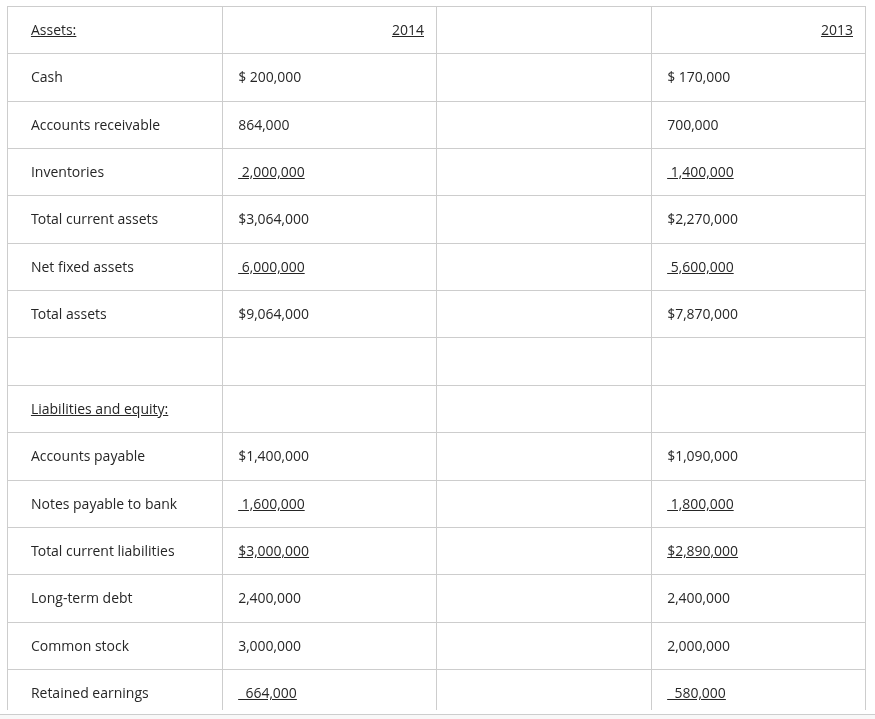
Missing from table:
Total common equity
2014; $3,664,000, 2013; $2,580,000
Total liabilities and equity
2014; $9,064,000, 2013; $7,870,000
The firm has never paid a dividend on its common stock, and it issued $2,400,000 of 10-year, non-callable, long-term debt in 2013. As of the end of 2014, none of the principal on this debt had been repaid. Assume that the company's sales in 2013 and 2014 were the same. Which of the following statements must be CORRECT?
Option A
The firm issued new common stock in 2014.
Option B
The firm repurchased some common stock in 2014.
Option C
The firm increased its short-term bank debt in 2014.
Option D
The firm issued long-term debt in 2014.
Option A
The ______ is published once a year and provides stockholders with details about the company's performance and financial condition
Option A
Annual report
Option B
Statement of retained earnings
Option C
Balance sheet
Option D
Statement of cash flows
Option A
Identify which type of activity is described by the following statement:
A company records a loss of $70,000 on the sale of its outdated inventory.
Option A
Financing activity
Option B
Operating activity
Option C
Investing activity
Option D
Not enough information
Option B
Which of the following statements is CORRECT?
Option A
Dividends do not show up in the statement of cash flows because dividends are considered to be a financing activity, not an operating activity.
Option B
In the statement of cash flows, a decrease in accounts payable is subtracted from net income in the operating activities section.
Option C
In the statement of cash flows, a decrease in accounts receivable is subtracted from net income in the operating activities section.
Option D
In the statement of cash flows, depreciation is subtracted from net income in the operating activities section.
Option B
Brown Office Supplies recently reported $15,500 of sales, $8,250 of operating costs other than depreciation, and $1,750 of depreciation. It had $9,000 of bonds outstanding that carry a 7.0% interest rate, and its federal-plus-state income tax rate was 40%. How much was the firm's EBIT (earnings before interests and taxes)?
Option A
$4870
Option B
$2922
Option C
$1948
Option D
$5500
Option D
EBIT = sales - operating costs - depreciation
EBIT = 15,500 - 8,250 - 1,750
EBIT = 5,500
NOW Inc. released its annual results and financial statements. Grace is reading the summary in the business pages of today's paper. In its annual report, NOW Inc. reported a net income of $200 million. Last year, the company reported a retained earnings balance of $544 million, whereas this year it increased to $640 million. How much was paid out in dividends this year?
Option A
$3 million
Option B
$296 million
Option C
$104 million
Option D
$525 million
Option C
Ending RE = Beginning RE + NI - Dividends
640 = 544 + 200 - Dividends
640 = 744 - Dividends
Dividends = 744 - 640 = 104
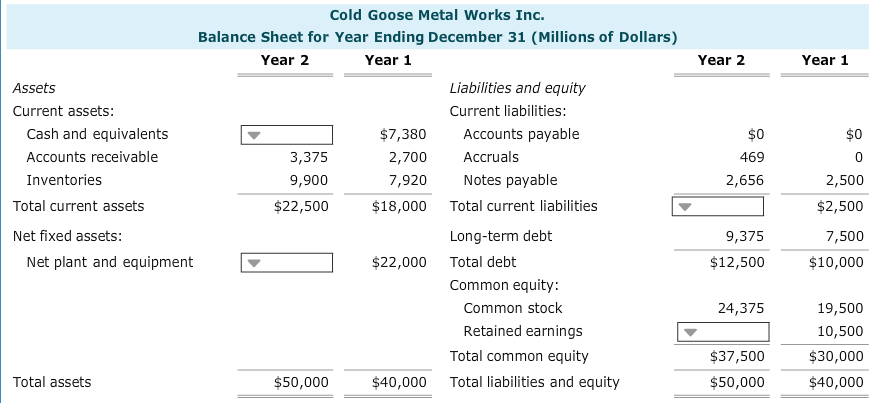
Calculate the missing blanks of the balance sheet before answering the following question.
Is the following statement true or false, and why?
Statement 1: Cold Goose's pool of relatively liquid assets, which are available to support the company's current and future sales, decreased from Year 1 to Year 2.
Option A
False, because Cold Goose's total current asset balance actually increased from $18,000 million to $22,500 million between Year 1 and Year 2.
Option B
True, because Cold Goose's total current liabilities decreased by $4,500 million between Year 1 and Year 2.
Option C
False, because Cold Goose's total current asset balance decreased from $22,500 million to $18,000 million between Year 1 and Year 2.
Option D
True, because Cold Goose's total current asset balance actually decreased from $18,000 million to $22,500 million between Year 1 and Year 2.
Option A
Total Current Assets
Year 1 = 18,000
Year 2 = 22,500
Increase, not a decrease
Other things held constant, which of the following actions would increase the amount of cash on a company's balance sheet?
Option A
The company pays a dividend.
Option B
The company gives customers more time to pay their bills.
Option C
The company repurchases common stock.
Option D
The company issues new common stock.
Option D