Lab J: Isolation of Bixin from Annatto Seeds using Column Chromatography (Part II)
 Studied by 0 people
 Call Kai
 Learn
Learn Practice Test
 Spaced Repetition
 Match
Match Flashcards
 Knowt Play
1/9

There's no tags or description
Looks like no tags are added yet.
Name | Mastery | Learn | Test | Matching | Spaced |
|---|
No study sessions yet.
10 Terms
What is chromatography?
Separation of compounds based on polarity.
Most common organic purification technique.
What is column chromatography?
Separates macroscopic amounts of compounds
Like running a “larger TLC”
How do you choose a suitable solvent?
Use TLC to determine appropriate solvent for separation.
You want a solvent such that desired compound will move off the baseline + separate well from other compounds
Choice of solvents:
– Dichloromethane (DCM)
– 3 % Ethanol in Dichloromethane (3% EtOH in DCM)
– 10 % Ethanol in Dichloromethane (10% EtOH in DCM)
Packing the column reminders?
Make sure the Column is clamped in the middle and it is vertical.
Prepare (in a beaker) a slurry of silica gel and the appropriate solvent.
Add slurry via POWDER FUNNEL.
Add more solvent to wash slurry down the sides of the column using a pipette.
Open stopcock to collect the solvent in a beaker and reuse solvent (as long as it’s not colored).
DO NOT let solvent level fall below the top of the silica.
Reminders when preparing the sample?
Sample needs to be COMPLETELY DISSOLVED. Use pipette to dissolve as much sample as possible.
Load sample in a narrow band onto the column.
How do you avoid broad bands?
Use as concentrated a solution of the extract as possible but load all your product onto the column.
Make sure the extract is fully loaded into the column before adding solvent all the way to the top.
This process usually takes a few rounds of adding the 3-4 mL of solvent in order to push the colored bands down the column.
Why should you not let the column run dry?
Make sure there is always solvent above silica gel.
If dry, cracks develop inside silica gel in column and affects separation.
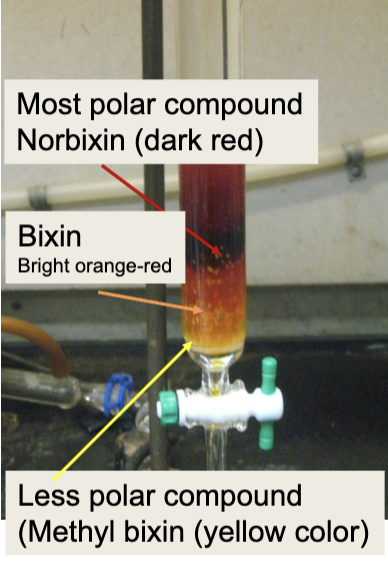
What will the fractions look like?
Yellow fractions will come off the column first. Collect these in a 125 mL Erlenmeyer flask.
The intense Orange-red (Bixin) band will be next.
When the Bixin band has finished eluting – you should stop collecting fractions
Waste disposal?
After combining fractions to be rotovaped - drain columnwaste into Erlenmeyer flask
After draining, turn column upside and place 4 weigh boats below.
Test tubes w/ unused fractions —> C,H,O halogenated waste container
Safety hazards?
Silica gel is an inhalation hazard.
Dichloromethane is a carcinogenic compound.