Nutritional epidemiology
 Call Kai
 Learn
Learn Practice Test
 Spaced Repetition
 Match
Match Flashcards
 Knowt Play
1/25

There's no tags or description
Looks like no tags are added yet.
Name | Mastery | Learn | Test | Matching | Spaced | Call with Kai | Chat |
|---|
No analytics yet
Send a link to your students to track their progress
26 Terms
Nutritional epidemiology
Nutritional epidemiology is the discipline that studies the relation between nutrition and health
within populations. It provides evidence to establish generic dietary guidelines.
What is descriptive epidemiology?
tries to describe the data on one or more characteristics of a group of individuals. These studies do not try to answer questions or establish relationships between variables.
Leads to a hypothesis
Used to describe populations and generate hypotheses. It does not involve a comparison group.
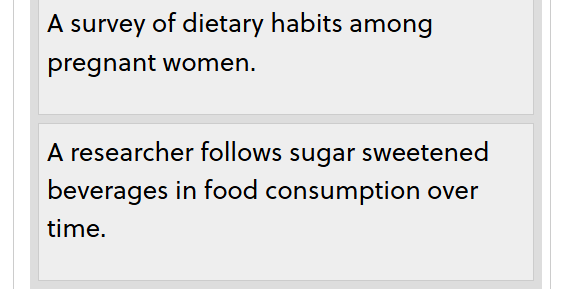
What is a survey?
descriptive epidemiological method
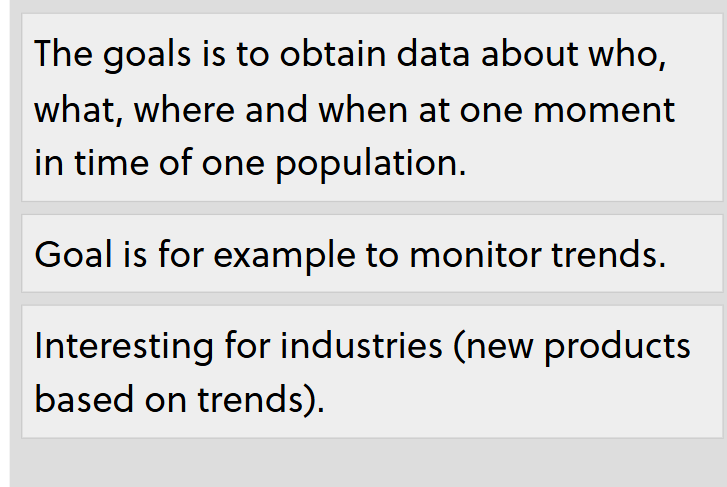
What is an ecological study?
descriptive epidemiological method
Advantages:
- Data often already collected.
- Data available from a reliable source.
Disadvantages:
- An association between exposure and outcome at group level may not hold at an individual level.
- The association may be related to a third factor which in turn is related to both the exposure and the outcome: confounding, e.g. a high prevalence of obesity that is related to both a higher income and an increase in the occurrence of cardiovascular diseases.
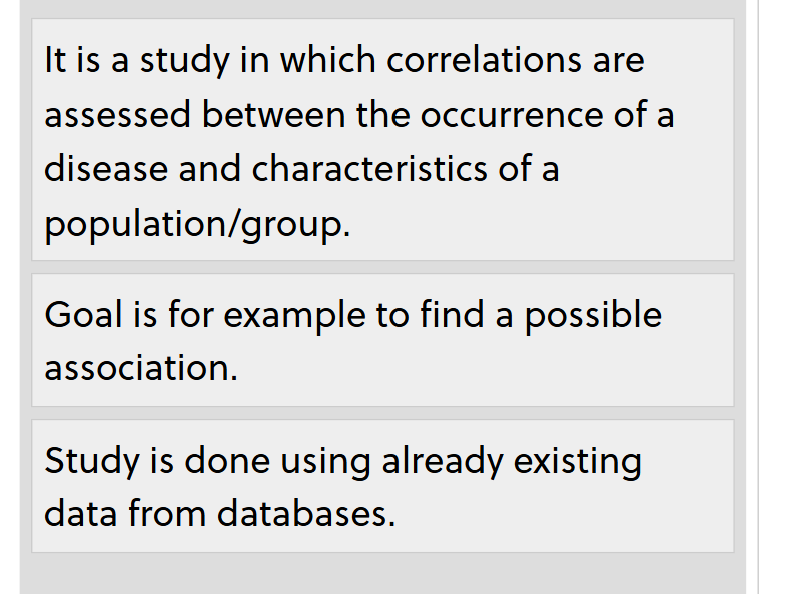
What is analytical epidemiology - observational and what are the 3 types of studies?
Used to explain why people get ill. It requires at least two groups to compare (or different "doses" of exposure) to establish an exposure-disease association.
Tests a hypothesis
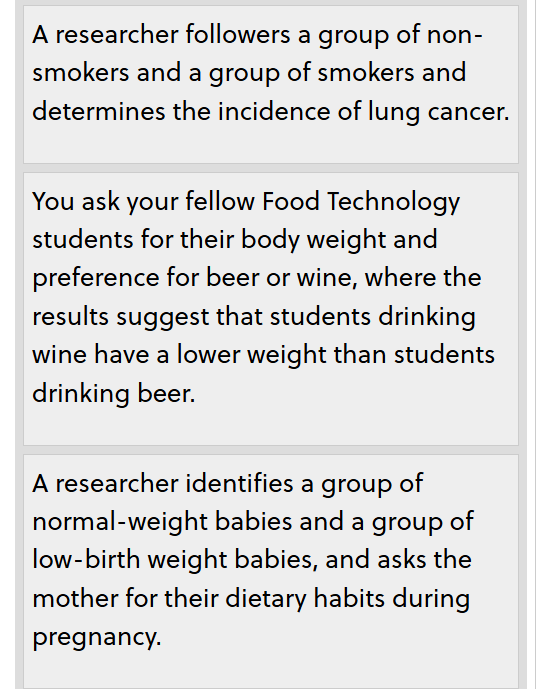
Cross-sectional study: Looks at a population at one point in time to see how common an exposure or outcome is.
Case-control study: Starts with people who have a condition (cases) and those who don’t (controls) and looks back to compare past exposures.
Cohort study: Follows a group over time to see how exposure affects the development of an outcome.
What is analytical epidemiology - experimental
Tests a hypothesis
intervention study or trials
Used to explain why people get ill. It requires at least two groups to compare (or different "doses" of exposure) to establish an exposure-disease association.
What are the four main types of nutrition research, and how do they differ?
In vitro studies – conducted in cell cultures or test tubes.
Animal experiments – performed in animals like mice or rats.
Observational studies – researchers observe natural habits without assigning exposure.
Human intervention trials (RCTs) – researchers assign exposure.
They differ mainly in control, ethical feasibility, cost, and ability to prove causality.
What are the strengths and weaknesses of in vitro studies?
Strength: Very high control over variables; useful for studying biological mechanisms (e.g., how heme iron damages colon cells).
Weakness: Cannot replicate the complexity of a whole human body, so results have low generalisability.
Why are animal studies useful, and what is their main limitation?
Animal studies allow strict control of diet, genetics, and environment. Researchers can perform invasive procedures that are unethical in humans.
However, animals are biologically different from humans, so results may not translate directly to human health outcomes.
What are observational studies, and why can they not prove causality on their own?
Observational studies measure exposures and outcomes without assigning the exposure.
They are good for studying long-term dietary patterns in large populations.
However, they are vulnerable to bias and confounding, meaning they can show associations but cannot definitively prove causality.
Example: People who eat plant-based diets may also exercise more.
What defines a randomised controlled trial (RCT), and why is it considered the gold standard?
An RCT randomly assigns participants to exposure groups (e.g., plant-based diet vs meat-based diet).
Randomisation distributes confounders equally between groups, reducing bias.
It is the strongest design for proving causality, but it is expensive, complex, and sometimes unethical (e.g., assigning smoking).
What is a survey, what type of epidemiological study is it, and what are its strengths and weaknesses?
Descriptive epidemiology
A survey describes characteristics of a population at one moment in time (who, what, where, when).
Strengths:
Good for monitoring trends.
Useful for industries and policy.
Weaknesses:
Recruitment bias.
Must ensure representativeness.
Example: Dutch National Consumption Survey measuring dietary patterns
What is an ecological study, and what is the ecological fallacy?
An ecological study uses aggregated group-level data to study correlations between exposure and disease.
Example: Comparing obesity rates and income levels across countries.
Limitation: An association at group level may not hold at individual level. This is called the ecological fallacy.
When is a study population considered representative?
A population is representative if it reflects the diversity of the target population in age, gender, ethnicity, region, education, etc.
If you only study first-year Food Technology students, results cannot be generalized to elderly populations.
What is the difference between prevalence and incidence?
Prevalence = total existing cases at a specific time.
Incidence = new cases occurring during a period.
Example:
1.2 million people with diabetes → prevalence.
1,000 new diagnoses per week → incidence.
What characterizes a cross-sectional study, and what is its main limitation?
Observational; A cross-sectional study measures exposure and outcome at the same time.
It is quick and relatively cheap.
Main limitation: Reverse causation — you cannot know if the exposure caused the disease or if the disease changed behavior.
Example: Overweight people might switch to diet soda after gaining weight.
What defines a case-control study, and when is it most useful?
Observational; A case-control study starts with the outcome (e.g., cancer patients) and looks backward to determine prior exposure.
It is efficient and useful for rare diseases.
Limitation: Recall bias and selection bias.
What defines a cohort study, and what are its advantages?
Observational; A cohort study starts with exposure and follows participants forward in time to observe disease occurrence.
Advantages:
Clear time sequence.
Can study multiple outcomes.
Less recall bias than case-control.
Limitation: Expensive and time-consuming.
Example: Following smokers and non-smokers to observe lung cancer incidence.
What is the difference between observational and experimental research?
In observational research, the researcher does not assign exposure.
In experimental research, the researcher actively assigns exposure.
Example:
Observing students’ natural diets → observational.
Assigning margarine enriched with fatty acids → experimental.
What is internal validity?
Internal validity refers to whether the results of the study are true for the study population.
It depends on absence of bias and confounding.
If a study has recall bias or selection bias, internal validity is threatened.
What is external validity?
External validity refers to generalisability.
It asks whether results apply to other populations (e.g., different age groups, ethnicities, or countries).
What is information bias?
Information bias occurs when exposure or outcome is measured inaccurately.
Example: Mothers of low-birth-weight babies may remember unhealthy diet habits more clearly than mothers of normal-weight babies (recall bias).
What is selection bias, and give an example?
Selection bias occurs when inclusion in the study is related to the exposure-disease relationship.
Example: Only health-conscious students volunteer for a diet study.
What is confounding?
Confounding occurs when a third variable is associated with both exposure and outcome, distorting the true association.
Example: In a study comparing plant-based vs meat diets and blood pressure, if meat-eaters smoke more frequently, smoking is a confounder.
What is relative risk (RR), and how is it interpreted?
Relative Risk is the ratio of disease risk in exposed vs unexposed groups.
RR = 1 → no association
RR > 1 → higher risk
RR < 1 → lower risk (protective)
Example: RR = 0.63 means the exposed group has 37% lower risk.

What is a meta-analysis, and what makes it reliable?
A meta-analysis statistically combines results from multiple studies and reports a pooled RR/OR/HR.
To be reliable:
Literature search must be transparent and reproducible.
Heterogeneity must be explained.
Study quality must be assessed.
Sensitivity analyses performed.
Limitation: Garbage in = garbage out.