Anterior Segment 1 - Lecture 1
 Call Kai
 Learn
Learn Practice Test
 Spaced Repetition
 Match
Match Flashcards
 Knowt Play
1/173

There's no tags or description
Looks like no tags are added yet.
Name | Mastery | Learn | Test | Matching | Spaced | Call with Kai | Chat |
|---|
No analytics yet
Send a link to your students to track their progress
174 Terms
What kind of joints are cranial sutures?
Fibrous Joints
What is the purpose of the cranial sutures?
Allows for expansion of the brain
What are the four cranial sutures?
Metopic, sagittal, coronal, lambdoid
What is craniosynostosis?
Premature fusion of the cranial sutures
What is the result of craniosynostosis?
Abnormal skull and brain development
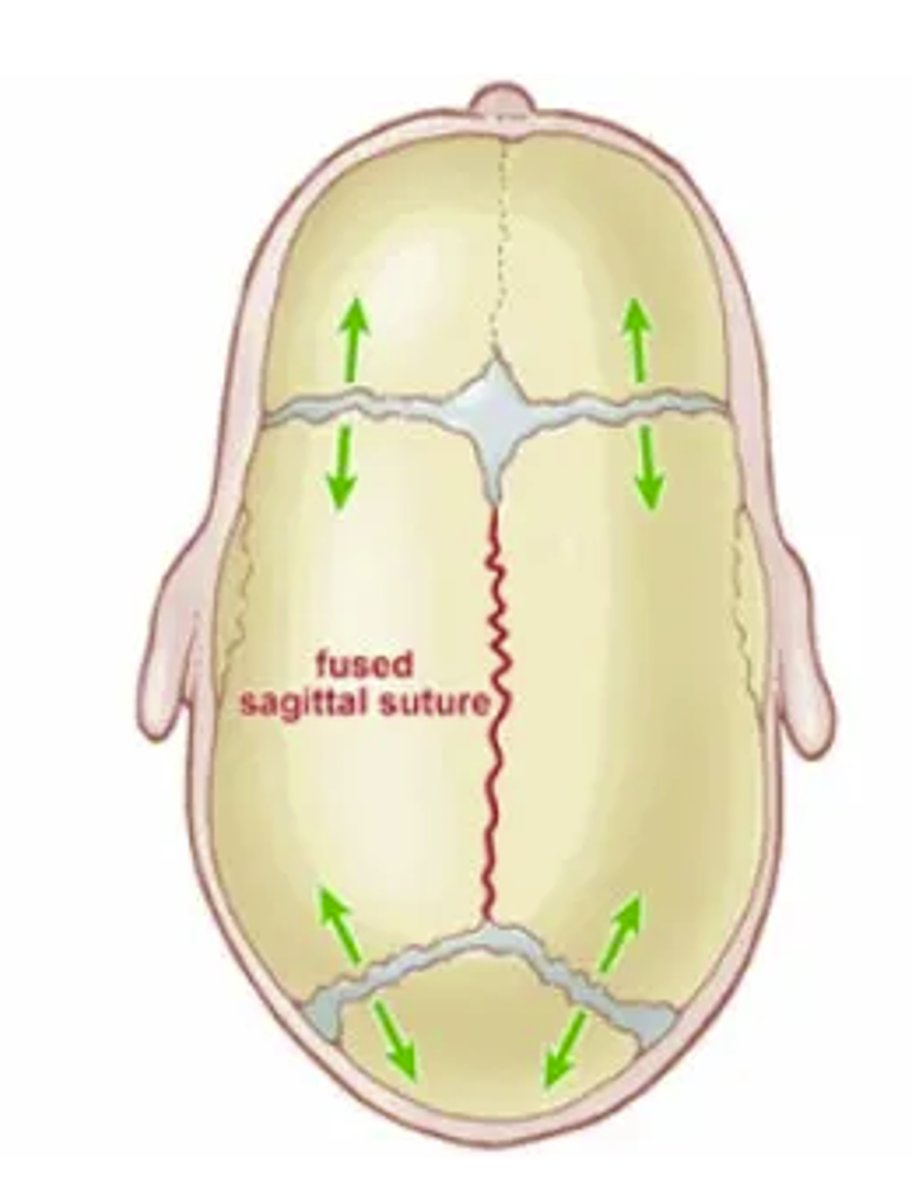
What is Virchow's Law?
In cases of craniosynostosis, restricted growth of the skull occurs perpendicular to the prematurely fused suture.

According to Virchow's law, what happens to skull growth parallel to a fused suture in craniosynostosis?
Compensatory overgrowth occurs parallel to the fused suture.
What finding may be elevated due to brain growth within a confined space?
Intracranial pressure
What are the ocular manifestations of increased intracranial pressure? (3)
1. Proptosis
2. Papilledema
3. Paresis of EOMs
What are the five non-syndromic craniosynostosis?
1. Brachycephaly
2. Scaphocephaly
3. Trigonocephaly
4. Oxycephaly
5. Positional Plagiocephaly
B...STOP
What is brachycephaly?
Premature fusion of coronal sutures

Head shape: Brachycephaly
Skull will grow parallel to the prematurely fused suture, so head will be wide and shortened front to back according to Virchow's law
Treatment: Brachycephaly
Surgery
What is scaphocephaly?
Premature fusion of the sagittal suture

Head shape: Scaphocephaly
Head will grow parallel to prematurely fused suture, so elongated anterior to posterior
An inverted boat or football head shape is seen with which non-syndromic craniosynostosis?
Scaphocephaly
Treatment: Scaphocephaly
Surgery
What is trigonocephaly?
Premature fusion of the metopic suture
Head shape: Trigonocephaly
Head will grow parallel to the fused suture so V-shaped head with high retreating forehead
Treatment: Trigonocephaly
Surgery
What condition is characterized by premature fusion of the coronal and sagittal and/or lambdoid sutures?
Oxycephaly
What condition presents with a tower skull or "high-head" syndrome?
Oxycephaly
Treatment: Oxycephaly
Surgery
What is the most common cause of misshapen head during infancy?
Positional plagiocephaly
Which sutures prematurely fuse in positional plagiocephaly?
None; all sutures remain open
What results in the flatter head in positional plagiocephaly?
Due to position in the womb during pregnancy
In which condition is positional plagiocephaly more common?
In multiple pregnancy (twins or triplets)
What is the treatment for positional plagiocephaly?
No treatment needed
What two bones make up the orbital roof?
1. Frontal
2. Lesser wing of the sphenoid
(Roof is Front-Less)

What is found in the superotemporal aspect of the orbital roof?
Lacrimal gland
What 3 bones make up the orbital floor?
1. Maxillary
2. Palatine
3. Zygomatic
(My pal left his Z's on the floor)

Which part of the orbital floor is susceptible to orbital fracture/blow out fracture?
Posteromedial portion of the maxillary bone
What makes up the roof of the maxillary sinus?
Orbital floor
What four bones make up the medial wall of the orbit?
1. Maxillary
2. Lacrimal
3. Ethmoid
4. Sphenoid
SMEL (medial near the nose)

What is the thinnest bone within the orbit and can erode in ethmoid sinusitis infections?
Lamina papyracea of the ethmoid
What two bones make up the lateral wall of the orbit?
1. Greater wing of the sphenoid
2. Zygomatic

The lateral wall of the orbit protects the (anterior/posterior) half of the globe.
Posterior (anterior half is susceptible to trauma)
What are syndromic craniosynostosis?
Inherited/genetic conditions characterized by a collection of distinct facial and body abnormalities
What identifying feature can differentiate between various syndromic craniosynostosis?
Presence of limb and hand abnormalities
What are the five syndromic craniosynostosis?
1. Crouzon syndrome
2. Apert syndrome
3. Muenke syndrome
4. Pfeiffer syndrome
5. Saethre-Chotzen syndrome
CAMPS
Inheritance pattern for syndromic craniosynostosis?
Autosomal dominant
Acrocephalosyndactyly
Apert syndrome
Which craniosynostosis is present in Apert syndrome?
Brachycephaly and/or oxycephaly
Proptosis can be seen in which syndromic craniosynostosis?
Apert syndrome
T/F Fusion of the digits is present with Apert syndrome
True
Which craniosynostosis is present with Crouzon syndrome?
Brachycephaly
T/F Crouzon syndrome does not present with any hand/feet abnormalities
True
Which syndromic craniosynostosis presents with wide set proptotic eyes, underdeveloped jaw and potential dental issues?
Crouzon syndrome
Which craniosynostosis is present with Muenke syndrome?
Brachycephaly
Which syndromic craniosynostosis is associated with flattened cheek bones and mild hand and feet abnormalities?
Muenke syndrome
T/F Muenke syndrome has no associated intellectual disabilities
True
Which craniosynostosis is associated with wide set eyes, underdeveloped upper jaw, hearing issues, and thumb/big toe pointing away from other digits?
Pfeiffer syndrome
Which craniosynostosis is present with Saethre-Chotzen syndrome?
Brachycephaly
Which craniosynostosis may present with ptosis?
Saethre-Chotzen syndrome
Which craniosynostosis presents with wide spaced eyes, ptosis, small ears, facial asymmetry, fusion of the 2nd and 3rd fingers, and broad nasal bridge?
Saethre-Chotzen syndrome
T/F Saethre-Chotzen does not affect intellect
True
What are the ocular risks of proptosis?
Exposure keratopathy
Who to refer patients with craniosynostosis?
Pediatric craniofacial specialist
Treatment for exposure keratopathy secondary to proptosis
Artificial tears (QID), gel/ointment qHS, possible lid taping qHS
What innervates the eyelid skin?
Upper: CN V1
Lower: CN V2
What innervates the orbicularis oculi?
CN VII
What CN provides taste to the anterior 2/3 of the tongue?
CN VII
Which CN aids in lacrimation?
CN VII
Levator is innervated by which CN?
CN III
Muscle of Mueller is innervated by what?
Sympathetics
What artery gives rise to the lateral palpebral artery?
Lacrimal
What artery gives rise to the medial palpebral artery?
Ophthalmic
Where do all recti muscles originate?
Common tendinous ring (tendinous annulus)
Which condition presents with eyelid edema, erythema, warmth, tenderness, conjunctival injection and chemosis, febrile state with fatigue and proptosis?
Orbital cellulitis
T/F Orbital cellulitis is a life threatening condition
True
Motility with orbital cellulitis
Restricted extraocular motiltiy and pain with eye movements
What is the cause of orbital cellulitis?
1. Bacterial infection in vicinity that spread to the orbit
2. Orbital trauma or surgery
3. Systemic bacteremia
4. Orbital venous stasis or cavernous sinus thrombosis
Which bacteria are responsible for orbital cellulitis in adults?
Staphylococcus or streptococcus
Which bacteria is responsible for orbital cellulitis in children typically?
H. influenzae
A fungal infection from which species could result in orbital cellulitis?
Mucormycosis/Zygomycosis or aspergillus
What does the presence of an APD in orbital cellulitis suggest?
Compressive optic neuropathy
What is the workup for orbital cellulitis in the ED?
CT scan of the orbit/paranasal sinuses with contrast to confirm diagnosis
What is the treatment for orbital cellulitis?
Hospitalization with IV antibiotics
What are the four types of idiopathic orbital inflammation conditions?
Dacryoadenitis, Myositis, Dacryoadenitis + Myositis, Orbital apex syndrome
What is the cause of IOI?
Idiopathic acute or chronic inflammatory disorder of orbital tissue
Myositits
Limitation of EOM and pain eith EOM movement
Which condition typically presents unilaterally in adults with dacryoadenitis, myositis, proptosis, decreased orbital retropulsion, conjunctival chemosis, increased IOP
IOI
T/F Idiopathic orbital inflammation is a diagnosis of exclusion
True
Dacryoadenitis
Inflammation of the lacrimal gland
How to differentiate between IOI and thyroid ophthalmopathy on CT scan?
In IOI both tendon and muscle is enlarged, in Thyroid ophthalmopathy the muscle belly is enlarged
Treatment of IOI
Hospitalization for CT scan, systemic steroids once all other conditions have been ruled out
Hemotology is run in cases of IOI to rule out which condition?
Vasculitis (Wegner's granulomatosis, Polyarteritis nodosa)
Which condition involves unilateral vision loss with ophthalmoplegia involving multiple cranial nerves?
Orbital apex syndrome
Periorbital facial pain and forehead hypoesthesia is caused by what in orbital apex syndrome?
Involvement of CN V1
Vision loss in orbital apex syndrome is caused by what?
CN II affected
Ophthalmoplegia in orbital apex syndrome is caused by what?
Involvement of CN III, IV, VI
Mydriasis and Ptosis are seen with which condition?
Orbital apex syndrome due to CN III involvement
How to differentiate between orbital apex syndrome and cavernous sinus syndromes?
Cavernous sinus syndromes do not involve CN II, thus no vision loss should be expected
Treatment of orbital apex syndrome
Hospitalization for CT and MRI and initiate systemic steroids once other conditions have been ruled out
Which nerves travel within the cavenous sinus?
CN III, IV, VI, V1, V2, and sympathetics
Orbital varix is what type of disorder of the orbit?
Vasculopathic
Carotid cavernous fistula is what type of disorder of the orbit?
Vasculopathic
What condition is characterized by intermittent proptosis that is non-pulsatile and not associated with a bruit?
Orbital varix
What causes proptosis in orbital varix?
Valsalva manuever (on command) or compression of jugular veins
How to diagnose orbital varix?
Xray of orbit to rule out mass