Chemistry Measurements: Accuracy, Precision, and Errors
 Call Kai
 Learn
Learn Practice Test
 Spaced Repetition
 Match
Match Flashcards
 Knowt Play
1/17

There's no tags or description
Looks like no tags are added yet.
Name | Mastery | Learn | Test | Matching | Spaced | Call with Kai | Chat |
|---|
No analytics yet
Send a link to your students to track their progress
18 Terms
What does accuracy mean in chemistry?
Accuracy refers to how close a measured value is to the true or accepted value.
What is an example of an accurate measurement?
Measuring the mass of a chemical sample where the actual mass is 25.0 g and the balance shows 24.9 g.
Define precision in the context of measurements.
Precision is the quality of being exact and consistent, referring to how close repeated measurements are to each other.
What is an example of a precise measurement?
A digital scale measures a book as 250.2 g, 250.1 g, and 250.2 g, showing high precision.
How do accuracy and precision differ?
Accuracy is about being correct (close to the true value), while precision is about being consistent (close to repeated measurements).

What is measurement error?
Measurement errors are the differences between the measured value and the true or actual value.
What is a random error in scientific measurements?
A random error is a chance difference between the observed value and its true value, unpredictable and without a set pattern.
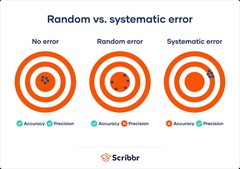
Give an example of a systematic error.
A systematic error occurs when an electronic weighing scale is not reset or calibrated before measuring weights.
How can systematic errors be minimized?
By calibrating equipment, ensuring instruments read zero before use, controlling environmental conditions, fixing observational angles, and using blank controls.
How can random errors be minimized?
By repeating measurements, increasing sample size, using automated tools, and upgrading shielding to protect sensitive equipment.
What is the importance of calibration in measurements?
Calibration ensures that instruments provide accurate readings by comparing them against known standards.
What does it mean to zero an instrument?
Zeroing an instrument means ensuring it reads exactly zero before placing an item on it for measurement.
What is parallax error?
Parallax error occurs when measurements are read at an angle rather than directly at eye level, leading to inaccuracies.
Why is it important to control laboratory conditions?
Controlling conditions like temperature and humidity helps minimize systematic errors in measurements.
What is the role of blank controls in experiments?
Blank controls are used to detect signals or contamination before testing the actual sample.
What is the effect of increasing sample size on random error?
Increasing sample size helps cancel out unpredictable fluctuations, leading to more reliable results.
How do automated tools help in reducing measurement errors?
Automated tools eliminate human reaction time, reducing the chance of errors in data collection.
What is the significance of taking multiple readings?
Taking multiple readings allows for finding a reliable statistical average, which helps minimize random errors.