MED ORG LEC - 01 Review of Prerequisites
 Call Kai
 Learn
Learn Practice Test
 Spaced Repetition
 Match
Match Flashcards
 Knowt Play
1/52

There's no tags or description
Looks like no tags are added yet.
Name | Mastery | Learn | Test | Matching | Spaced | Call with Kai | Chat |
|---|
No analytics yet
Send a link to your students to track their progress
53 Terms
Target
Biomolecule which is targeted by the ligand
Receptor
Transmits signals through messengers
Transporter
Transports ions (channels, pumps)
Enzyme
Catalyzes reactions
Catalyst
Speeds up reaction
Ligand
Compound which binds to the target
Drug
Approved by the FDA
TRUE
TRUE or FALSE
Not all ligands are drugs, but all drugs are ligands
Drug
Approved by the FDA
Inhibitor
Prevents enzyme breakdown
Chemical Foundations
The molecule themselves
Small molecules
Biomolecules
Polarity and Ionization
Weak acids and bases
Intermolecular forces (IMF)
Isomerism
Reactivity
Saturated
Molecule with purely single C-C bonds
Unsaturated
Molecule with at least one C=C or C≡C
Conjugated
Alternating C-C and C=C bonds
ex. benzene
Open-chain
Has terminal parts
Not cyclic
ex. linear, branched
Cyclic
Has no terminal parts
Forms a ring
ex. clycopentane
Carbocyles
Phenol
Aniline
Toluene
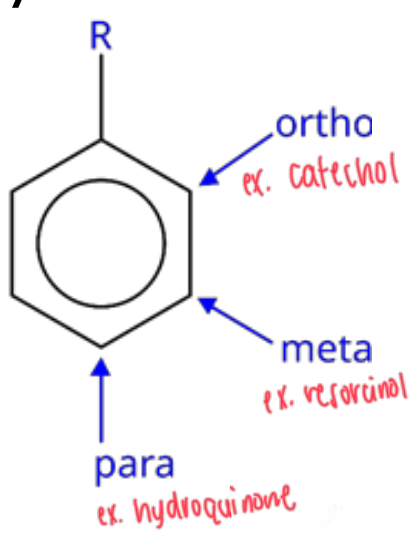
Catechol
Resorcinol
Hydroquinone
Orthoxylene
Orthocresol
Benzaldehyde
Benzoic Acid
Salicylic Acid
Anthralinic Acid
Naphthalene
Anthracene
Phenanthrene
Heterocycles
Pyrrole
Furan
Thiophene
Imidazole
Oxazole
Thiazole
Pyridine
Pyrazine
Piperidine
Piperazine
Pyrimidine
Purine
Quinoline
Indole
Isoquinoline
Benzimidazole
Small Molecules
Involve organic or inorganic compounds with a MW not exceeding 500 g/mol
Must also have a reasonable polarity, allowing it to be either ionized or not depending on the pH
May be extracted naturally (pharmacognosy) or produced synthetically (synthetic medicinal chemistry)
Many natural product exceed 500 g/mol but are still enough to fit some drug targets
ex. digoxin 780 - anti-arrythmic
vincristine 824 - for cancer
erythromycin 734 - antibiotic
Amino Acids
Building blocks of Proteins
Nucleotides
Building blocks of Nucleic acids
Monosaccharides
Building blocks of Carbohydrates
No Universal Building Block
Universal blocks of Lipids
Nonpolar Amino Acids
Glycine (Gly, G)
Alanine (Ala, A)
Valine (Val, V)
Leucine (Leu, L)
Isoleucine (Ile, I)
Methionine (Met, M)
Phenylalanine (Phe, F)
Tryptophan (Trp, W)
Proline (Pro, P)
Polar Amino Acids
Serine (Ser, S)
Threonine (Thr, T)
Cysteine (Cys, C)
Tyrosine (Tyr, Y)
Asparagine (Asn, N)
Glutamine (Glu, Q)
Electrically-charged Amino Acids
Aspartate (Asp, D)
Glutamate (Glu, E)
Lysine (Lys, K)
Arginine (Arg, R)
Histidine (His, H)
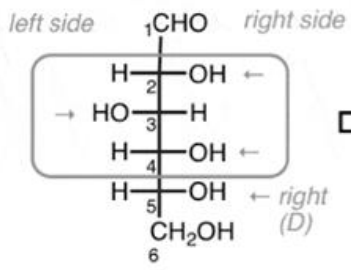
Fischer Projection
Fischer Project or Haworth Projection
ex. D-Glucose
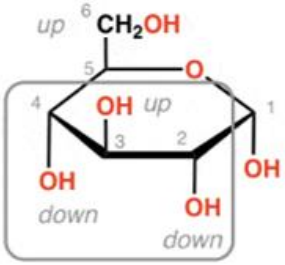
Haworth Projection
Fischer Project or Haworth Projection
ex. α-D-Glucopyranose
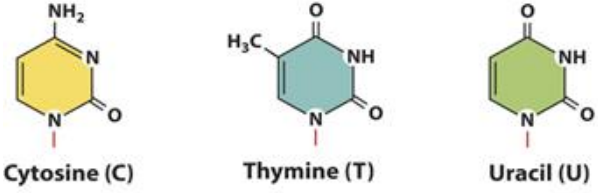
Pyrimidine Bases
Cytosine (C)
Uracil (U)
Thymine (T)
Hint: Py-CUT
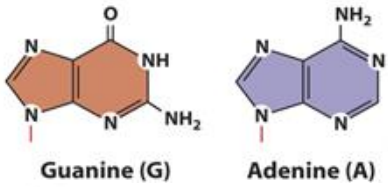
Purine Bases
Guanine (G)
Adenine (A)
Hint: Pur-GA
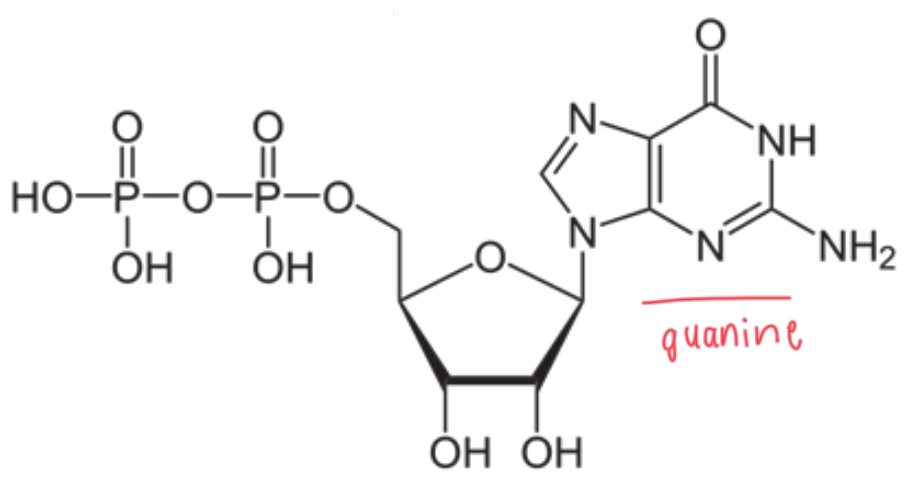
Guanosine diphosphate
Name this:
Carboxylic Acids
Organic acids are often _____
Amines
Organic bases are often _____
Unionized
Ionized or Unionized
Acidic pH
Weak Acid
Ionized
Ionized or Unionized
Basic pH
Weak Acid
Ionized
Ionized or Unionized
Acidic pH
Weak Base
Unionized
Ionized or Unionized
Basic pH
Weak Base
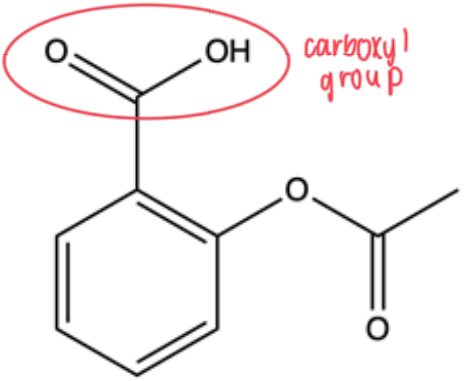
Aspririn
Name this structure
Unionized
Is Aspirin (acidic) ionized or unionized in the stomach?
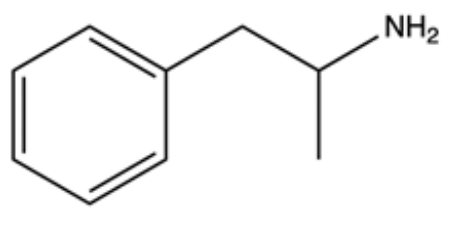
Amphetamine
Name this structure
Ionized
Is Amphetamine (basic) ionized or unionized in the stomach?
Intermolecular Forces
The actualization of the binding between target and ligand
Ion-Dipole
IMF Type where:
One should be: Ion (cation/anion)
The other: Polar
Hydrogen Bond
IMF Type where:
One should be: Polar, specifically OH, NH, or FH
The other: Polar
Dipole-Dipole (Keesom)
IMF Type where:
One should be: Polar
The other: Polar
Dipole-Induced Dipole (Debye/Van der Waals)
IMF Type where:
One should be: Polar
The other: Polar
Induced Dipole-Induced Dipole (London/Hydrophobic)
IMF Type where:
One should be: Nonpolar
The other: Nonpolar
Isomerism
Same molecular formula having different arrangement
Allows us to review why some molecules have certain prefixes or suffixes in their name
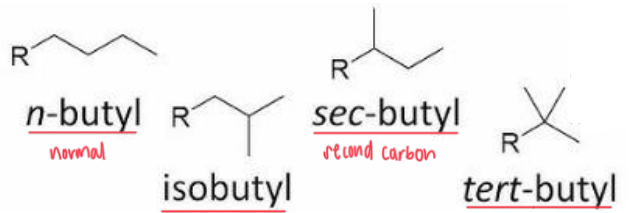
Skeletal isomerism
n
iso
sec
tert
Positional Isomerism
ortho
meta
para
Configurational Isomers
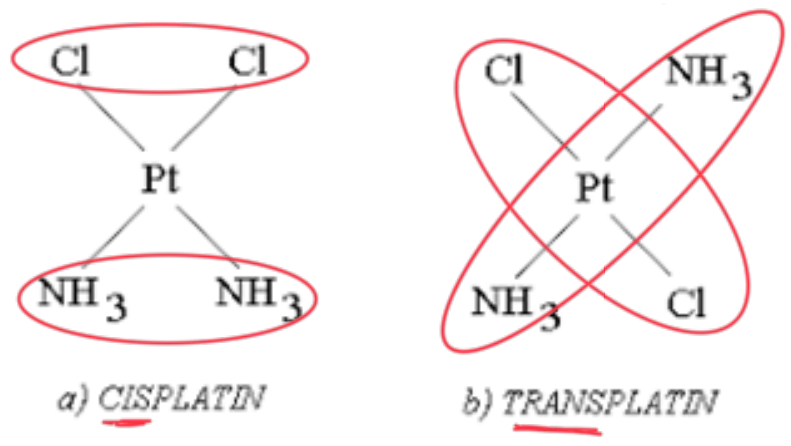
Geometric Isomers
cis
trans
E
Z
Optical Isomers
R
S
Racemic Mixtures
Active Conformation
Conformational Isomers
Optimal arrangement in the binding site