Exam 1 Chapter 3: Bacterial Cell Structure
 Call Kai
 Learn
Learn Practice Test
 Spaced Repetition
 Match
Match Flashcards
 Knowt Play
1/83

There's no tags or description
Looks like no tags are added yet.
Name | Mastery | Learn | Test | Matching | Spaced | Call with Kai | Chat |
|---|
No analytics yet
Send a link to your students to track their progress
84 Terms
categories of bacterial shapes
coccus, coccobacilus, bacillus, vibrio, spirillum, spirochete, pleomorphic
coccobacilus
between coccus and bacillus (can look like cocci that are replicating or immature bacillus)
shape of coccus
circle
shape of bacillus
rod
shape of vibrio
comma/ crescent
shape of spirrilium and spirochete
crinkle cut fries
difference between spirillum and spirochete
spirillum= stiff
spirochete= flexible
shape of pleomorphic
no exact shape
Shape of Staphylococcus
coccus
Shape of Chlamydia
coccobacilus
Shape of Escherichia
bacillus
Shape of Cresentus
vibrio
Shape of Camphylobacter
Spirillum
Shape of Borrelia
spirochete
Shape of corynebacterium
pleomorphic
disease caused by borrelia
lyme disease
disease caused by corynebacterium diptherieae
diptherea
filamentous
make hyphae (mycelium)
similar to fungi
bacterial shape for cyanobacteria & streptomyces
filamentous
filamentous bacteria can be confused for…
fungi
complex bacteria shape
create fruiting bodies
Myxococcus is an example of
complex bacteria

Types of Bacterial arrangement: cocci
cocus (1)
diplococci (2)
staphylococci (grape)
streptococci (line)
sarcina (2groups of 4 stacked, cubed)
tetrad (4)
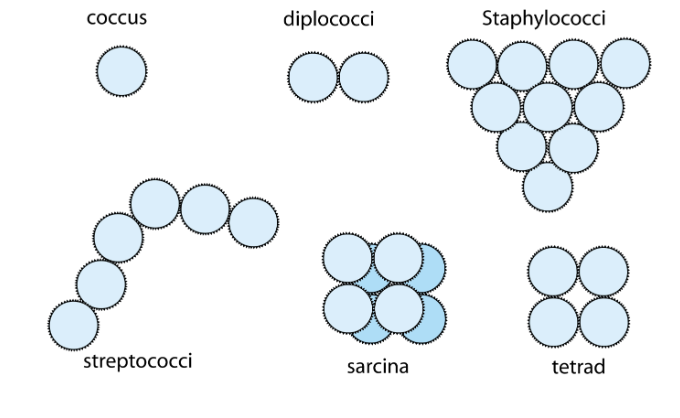
Types of Bacterial arrangement: bacillus
coccobacillus
bacilli (1)
diplobacilli (2)
palisades (fence)
streptobacilli (necklace)

myco usually indicates…
fungi
smallest bacterial size
0.3 micrometers
what is the smallest bacteria?
mycoplasma (0.3 mycoplasma)
Why do mycoplasma only grow inside of other cells?
they do not have a cell wall
average rod size
1.1-1.5×2-6 micrometers
E. coli size
average (very nice personality)
very large bacterial size
600×80 micrometers
epulopiscium fishelsoni bacterial size
very large
size shape relationship
nutrient uptake, protective mechanism from predation, rate of metabolism
transport rate
surface area to volume ratio
True or False: Rods are more efficient than cocci
True
haemophilus inlfuenzae
does not cause the flu, bacteria, tiny hides inside cells, first bacteria to have its whole genome sequenced
more surface area=
more absorption
surface area formula
4πr2
volume formula
4πr3 / 3
surface area to volume ration formula
3 / r
optional layers above the cell membrane in order from inner to outer
peptidolgycan, outer mmebrane (LPS), S layer, capsule/ slime layer
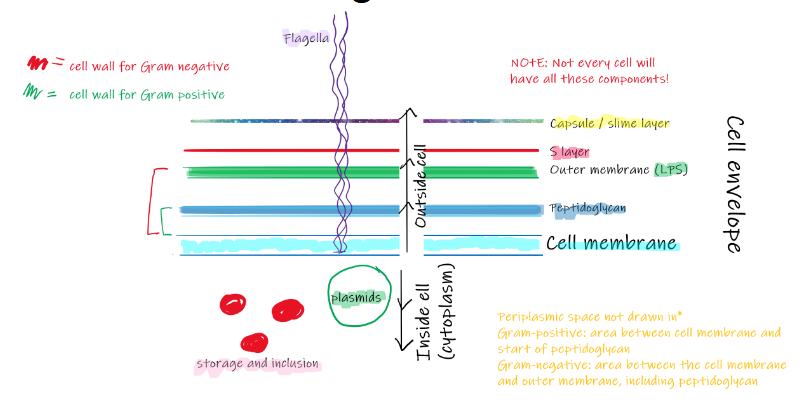
peptidoglycan is unique to which domain of life
bacteria
True or False: All bacteria have peptidoglycan
false
gram positive bacteria have what on top of their cell membrane?
peptidoglycan
gram negative bacteria have what on top of their cell membrane?
peptidoglycan AND LPS (outer membrane)
S layer is found in what type of cellular microorganism?
prokaryotes
envelope
cell membrane and anything above
true or false: eukaryotes cannot have flagella
false
plasmids
double stranded extrachromosomal DNA, can be independent or can become incorporated into the chromosome
ribosome function
bind to mRNA in translation to make polypeptides
examples of cytoskeletal proteins
FtsZ, MreB, CreS, MamK
FtsZ
found in middle of cell, found in many bacteria, tubulin homologue
MreB
coils inside bacteria to give rod shape, actin homologue
CreS
only found on inside of bacteria, maintains curve shape, generally found in addition to MreB, intermediate filament homologue
storage inclusion
saves nutrients, metabolic end products, energy or building blocks for later when these are in abundance
glycogen storage
glucose storage
# of carbons in glucose
6
poly- B- hydroxybutyrate (PHB)
carbon storage
polyphosphate granules
phosphate storage
phosphate role in cell
back bone of DNA and RNA & ATP
sulfur globules
sulfur storage
cyanophycin granules
amino acid storage
used for movement NOT for storage
inclusions
gas vacuoles
used to control buoyancy of cell, moves cell up and down in liquid medium, it is why we resuspend broth samples
magnetosomes
use earth’s magnetic field to find bottom of the ocean, uses MamK granules to control weight distribution of cell based on desired magnetic field strength
bacteria that has magnetosomes
magnetospirillum gryphiwaldense
magnitite particles
magnetosome granules
characteristics of bacterial DNA
generally have one double stranded circular chromosome, haploid (1 copy of chromosome)
plasmid replication
exist and replicate independently of chromosome
categories of plasmids
conjugate plasmids, R plasmids, virulence plasmids, Col plasmids
conjugate plasmids function
used for conjugation (horizontal gene transfer)
R plasmids function
r center ressitance = antibiotic resistance
episome
integrated plasmid into bacterial DNA
virulence plasmid function
makes bacteria more pathogenic
col plasmids function
colasin kills/inhibits neighbors of similar morphology (competition)
plasma membrane
ecompasses cytoplasm
plasma membrane
selectively permeable, outer and inner leaflet, phospholipid (inner= hydrophobic, outer= hydrophillic)
functions of proteins embedded in plasma membrane
interact with external environment, receptors for detection and response to chemical surroundings, transport, metabolism (prokaryotes)
ETC location for bacteria (electron transport chain)
cell membrane
amphipathic lipids
two parts hydrophilic head, hydrophobic tail
integral proteins
embedded in the membrane
transmembrane protein
span across membrane
all transmembrane proteins are integral not all integral are transmembrane