Role of the Hypothalamus and Hormones of the Anterior Pituitary Gland
 Call Kai
 Learn
Learn Practice Test
 Spaced Repetition
 Match
Match Flashcards
 Knowt Play
1/9

There's no tags or description
Looks like no tags are added yet.
Name | Mastery | Learn | Test | Matching | Spaced | Call with Kai | Chat |
|---|
No analytics yet
Send a link to your students to track their progress
10 Terms
The hypothalamic-pituitary-gonadal axis is the complex interactions that take place between the —
hypothalamus, pituitary gland, and ovaries as part of the female reproductive cycle
The hypothalamus is an area within the brain that is located just —
beneath the thalamus.
The primary responsibility of the hypothalamus, as it relates to the menstrual cycle, is to —
regulate the release of hormones by the anterior pituitary gland
The hypothalamus achieves this function by —
releasing its own hormone, gonadotropin-releasing hormone (GnRH)
GnRH stimulates the
release of hormones by the anterior pituitary gland
The pituitary gland, often referred to as — is an endocrine gland located within the brain that consists of an anterior and a posterior lobe
the “master gland”
The anterior lobe of the pituitary gland is responsible for the release of two chief hormones that influence the menstrual cycle:
follicle-stimulating hormone (FSH) and luteinizing hormone (LH)
— causes the development of multiple follicles on the ovaries
FSH
— surges around day 14 of the menstrual cycle, resulting in ovulation
LH
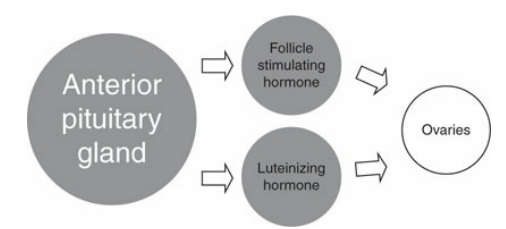
Hormones of the anterior pituitary gland influence the ovaries