Learn: Exam 1, Lab 3
 Call Kai
 Learn
Learn Practice Test
 Spaced Repetition
 Match
Match Flashcards
 Knowt Play
1/272

There's no tags or description
Looks like no tags are added yet.
Name | Mastery | Learn | Test | Matching | Spaced | Call with Kai | Chat |
|---|
No analytics yet
Send a link to your students to track their progress
273 Terms
Hypothesis
Suggests a possible explanation/The testable explanation
Theory
Explains why it happens
Law
Describes what happens
Scientific Method
Observation, Question, Hypothesis, Prediction, Experiment (Data Collection & Analysis), Conclusion
Observation
Notice something in the world
Question
Ask: Why is this happening?
Hypothesis
Suggests a possible explanation/The testable explanation
Prediction
If, then statement
Experiment (Data Collection & Analysis)
Record what happens
Conclusion
Support or Reject hypothesis?
Hypothesis - General Format Equation
If [the specific treatment], then [a predicted result].
Experimental Group
group being tested on
Control Group
group not being tested on
Independent variable
the variable that you are changing
Dependent variable
the variable that is being measured
Constant variable
variables that stay CONSTANT
Hypothesis must be
testable and falsifiable
Not blind
Test subjects and researchers both know which group is which
Single blind
Test subjects don't know which group is which, but researchers know which group is which
Double blind
Test subjects don't know which group is which, and researchers don't know which group is which
Biology
the scientific study of life
Characteristics of life
Order
Cells
Growth and development
Energy processing
Regulation
Response to the environment
Reproduction
Evolution
5 unifying themes in biology
1. Structure and function
2. Information flow
3. Pathways that transform Energy and Matter
4. Interactions with biological systems
5. Evolution
Ocular lens magnification
10X
Red lens
4X
Yellow lens
10X
Blue lens
40X
mega
M 10^6
kilo
k 10^3
hecto
H 10^2
deca
Da 10^1
deci
d 10^-1
centi
c 10^-2
milli
m 10^-3
micro
u 10^-6
Ocular lens
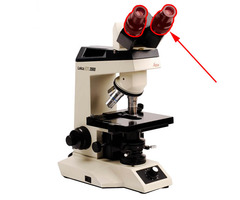
Head
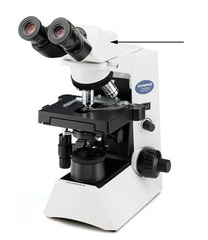
Arm

Nosepiece
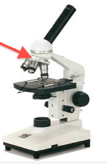
Objective Lens

Stage

Coarse Adjustment

Fine Adjustment
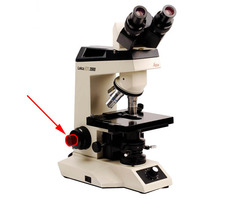
Condenser

Light

Stage controls

Base

Brightness adjustment

light switch
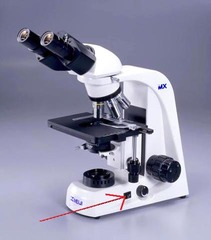
How to use microscope
Set microscope on 4X objective by rotating
nosepiece and set stage lowest position by
rotating coarse adjustment
Place the slide on stage by moving the metal
holders
Use the stage control to place the slide directly
on top of the light
Begin focusing on by rotating coarse
adjustment until clear
Once focused, draw what you see and write
the total magnification in Part II number 4
circle
Rotate the nosepiece until the 10X objective
lens and again focus using the coarse
adjustment until image is CLEAR
Rotate the nosepiece until the 40X objective
lens and again focus using the only fine
adjustment until image is CLEAR
Once finished, rotate nosepiece back to 4X
objective and remove the slide and return into
container
Proton
A subatomic particle that has a positive charge and that is found in the nucleus of an atom
Neutron
A subatomic particle that has no charge and that is found in the nucleus of an atom
Electron
A subatomic particle that has a negative charge
Atomic Number
the number of protons in the nucleus of an atom
Mass number
the sum of the number of neutrons and protons in an atomic nucleus
Isotopes
Atoms with the same number of protons but different numbers of neutrons
radioactive isotopes
Atoms that are unstable, meaning they decay, or break down, to form stable atoms of a different element
Ionic bond
Formed when one or more electrons are transferred from one atom to another
Covalent bond
A chemical bond that involves sharing a pair of electrons between atoms in a molecule
Polar Covalent Bond
A covalent bond in which electrons are not shared equally
nonpolar covalent bond
a covalent bond in which the electrons are shared equally by the two atoms
Hydrogen bond
Attraction between a slightly positive hydrogen atom and a slightly negative atom.
polar molecule
molecule with an unequal distribution of charge, resulting in the molecule having a positive end and a negative end
nonpolar molecule
molecule that shares electrons equally and does not have oppositely charged ends
Hydrophobic
Water fearing
Hydrophilic
water loving
polar molecules are
hydrophilic
nonpolar molecules are
hydrophobic
What type of bond joins individual water molecules to each other?
hydrogen bonds
How are the individual hydrogen and oxygen atoms inside each water molecule are joined?
polar covalent bonds
States of matter
solid, liquid, gas
What properties of water allow it to sustain life?
The cohesion of water
Water can moderate temperature
The biological significance of ice floating
Water as the solvent of life
The cohesion of water
Then tendency of molecules of the same kind to stick together
Water can moderate temperature
Hydrogen bonds gives water a stronger resistance to temperature change
Earth's giant water supply enables planet temperatures to stay within limits that permit life
The biological significance of ice floating
Each water molecule has 4 H-bonds holing it in place with neighboring water molecules
Makes ice less dense than water, floats
Allows life in the water to persist beneath frozen surface
Water as the solvent of life
Water can dissolve a large variety of necessary solutes for life
Provides a medium for chemical reactions
Solute
A substance that is dissolved in a solution.
Solvent
A liquid substance capable of dissolving other substances
Ion
An atom or group of atoms that has a positive or negative charge.
Hydrogen in water
slightly positive
Oxygen in water
slightly negative
pH scale
measurement system used to indicate the concentration of hydrogen ions (H+) in solution; ranges from 0 to 14
An increase of 1 on the pH scale represents
a tenfold (10 times) decrease in the concentration of hydrogen ions
a decrease in 1 on the pH scale represents what
A decrease of 1 unit on the pH scale represents a tenfold (10x) increase in hydrogen ion concentration and acidity
Acid
A substance that increases the hydrogen ion concentration of a solution.
Base
A substance that decreases the hydrogen ion concentration in a solution.
4 elements that make up 96% of humans
Oxygen (O)
Carbon (C)
Hydrogen (H)
Nitrogen (N)
How many elements are essential for humans?
25
DNA
deoxyribonucleic acid
DNA function
DNA is the code for making proteins and stores genetic information
What makes up DNA?
Adenine, Thymine, Guanine, Cytosine (ATGC)
Genes
stretches of DNA that code for the production of proteins
RNA
ribonucleic acid
RNA function
performs protein synthesis
What makes up RNA?
adenine, cytosine, guanine, uracil (ACGU)
Transcription
(genetics) the organic process whereby the DNA sequence in a gene is copied into mRNA
Translation
Process by which mRNA is decoded and a protein is produced
What is mRNA?
messenger RNA
Double bond
A chemical bond formed when atoms share two pairs of electrons
Single bond
a covalent bond in which two atoms share one pair of electrons