[MATTER] Types of Matter ➡️ Properties and Changes in Matter
 Call Kai
 Learn
Learn Practice Test
 Spaced Repetition
 Match
Match Flashcards
 Knowt Play
1/60

Earn XP
Name | Mastery | Learn | Test | Matching | Spaced | Call with Kai | Chat |
|---|
No analytics yet
Send a link to your students to track their progress
61 Terms
General Chemistry
________ studies the properties of and changes in matter
Reaction
_____ change in matter
Matter
[TYPES OF MATTER]
______ is anything that occupies SPACE and has MASS
TRUE
TRUE OR FALSE:
Outside the earth or the planet that we live in PLASMA is the most abundant form of matter.
FALSE ; Oxygen is an element, not a compound
TRUE OR FALSE:
Oxygen is a compound
TRUE
TRUE OR FALSE:
In earth solid , liquid and gas are the most dominant forms of matter
Solid
Liquid
Gas
Types of Matter [3]
Solid
[TYPES OF MATTER]
Have FIXED VOLUME and FIXED SHAPE
Liquid
[TYPES OF MATTER]
Have FIXED VOLUME and VARIABLE SHAPE
Gas
[TYPES OF MATTER]
Have VARIABLE SHAPE and VARIABLE VOLUME
Example:
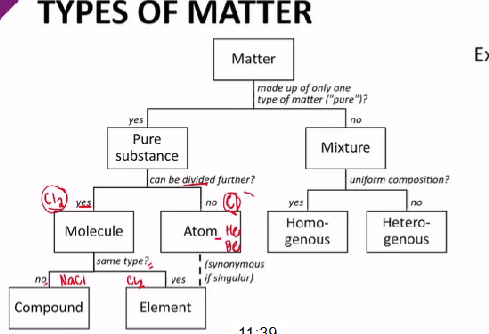
Iron (Fe) , Heliul (He) , Beryllium (Be) → atom
Halo-halo → Heterogenous mixture
Ferric (Fe+3) → Elements , Atom, Cation
Carbon dioxide (CO2) → Compound
Crude extracts → Heterogenous mixture
Phosphate (PO4 -3) → Molecule , Compound, Anion
[TYPES OF MATTER]
Types of Matter based on complexity [Diagram]
TRUE
[TYPES OF MATTER]
TRUE OR FALSE:
A COMPOUND can never be an ATOM
TRUE
[TYPES OF MATTER]
TRUE OR FALSE:
Atoms should be strictly SINGULAR
TRUE
[TYPES OF MATTER]
TRUE OR FALSE:
Elements can be SINGULAR or PLURAL
TRUE
[TYPES OF MATTER]
TRUE OR FALSE:
All COMPOUNDS are molecule but not all MOLECULES are compounds. For example:
Helium (He) is a singular entity so it’s an atom and element
Hydrogen (H2) is a molecule (plural) and element (the two atoms are of the same type)
Sodium Chloride (NaCl) is a molecule and compound (Na and Cl are different types of atom)
neutral (unionized /uncharged)
[TYPES OF MATTER]
Uttering “atom”, element “, molecule, or “compound” often implies that a pure substance is _______
ion
[TYPES OF MATTER]
If an atom”, element “, molecule, or “compound” has a charge , the preferred word to use is ______
TRUE
[TYPES OF MATTER]
TRUE OR FALSE:
Based on the charge an ION can be positive (cation) or negative (anion)
Cation
[TYPES OF MATTER]
A positively charged ion
a. Cation
b. Anion
Anion
[TYPES OF MATTER]
A negatively charged ion
a. Cation
b. Anion
TRUE
[TYPES OF MATTER]
TRUE OR FALSE:
Mixtures can be comprised of one (homogenous) or multiple (heterogenous) compositions
Solution
[TYPES OF MATTER]
TRUE OR FALSE:
Majority of HOMOGENOUS substances are ______ since the solute and solvent are treated as one composition
Solution
[TYPES OF MATTER]
Solute + Solvent = ______
Colloids
Gels
Lotions
[TYPES OF MATTER]
Some Examples of Heterogenous mixtures [3]
Plasma
[TYPES OF MATTER]
_____also called as IONIZED GAS , a gas with + or - charges
Ionized Gas
[TYPES OF MATTER]
Plasma is also called as _____
Law of Conservation of Mass (by Lavoisier)
Law of Definite Proportion / Constant Composition (by Proust)
Law of Multiple Proportion (by Dalton)
[TYPES OF MATTER]
In order to separate pure substances from mixtures, the three fundamental laws of chemistry were put into place such as the _____ [3]
Law of Conservation of Mass
[FUNDAMENTAL LAWS OF CHEMISTRY]
______states that the total mass of substances present after a chemical reaction is the same as the total mass before the reaction
Law of Definite Proportion / Law of Constant Composition
[FUNDAMENTAL LAWS OF CHEMISTRY]
______states that in a given substance, the relative number and kinds of atoms are constant in a ratio of small whole numbers
Law of Multiple Proprotions
[FUNDAMENTAL LAWS OF CHEMISTRY]
______states that when substances combine to form new products (i.e to react), the mass of the elements are represented in the ratio of small whole numbers
Lavoiser
[FUNDAMENTAL LAWS OF CHEMISTRY]
States the Law of Conservation of Mass
Proust
[FUNDAMENTAL LAWS OF CHEMISTRY]
States the Law of Definite Proportion / Constant Composition
Dalton
[FUNDAMENTAL LAWS OF CHEMISTRY]
States the Law of Multiple Proportion
Molecular Formulas
Emperical Formulas
When pure substances are written , they are either written as ____ [2]
Molecular Formulas
Show exact number of atoms
Example:
a.) Molecular Formulas
b.) Emperical Formulas
Emperical Formulas
Simplify atom counts to the lowest terms
a.) Molecular Formulas
b.) Emperical Formulas
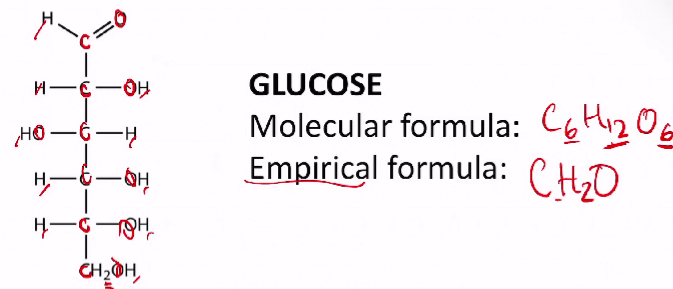
Example for Molecular and Emperical Formula of Glucose:
Change
[PROPERTIES AND CHANGES IN MATTER]
________ is a process that makes matter different from what it was, and is either visible or invisible.
Physical Change
Chemical Change
[PROPERTIES AND CHANGES IN MATTER]
Changes in matter can be ____ [2]
Physical Change
[PROPERTIES AND CHANGES IN MATTER]
Does not change the identity of matter
a.) Physical Change
b) Chemical Change
Composition (e.g. whether things are mixed or separate)
Tangible qualities like texture, viscosity, or color (e.g. smoothing with sandpaper, brushing paint on walls
Actual physical state (solid, liquid, gas)
Melting (S→L)
Freezing (L→S)
Sublimation (S→G)
Deposition (G→S)
Evaporation (L→G)
Condensation (G→L)
[PROPERTIES AND CHANGES IN MATTER]
Properties that count for Physical Change [3]
a.) Physical Change
[PROPERTIES AND CHANGES IN MATTER]
Water + Orange juice / Milo
a.) Physical Change
b) Chemical Change
Melting
[PROPERTIES AND CHANGES IN MATTER]
Phase change from SOLID to LIQUID
Freezing
[PROPERTIES AND CHANGES IN MATTER]
Phase change from LIQUID to SOLID
Sublimation
[PROPERTIES AND CHANGES IN MATTER]
Phase change from SOLID to GAS
Vaporization
[PROPERTIES AND CHANGES IN MATTER]
Phase change from LIQUID to GAS
Deposition
[PROPERTIES AND CHANGES IN MATTER]
Phase change from GAS to SOLID
Condensation
[PROPERTIES AND CHANGES IN MATTER]
Phase change from GAS to LIQUID
Ionization
[PROPERTIES AND CHANGES IN MATTER]
Phase change from GAS to PLASMA
Deionization / Recombination
[PROPERTIES AND CHANGES IN MATTER]
Phase change from PLASMA to GAS
Chemical Reactions
[PROPERTIES AND CHANGES IN MATTER]
Chemical Change is also known as ____
Chemical Change (Chemical Reacions)
[PROPERTIES AND CHANGES IN MATTER]
Does change the identity of matter
a.) Physical Change
b) Chemical Change
a.) Physical Change
[PROPERTIES AND CHANGES IN MATTER]
Boling of Water
a.) Physical Change
b) Chemical Change
b) Chemical Change
[PROPERTIES AND CHANGES IN MATTER]
Open the phone flashlight
a.) Physical Change
b) Chemical Change
a.) Physical Change
[PROPERTIES AND CHANGES IN MATTER]
Precipitating a protein by salting out/in
a.) Physical Change
b) Chemical Change
Physical Change
[PROPERTIES AND CHANGES IN MATTER]
Start of Rain
a.) Physical Change
b) Chemical Change
Chemical Change
[PROPERTIES AND CHANGES IN MATTER]
Usage of Gasoline
a.) Physical Change
b) Chemical Change
Chemical change
[PROPERTIES AND CHANGES IN MATTER]
Heparin and protamine
a.) Physical Change
b) Chemical Change
Physical change
[PROPERTIES AND CHANGES IN MATTER]
Cutting of paper
a.) Physical Change
b) Chemical Change
Chemical change
—any metabolic pathway involved chemical reaction
[PROPERTIES AND CHANGES IN MATTER]
Glycolysis
a.) Physical Change
b) Chemical Change
Physical Change
[PROPERTIES AND CHANGES IN MATTER]
Concentration of a sauce
a.) Physical Change
b) Chemical Change