Unit 1 Cell Bio
 Call Kai
 Learn
Learn Practice Test
 Spaced Repetition
 Match
Match Flashcards
 Knowt Play
1/127

There's no tags or description
Looks like no tags are added yet.
Name | Mastery | Learn | Test | Matching | Spaced | Call with Kai | Chat |
|---|
No analytics yet
Send a link to your students to track their progress
128 Terms
The appeaance and function of cells are dictated by…
proteins
functions of proteins:
structure, catalyze chemical reactions, molecular motors
living species becomes gradually modified and adapt to environment in more sophisticated way
evolution
all cells have evolved from the same ancesteral cell ____
3.5-3.8 billion years ago
the ____ contains a DNA sequence which then instructs the cell how to function
genome
matthais jakob schidein theorized that…
cells comprise all tissues
theodorore shawn theorized…
all living cells are from the growth and division of previous cells (cell theory)
charles darwin theorized…
evolution
what is different about electron microscopes
they use electrons as a source of illumination and have more details with cells
What is different about a scanning electon miscropscope
electrons are scattered and emitted
prokaryotes have no…
nucleus, organelles, ribosomes
what type of organisms fall under prokaryotes
bacteria and archea
what contributed to the rapid evolution of prokaryotes
quick duplication, the ability to exchange genetic information
how did mitochondria come about
aerobic bacteria that lived inside anerobic ancestors of eukaryotes
These organisms play a big role in recycling nitrogen and carbon and living in primitive environments
archea
what are some single celled eukaryotes
ameoba and yeast
what is the double membrane in the nucleus called
nuclear envelope
Uses energy from oxidation or food molecules to produce energy
Cellular respiration
have their own dna
double membrane
reproduce by dividing
mitochondria
found in plant and alage cells
double membrane
photosynthesis
internal membrane stacks with chlorophyll
their own dna
reproduce by dividing in 2
chloroplast
Site where majority of membrane components & exported materials are made
• Extensive network in secretory type cells
endoplasmic reticulum
involved in modifying and packaging molecules made in ER
• Molecules transported through here can be secreted or transported to another compartment
golgi apparatus
Small, irregularly shape
• Intracellular digestion occurs releasing nutrients from Food into cytosol
• Breaking down unwanted molecules ➔ recycling /excretion.
• Acidic pH
• “Bag of enzymes”
lysosome
Small membrane-bound vesicles ➔ sequestered environment for reactions where H2O is2 used to inactivate toxic molecules
peroxisomes
ferries molecules from one organelle to another
transport vesicles
bringing resources inside the cell
endocytosis
getting rid of compounds from the cell
exocytosis
site of translation
largest site
aqueous crowded gel
cytosol
long fine filaments in the cytosol
control movement
three types: actin, microtubules, intermediate
cytoskeleton
Thinnest cytoskeleton type
• Abundant in eukaryotes
• Large number inside muscle cells (central part of muscle contraction machinery)
actin filament
thickest cytoskelton type
• Small hollow tubes
• Pull duplicated chromosomes apart & distribute into daughter cells equally
microtubules
Intermediate in thickness
• Strengthen cells
gives shape, mechanical strength, and drives movements
intermediate filaments
Why is the cytoskelton highly dynamic
involves motor proteins, uses ATP, cargo transported
rod shaped cell
lives in our gut
studies involving it helped back up dna replication, translation, and transcription
e.coli
single celled and small
studies with it helped with genetics and biochemistry discoveries (cell division)
cell wall and mitochondira
cheap and reproduces quickly
budding yeast
what is the model plant
arabidopsis
what are the model animals
fruit fly, worm, mouse, zebrafish
study humans directly by using isolated cells in a controlled laboratory setting
in vitro
Why is the chemistry of life special? (CAT CLT)
carbon compounds, reactions in aqueous environments, narrow temp range, complex, large polymers, tightly regulated
atoms linked together in groups
molecules
smallest particle of an element
atom
number of protons=
atomic number
number of protons + number of neutrons
atomic weight
the protons and neutons are surrounded by…
a cloud of negatively charged electrons
How many electrons can the first 4 shells hold
2,8,8,18
In an ionic bond electrons are ______
donated
In a covalent bond electrons are _____
shared
atoms with incomplete electron sheels have a tendency to…
interact with other atoms to change that
how are double bonds different from single bonds
shorter, stronger, less movement,
in polar structures the electrons are shared unequally resulting in a…
negative and positive charge
order bonds from strongest to weakest
covalent, ionic, van der waals, hydrogen bonding
Are polar bonds and hydrogen bonds hydrophobic or hydrophilic
hydrophilic
non-covalent bond when two atoms approach each other closely
van der waals interaction
substances that release a proton
acid
substances that accept a proton
base
carbon contating compounds=
organic molecules
sugars from…
polysaccahrides (glycogen and starchs)
fatty acids form…
fats and membrane lipids
amino acids form…
proteins
nucleotides form…
nucleic acids
switching the orientation of different OH groups on monosaccahrarides can change them between…
mannose and galactose
monosaccharides can be lnked via _________ to make large carbohydrates
glycosidic bond
disaccharides have ___ subunits
2
oligosaccharides have ______ subunits
2-10
polysaccharides have _____ subunits
100-1000
when a water molecule is expelled to form a bond
condensation
when a water molecule is consumed to break a bond
hydrolosis
when an organism has both a hydrophilic and hydrophobic structure
amphipatic
fatty acid and other derivaties such as tricylaglycerol molecules are categorized as…
lipids
phospholipids are comrpised of..
two fatty acids, gylcerol, phosphate, OH group linked to phosphate, polar group
how are amino acids charcterized
carboxylic acid group, amino group, a carbon, side chain attaches to a carbon
covalent bond between two amino acids
peptide bond
how are peptide bonds formed
condensation
chain of amino acids and peptide bonds
polypeptide
base + sugar=
nucleoside
dna/rna is comprised of…
5 carbon ring sugar (base), phosphate group, bases
the short term carriers of ATP (chemical energy)
nucleoside triphosphates
nucleoside triphosphates comprise of…
3 phosphates linked by 2 phosphoanhydride bonds
free phosphate group
5 end of DNA
free hydroxyl group
3 end of DNA
How to read DNA
5 to 3
______ bonds allow base pairing
hydrogen
When a new nucleotide is added to the growing DNA/RNA strand, two of the three phosphates are released together as ______ during phosophodiester bond formation
pyrophosphate
dna and rna chains are synthesized from…
nucleoside triphosphates
provide mechanical support to cells and tissues
structural proteins
catalyze covalent bond breakage or formation
enzymes
generate movement in cells and tissues
motor proteins
store amino acids or ions
storage protein
bind to DNA to switch genes on or off
transcription regulators
carry extracellular signals from cell to cell
signal proteins
detect signals and transmit them to the cell’s response machinery
receptor proteins
What is the repeating sequence in a polypeptide backbone
N-C-C
True or false: polypeptide chains fold in many ways but are constrained by many weak non covalent bonds
true
final folded structure of protein where free energy is minimized
protein conformation
when proteins are folded inside the cell they are assisted by ______ proteins which require ATP
chaperone
why are chaperone proteins useful
energetically favorable pathway, isolation chambers, more efficent and reliable
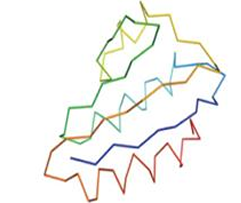
What type of model is this
backbone model
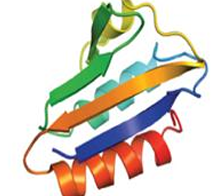
What type of model is this
ribbon model

What type of model is this
wire model
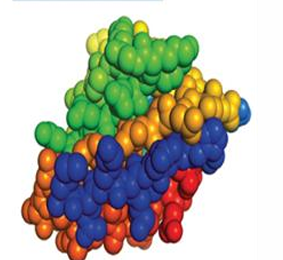
What type of model is this
space filling model
an alpha helix is found in the protein…
alpha keratin