Unit 5 - Cognition
 Call Kai
 Learn
Learn Practice Test
 Spaced Repetition
 Match
Match Flashcards
 Knowt Play
1/95

There's no tags or description
Looks like no tags are added yet.
Name | Mastery | Learn | Test | Matching | Spaced | Call with Kai | Chat |
|---|
No analytics yet
Send a link to your students to track their progress
96 Terms
Intelligence
A mental quality consisting of the ability to learn from experience, solve problems, and use knowledge to adapt to new situations.
G Factor
A general intelligence factor discovered by Charles Spearman, suggesting that if a person excels in one area, they are likely to excel in others.
Multiple Intelligences
The theory proposed by Howard Gardner that describes at least seven different types of intelligences, including linguistic, logical-mathematical, and spatial.
Triarchic Theory of Intelligence
Robert Sternberg's model comprising three types of intelligence: creative, analytical, and practical.
Emotional Intelligence (EQ)
The ability to perceive, understand, manage, and use emotions effectively, considered by some to be a better predictor of success than IQ.
Mental Age
A concept introduced by Alfred Binet, representing the age at which a person is expected to know a certain amount of information.
IQ (Intelligence Quotient)
A score derived from standardized tests designed to measure intelligence, calculated as (mental age/chronological age) X 100.
The Flynn Effect
The observed rise in intelligence test scores over time, necessitating periodic recalibration of tests to maintain an average score of 100.
Reliability
The consistency of a test's results across different administrations or interpretations.
Validity
The extent to which a test measures or predicts what it is intended to measure or predict.
Crystallized Intelligence
The accumulated knowledge a person has acquired and their ability to access that knowledge.
Fluid Intelligence
The ability to see complex relationships and solve problems.
Bias in Testing
The presence of factors that unfairly influence test results, including the stereotype threat, which affects performance based on social stereotypes.
Charles Spearman
Used factor analysis and discovered that what we see as many different skills is actually one General Intelligence.
Aptitude
Measure ability or potential. SAT correlates +.82 with general intelligence scores
achievement
Tests that measure what you have learned.
standardization
Defining meaningful scores by comparison with the performance of a pretest group
normal curve
The symmetrical, bell shaped curve that describes the distribution of many physical and psychological attributes.
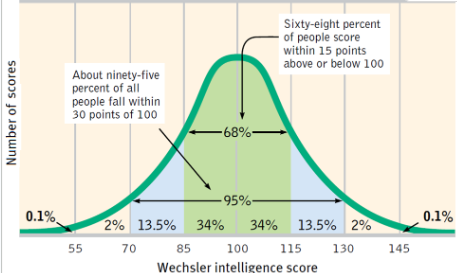
Average intelligence
100 with SD of 15
savant syndrome
a condition where a person has limited mental ability but is exceptional in one area
delayed gratification
Perceive emotions
Understand emotions
Manage emotions
Use emotions to enable adaptive or creative thinking
Interpersonal and intrapersonal intelligences.
Creative intelligence
reacting adaptively to novel situations and generating novel ideas
analytical intelligence
assessed by intelligence test, ability to find solutions to problems
practical intelligence
everyday tasks, which may be ill-defined
content validity
The extent to which a test samples the behavior that is of interest
predictive validity
How does the test predict what it is intended to predict
heritability
intelligence appears to be polygenetic (many genes involved)
Researches have pinpointed some specific gens that relate to intelligence and learning disabilities
grit
passion and perseverance in the pursuit of long-term goals.
stereotype threat
a self-confirming concern that one will be evaluated based on stereotypes
Recall
Retrieving information from memory without explicit cues, often used in fill-in-the-blank or essay tests.
Recognition
Identifying the target information from available options, commonly seen in multiple-choice tests.
Encoding
The process of converting information into a form that can be stored in the memory system.
Storage
The retention of encoded information over time.
Retrieval
The process of accessing and bringing stored information back into consciousness.
Sensory Memory
A short-term holding area for all sensory information, lasting only a moment.
Short Term Memory (STM)
Memory that holds about 7 items for about 20 seconds, encoded from sensory memory.
Long Term Memory (LTM)
The system responsible for the storage of information over lengthy periods.
Explicit Memory
Type of long-term memory that involves conscious recall, including facts and experiences.
Implicit Memory
Type of long-term memory that influences behavior without conscious awareness, including skills and tasks.
Chunking
The process of organizing items into manageable units to aid memory retention.
Mnemonic Devices
Techniques that assist memory retention by translating information into a more memorable format.
Ebbinghaus’s Rehearsal Study
Research that demonstrated the importance of repetition in learning and memory retention.
Primacy Effect
The tendency to better remember items presented at the beginning of a list.
Recency Effect
The tendency to better recall items presented at the end of a list.
Serial Positioning Effects
The influence of the order of information on recall performance.
Long-Term Potentiation (LTP)
A long-lasting enhancement in signal transmission between two neurons that arises from repeated stimulation.
Flashbulb Memories
Highly detailed, vivid memories of significant events, often emotionally charged.
Anterograde Amnesia
The inability to form new memories after a traumatic event.
Retroactive Interference
When new information disrupts the recall of old information.
Proactive Interference
When old information interferes with the learning of new information.
Source Amnesia
When a person cannot remember the source of their knowledge or memories.
Misinformation Effect
When misleading information is incorporated into one’s memory of an event.
Prospective Memory
The ability to remember to perform planned actions in the future.
parallel processing
ability of our brain to process multiple aspects of a thing at once
semantic
facts memorized
episodic
events and experiences
working memory
We focus on certain stimuli based on their importance or how novel they are.
We then process that incoming information, and retrieve long term information.
The working memory then associates new and old information to solve problems.
effortful processing
done on purpose
studying for test, forced memorization
rehearsal
Effortful learning usually requires rehearsal or conscious repetition.
spacing effect
we learn better when we space it out
relearning
it is easier to learn something again if you have learned it in the past
testing effect
frequent testing helps with memory
automatic processing
without effort
ex. remembering what you ate for breakfast space, time, frequency
Structural Encoding
What it looks like
Phonemic Encoding
encoding of the sound
Semantic Encoding
the encoding of meaning and comparing it to other things
mood-congruent memory
we recall memories that go with our mood
bad mood = bad memories
State Dependent Memory
memory that is recalled under the consciousness conditions it was formed
Priming
To retrieve a specific memory from the web of associations, you first need to activate one of the strands that lead to it, a process called priming
Retrograde amnesia
refers to problems with recall of information prior to a trauma
Cognition
Refers to all the mental activities associated with thinking, knowing, remembering, and communicating.
Fixation
Inability to see a problem from a fresh perspective, impeding problem solving.
Algorithm
A rule that guarantees the right solution to a problem, usually using a formula.
Heuristics
A general rule that can help make judgments or solve problems quickly but may lead to errors.
Representativeness Heuristic
Judging a situation based on how similar aspects are to prototypes.
Availability Heuristic
Judging the likelihood of a situation based on the availability of information in memory.
Mental Set
A tendency to approach a problem in one particular way, often based on past success.
Functional Fixedness
The tendency to think of things only in terms of their usual functions.
Insight
A sudden and novel realization of a solution to a problem.
Creativity
The ability to produce novel and valuable ideas.
Confirmation Bias
Looking for evidence to confirm beliefs and ignoring evidence that contradicts them.
Gambler's Fallacy
Mistaken belief that a random event is more likely to happen in the future due to its occurrence's frequency.
Overconfidence
Overestimating the accuracy of one’s knowledge and judgments.
Framing
The way a problem is presented can drastically affect how it is perceived.
Intuition
An effortless, immediate thought or feeling, contrasting with explicit reasoning.
Exaggerated Fear
A tendency for ill-founded fears to arise about potential negative outcomes.
Divergent Thinking
Used to solve problems that have multiple solutions, requiring creativity.
Convergent Thinking
Used to find a single best solution to a problem or question.
Inductive Reasoning
Makes broad generalizations from specific observations.
Deductive Reasoning
Starts with a general statement and examines possibilities to reach a specific conclusion.
Metacognition
Awareness and understanding of one's own thought processes.
Belief Bias
The tendency for beliefs to distort logical reasoning, potentially leading to invalid conclusions.
Belief Perseverance
The tendency to cling to beliefs in the face of contrary evidence.
concept
mental grouping of similar things
ex. birds- pigeon, crow, robbin, blue bird
prototype
the best example of a concept
ex our concept of a bird is usually a robin
prospective memory
the ability to remember to perform an intended action in the future