Renal System
 Call Kai
 Learn
Learn Practice Test
 Spaced Repetition
 Match
Match Flashcards
 Knowt Play
1/92

Earn XP
Description and Tags
A&P Exam 4
Name | Mastery | Learn | Test | Matching | Spaced | Call with Kai | Chat |
|---|
No analytics yet
Send a link to your students to track their progress
93 Terms
Direct functions of the kidneys
Regulation of water, inorganic ion balance, acid-base balance
Removal of metabolic waste and foreign chemicals from blood and excreting it in urine
Gluconeogenesis
Hormone production
Define gluconeogenesis
The creation of new glucose from non-glucose substrates
Where does urea and uric acid come from
Byproducts of protein breakdown
Where does bilirubin come from
Hemoglobin, a byproduct of breakdown of heme pigment and produces color derivatives
What hormones/enzymes do the kidneys produce? Explain
Erythropoietin - controls erythrocyte production
Renin - controls formation of angiotensin, which influences blood pressure and sodium balance
Vitamin D - activates it to influence calcium balance
Functional unit of kidney
Nephron
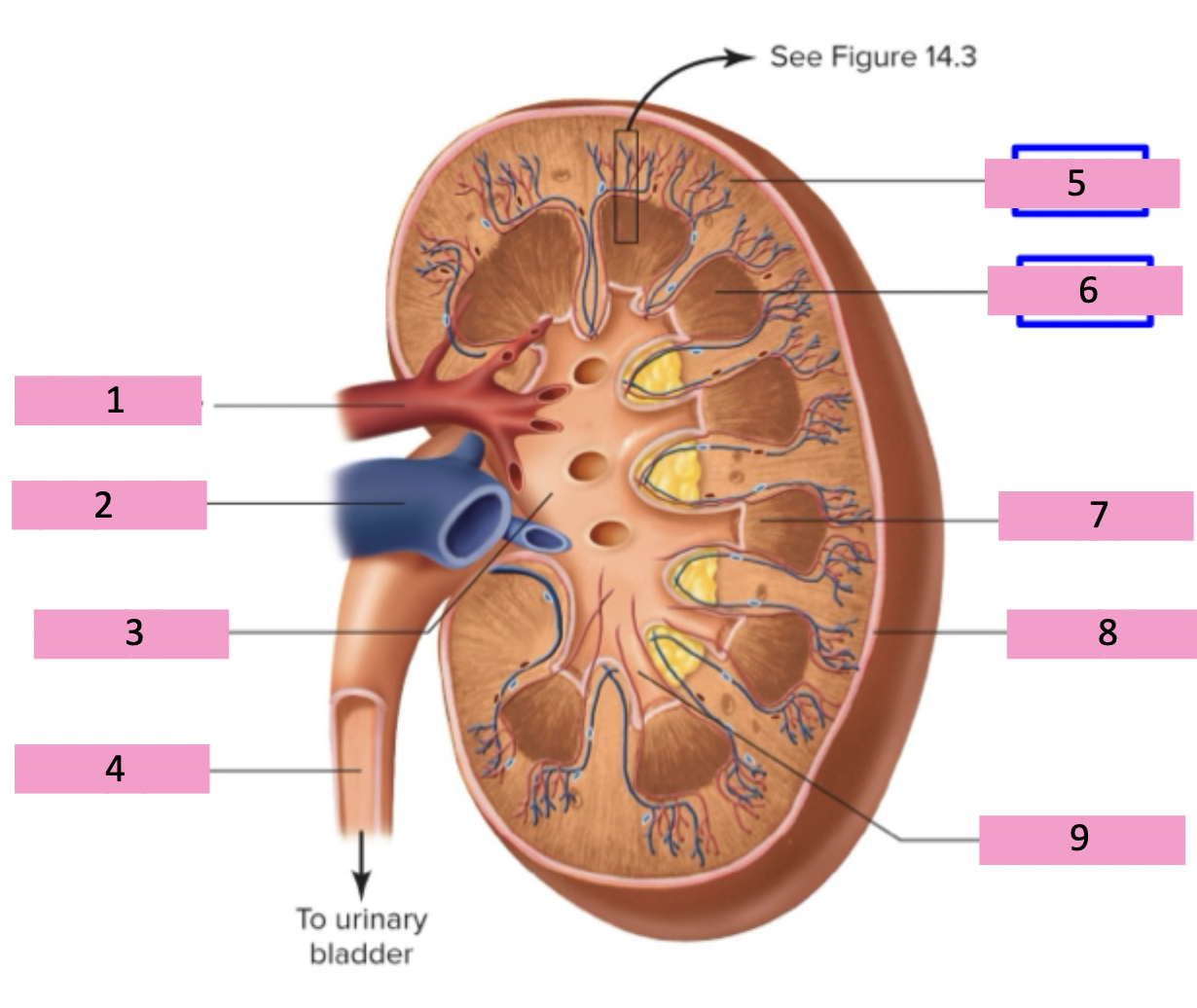
Name these structures
Renal artery
Renal vein
Renal pelvis
Ureter
Cortex
Medulla
Papilla
Capsule
Calyx
Describe the path of blood as it enters and leaves the kidney
Blood comes in from renal artery → dumped off in cortex (filtered) → filtrate moves through medulla in renal pyramids (modified) → dumped into calyx (drainage) → merges at renal pelvis (urine is removed) → clean blood is returned to systemic circulation via renal vein, urine sent to urinary bladder
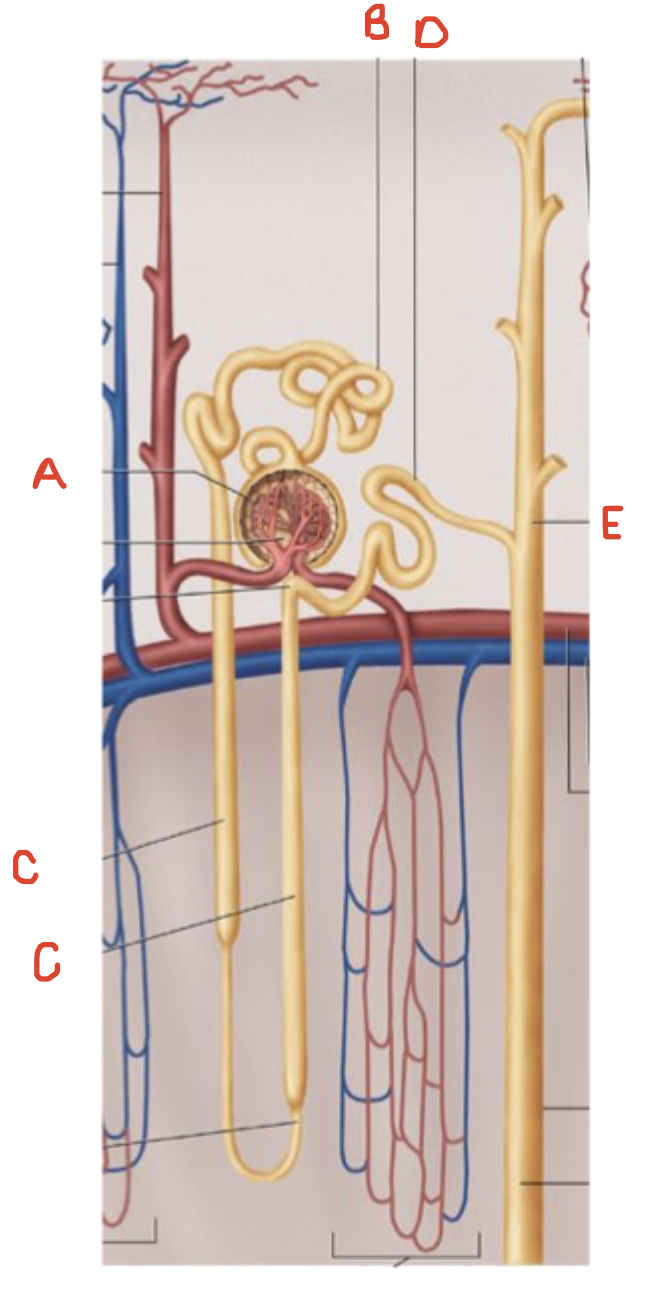
Name the tubular components of nephron
A. Bowman’s capsule
B. Proximal convoluted tubule
C. Loop of Henle
D. Distal convoluted tubule
E. Collecting duct
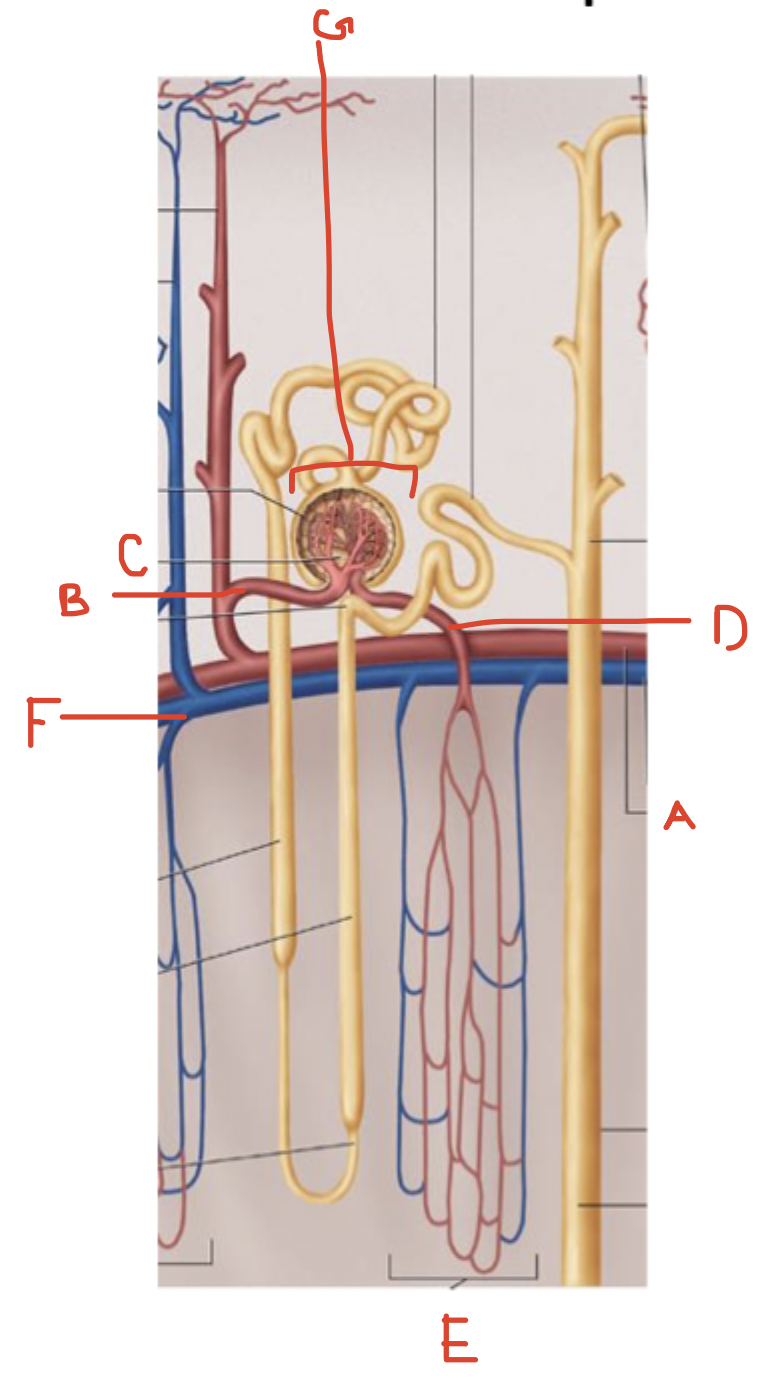
Name the vascular components of nephron
A. Renal artery
B. Afferent arteriole
C. Glomerular capillaries
D. Efferent arteriole
E. Peritubular capillaries
F. Renal vein
Name and describe the two types of nephrons
Juxtamedullary (15%) - has long loops of Henle that dip in the medulla, closest to medulla, generates gradient in medulla for H2O reabsorption, peritubular capillaries are called vasa recta
Cortical (85%) - short loops of Henle, don’t contribute to gradient in medulla
What does the renal cortex contain
Outer layer that contains…
Renal corpuscles of nephrons
Proximal and distal tubules of all nephrons
Cortical nephrons
Describe the renal medulla
Inner layer (renal pyramids) that contains…
Long loops of henle from juxtamedullary nephrons
Medullary portion of collecting ducts
Define the juxtaglomerular apparaturs
Specialized region that regulates glomerular filtration rate (GFR) and systemic blood pressure by sensing the amount of NaCl in filtrate
Controls release of renin
List parts of the juxtoglomerular apparatus
Juxtaglomerular cells, macula densa, sympathetic nerve fiber
Explain juxtaglomerular cells
AKA granular cells
Surrounds afferent arterioles
Synthesizes, stores, and secretes renin in response to BP, norepeinephrine, and macula densea
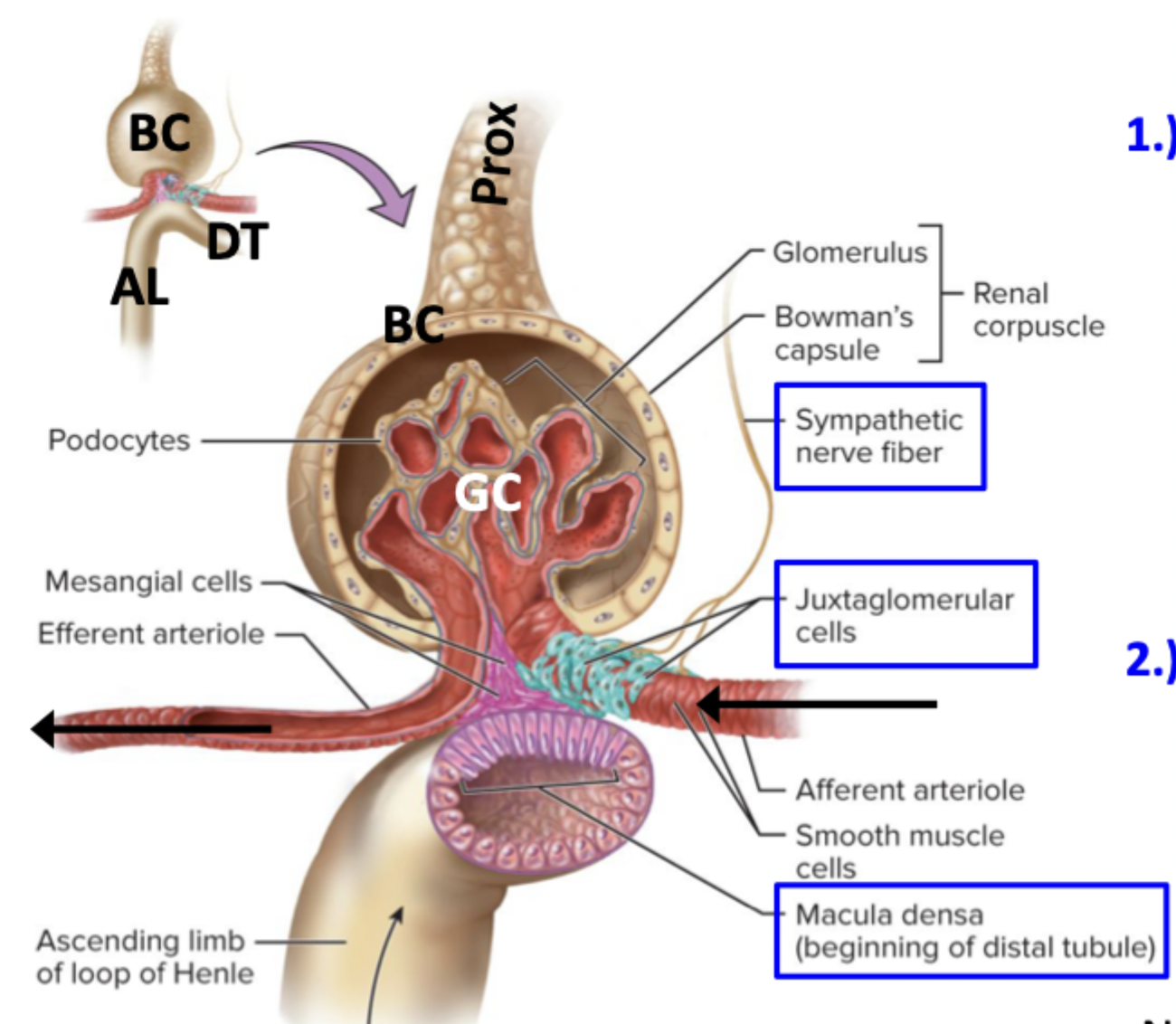
Explain the macula densa
Part of the wall of distal tubule
Senses filtrate flow and sends paracrine signals to afferent arteriole to regulate BP and amount of filtrate produced
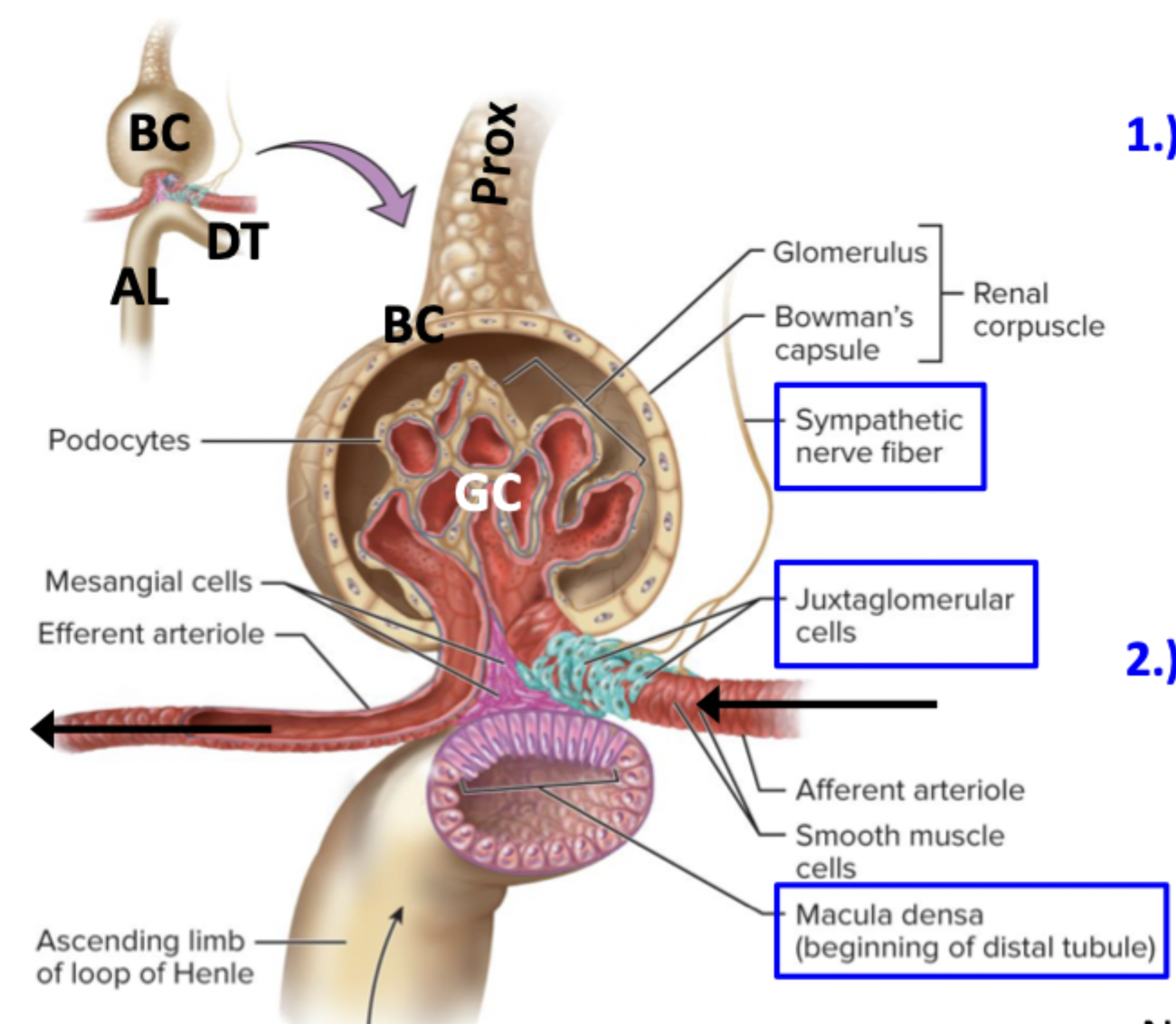
Explain the sympathetic nerve fiber
Comes from the VM center, constricts afferent arteriole
Causes renin secretion from JG cells
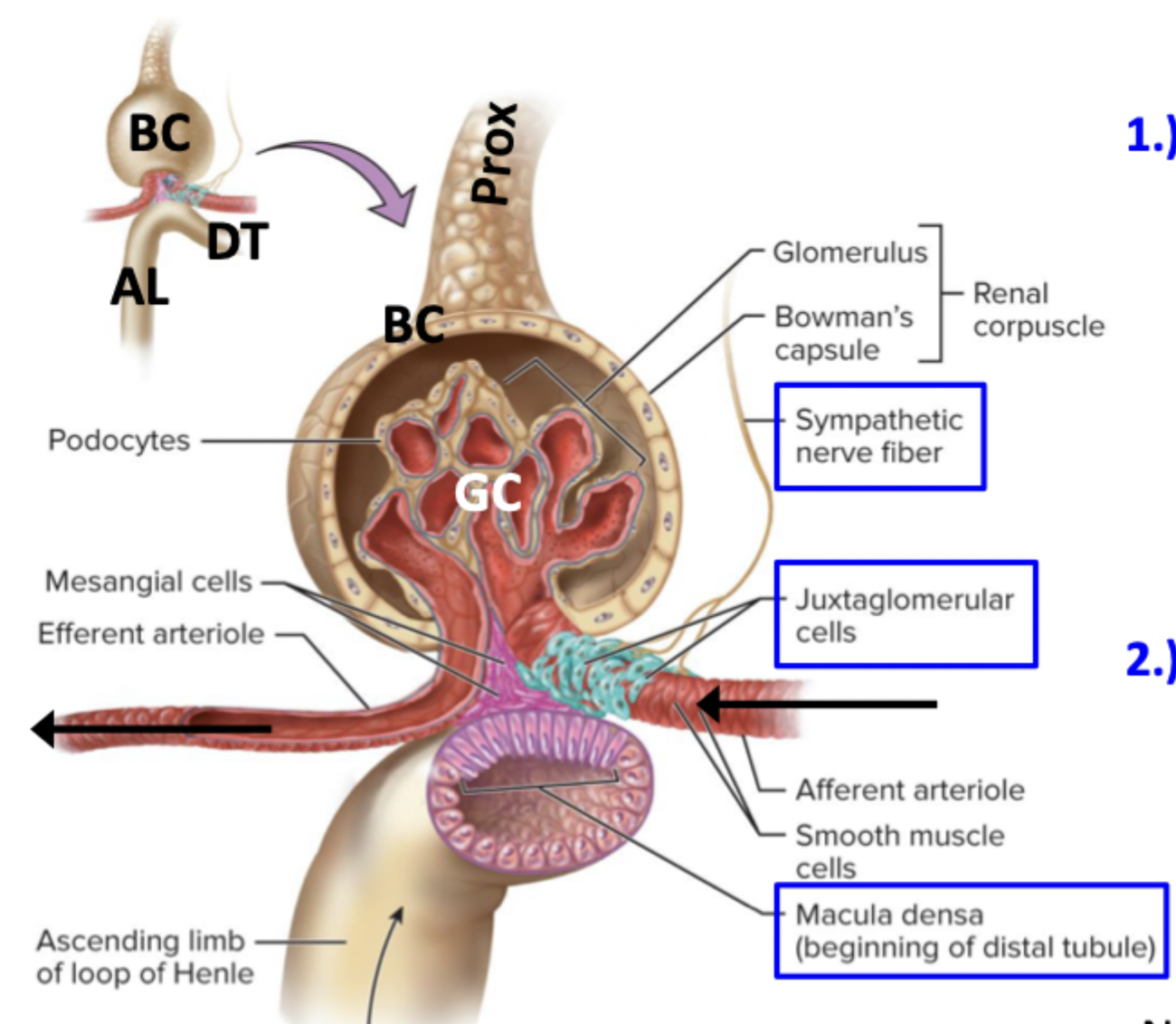
___% of plasma is filtered; ___% continues into efferent arteriole
20; 80
Excretion formula
= filtered + secreted - reabsorbed
Examples of substances that are all freely filtered but 100% secreted, partially reabsorbed, and 100% reabsorbed
100% secreted - drugs, toxins
Partially reabsorbed - Na+, Cl-, water
100% reabsorbed - glucose, amino acids
Name the three basic renal processes
Glomerular filtration, tubular reabsorption, tubular secretion
Define glomerular filtration
The first step in urine formation where water and small dissolved substances are filtered out of the blood and into Bowman’s capsule, occuring in the glomerulus
What occurs in glomerular filtration
Blood enters glomerulus where afferent arteriole has high pressure → pushes fluid out of blood through a filtration membrane → filtrate enters Bowman’s capsule → leaves to enter proximal tubule
Describe the three layers composing the filtration barrier
Capillary endothelium (fenestrated for more exchange)
Basement membrane (negatively charged matrix)
Bowman’s epithelium (podocytes and filtration slits)
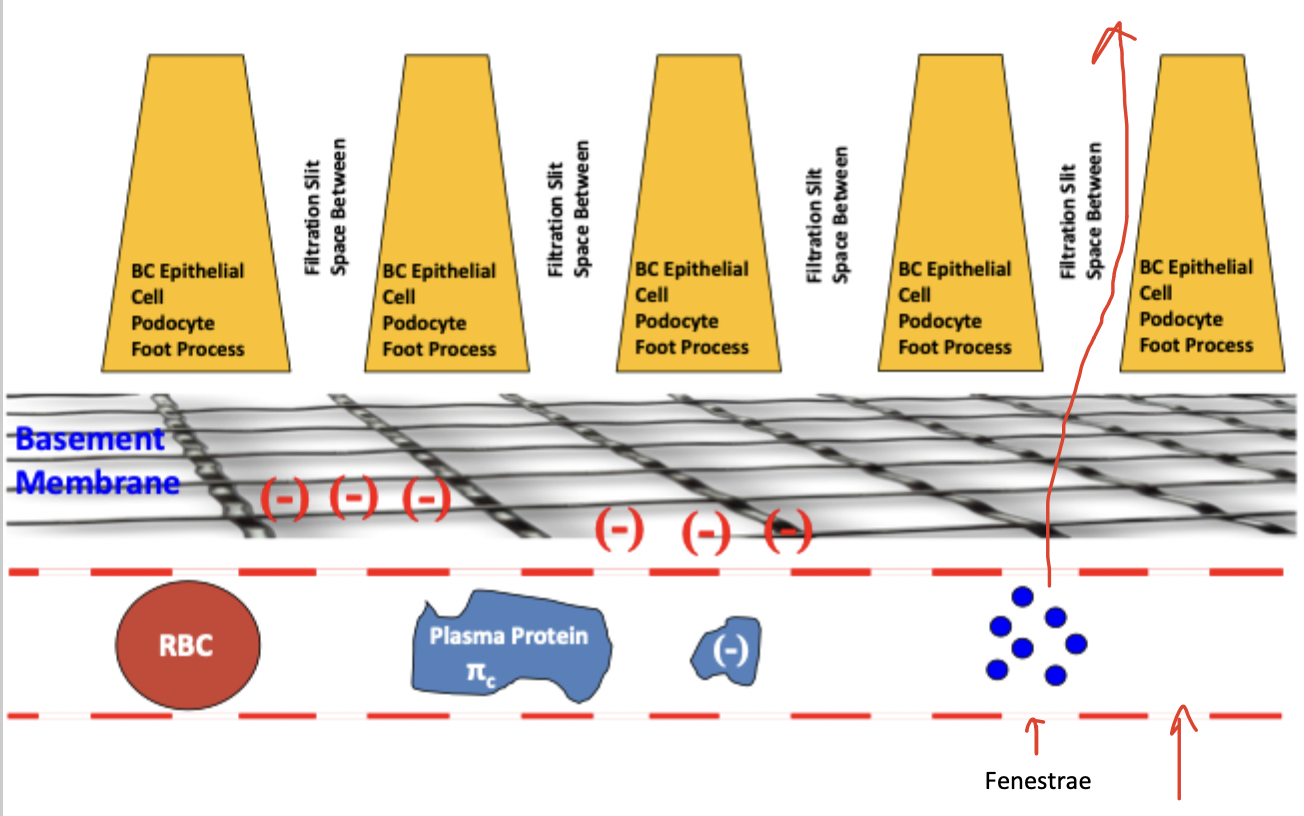
What substances cannot pass the filtration barrier and why
RBCs and plasma proteins because they’re too big to pass through the capillary fenestrations
Small proteins because they are negatively charged and will be repelled by the basement membrane
Explain starling forces involved in glomerular filtration
PGC (usually 60mmHg) - filtrates from glomerular capillary to Bowman’s space
PBS - opposes filtration
πGC - opposes filtration, determined by plasma proteins but usually deosn’t exist
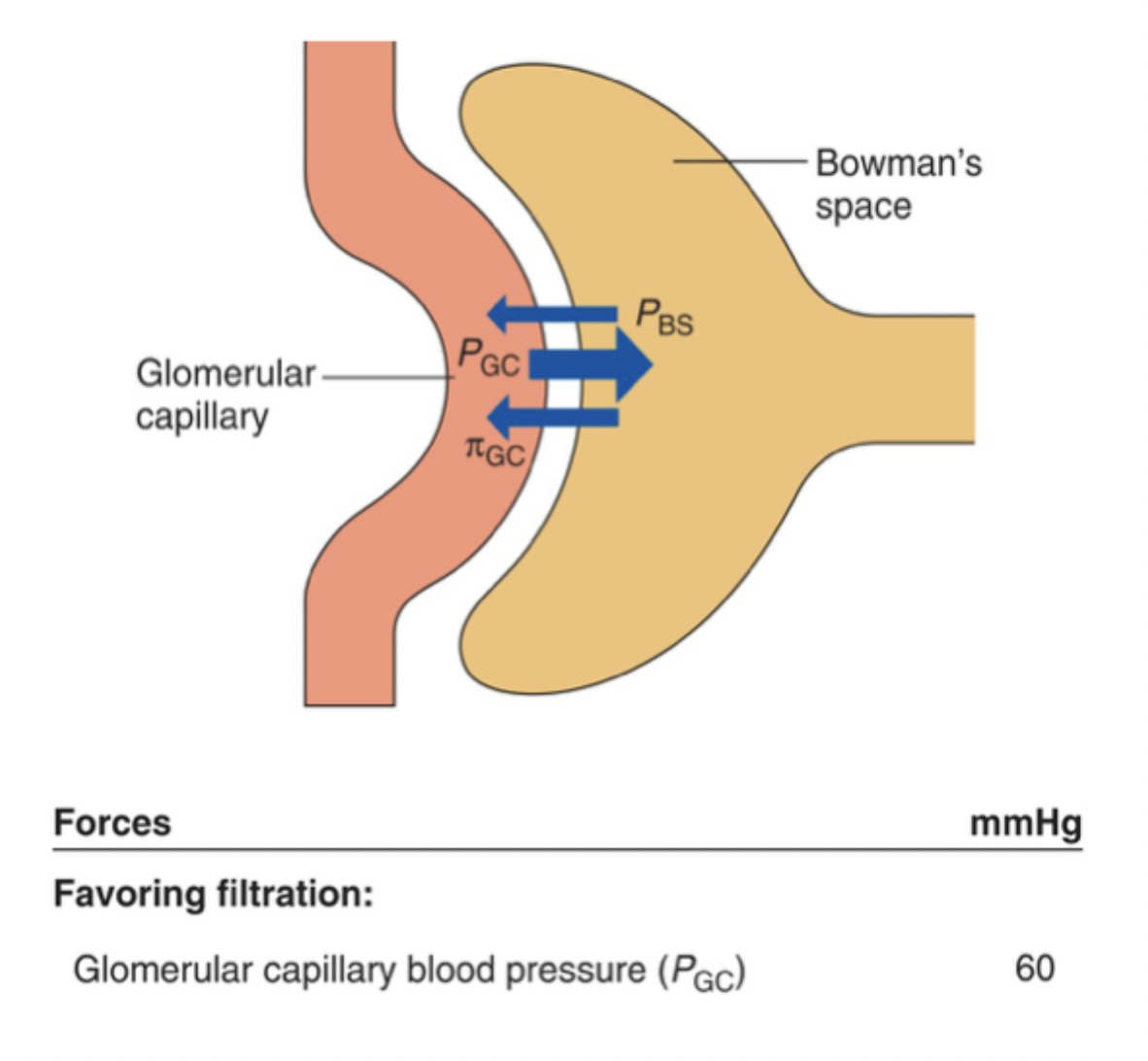
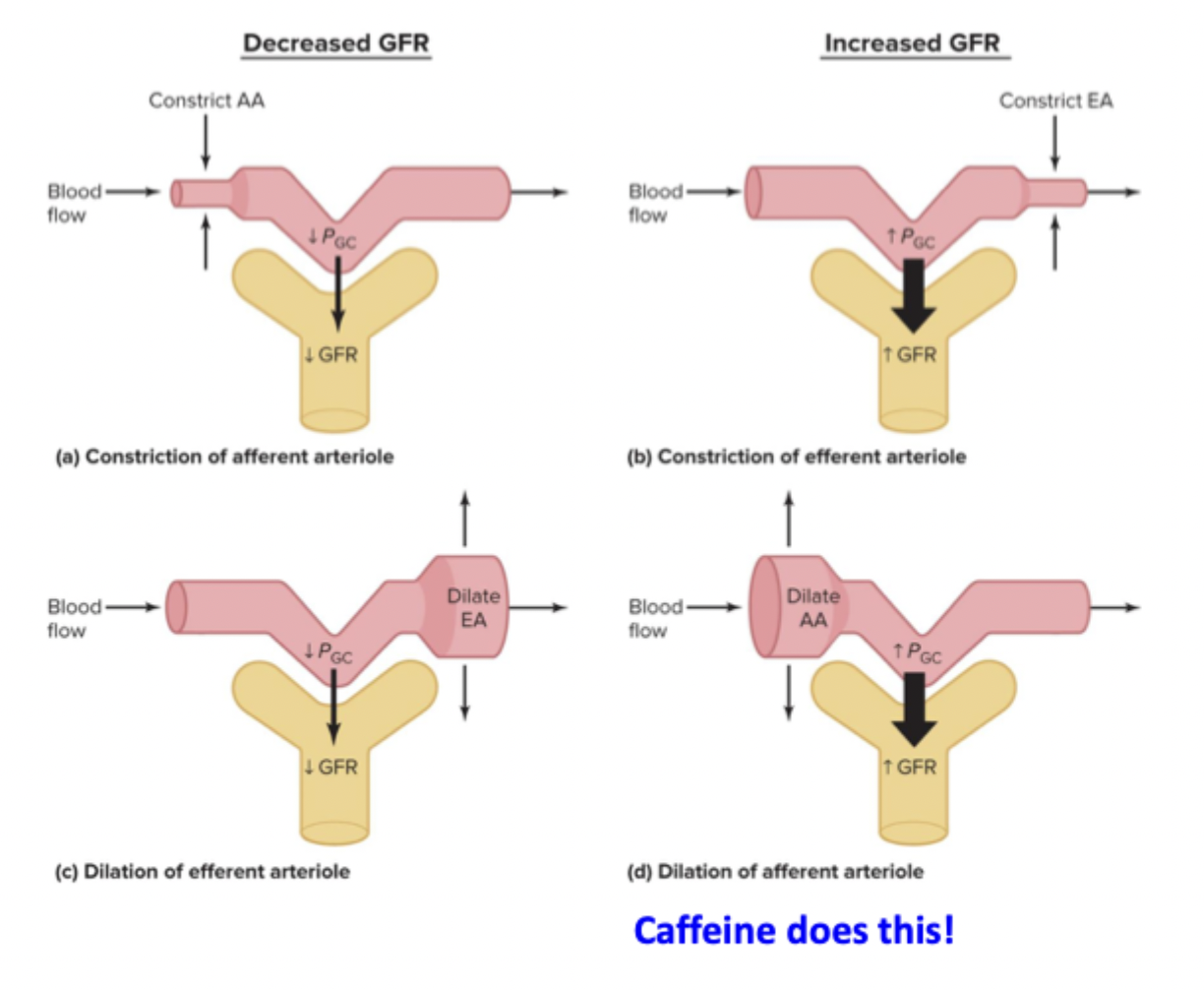
How do renal arterioles regulate PGC
Decreased GFR
Constricting afferent arteriole
Dilating efferent arteriole
Increased GFR
Constricting efferent arteriole
Dilated afferent arteriole
Net glomerular filtration pressure equation
= PGC - PBS - πGC
Filtered load equation
= GFR x [Ps] (plasma solute)
Excreted load equation
= V (urine flow rate) x [Us] (urine solute)
If filtered load > excreted load, there’s net ____. If filtered load < excreted load, there’s net ____
Reabsorption, secretion
What % of filtered volume is reabsorbed in tubular reabsorption
99
What are the modes of tubular reabsorption
Diffusion and mediated transport
What are the two routes of tubular reabsorption
Transcellular transport - through cell membranes to ISF
Paracellular transport - through tight junctions to ISF
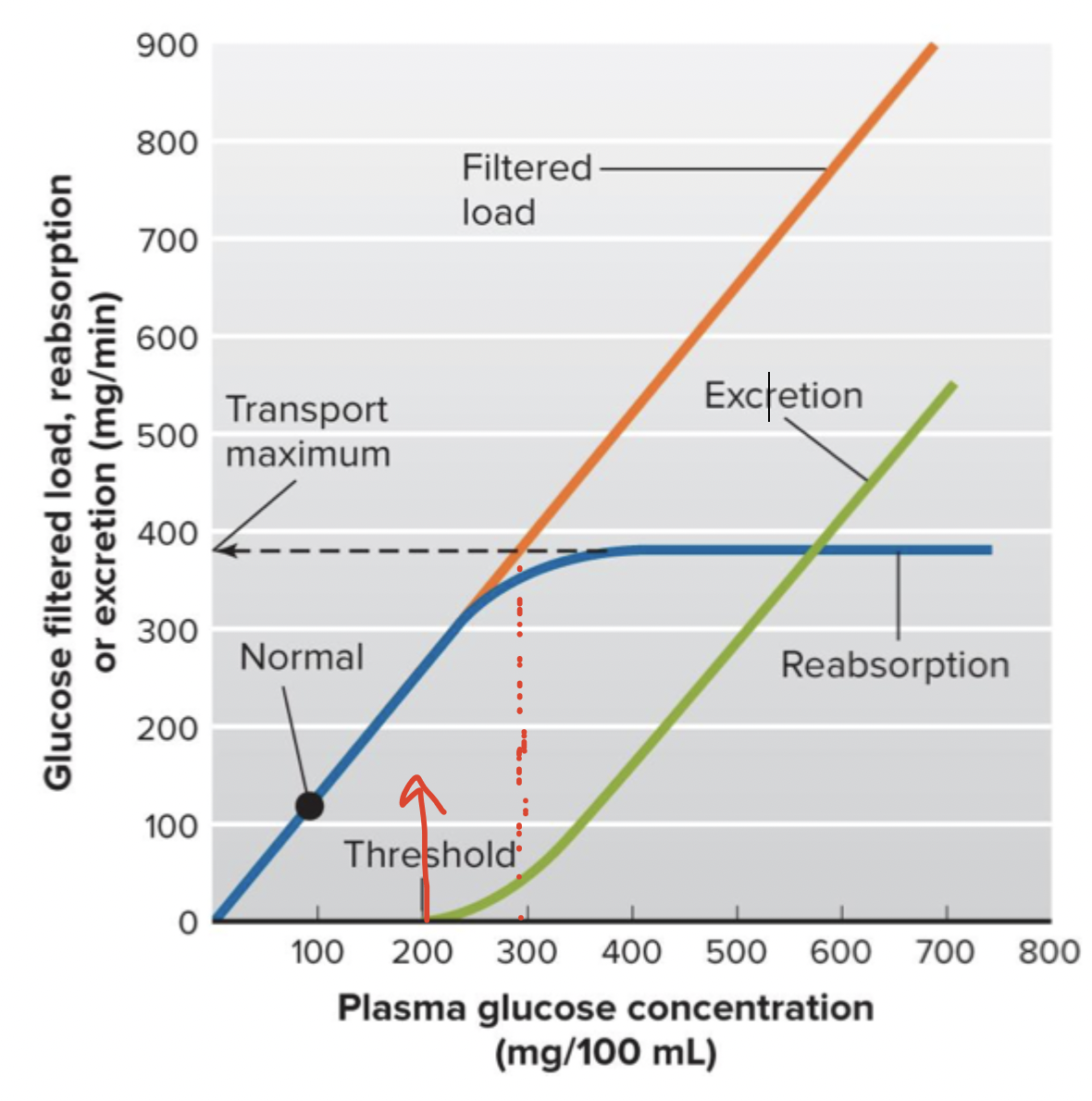
Explain the glucose concentration vs filtered load, reabsorption, excretion graph
Filtered load is normal, reabsorption keeps up with filtration at low plasma solute concentrations
Solute in urine with high plasma concentration will reabsorb but reach a transport maximum
Explain tubular secretion
Usually involves active transport but diffusion can occur
Occurs in proximal tubules
Also reaches a transport maximum
Define renal plasma clearance
The volume of plasma cleared of a specific substance per unit time. Higher RPC means the kidneys are removing more of that substance from the plasma
What does RPC tell us in relation to GRF
= GFR - everything filtered is secreted (ex. inulin)
< GFR - clearance is close to 0 mL, partially reabsorbed substances are filtered
> GFR - active secreted into tubule, almost everything is filtered
What muscles are involved in micturition. What’s their type and activity during filling and micturition
Detrusor - parasympathetic - inhibited - stimulated
Internal urethral sphincter - sympathetic - stimulated - inhibited
External urethral sphincter - somatic motor - stimulated inhibited
What are two main points about total-body balance of water
For homeostasis to be maintained, intake must equal output
Urine is the main regulator for intake to match output
What are the proportions of total-body fluid
NaCl prop ECF volume prop MAP
What are the typical values of volumes in the body
Plasma - 3L, ISF - 11L, ICF - 28L
What do osmoreceptors detect
ECF osmolarity and its changes due to pure gains in water
Water distributes itself equally across all membranes so most goes into cells
What do baroreceptors detect
Pressure changes in the ECF due to pure gains in NaCl
NaCl stays in ECF and needs pumps
How does water move across the three fluid compartments
After drinking water, there’s more H2O in the plasma → bulk flow to ISF → lower tonicity so water goes to ICF
How does NaCl move across the three fluid compartments
Add excess NaCl, greater osmolarity → net diffusion to ISF → NaCl stays in ISF, making it hypertonic → water moves from ICF to ISF → water leaving makes ECF greater in volume → more plasma volume and higher MAP
____ moves with sodium
Chloride ; to help maintain electroneutrality
Na+ and H2O are ____ filtered at the glomerulus and _____ reabsorbed with ____ secretion
Freely; mostly; no
What percentage of water and sodium is reabsorbed
99% each
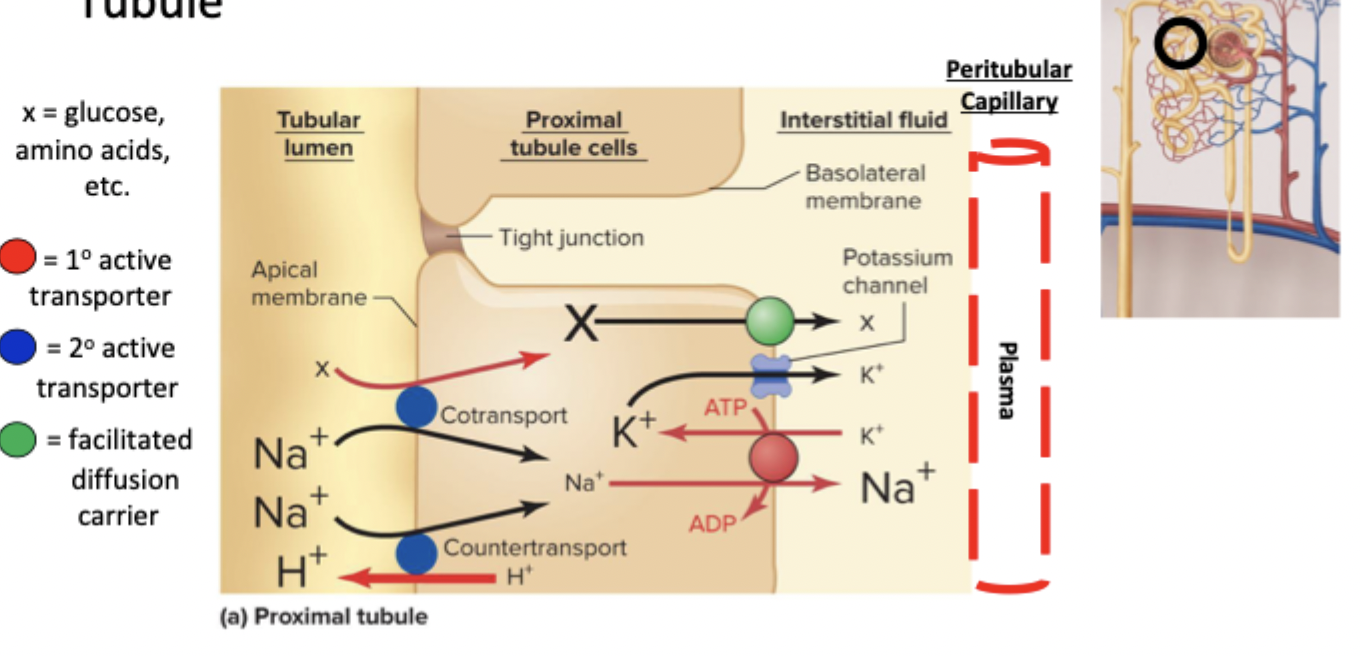
Describe the mechanism of Na+ reabsorption in the proximal tube
Na+ enters capillary via Na+/K+ ATPase, creates gradient
Na+ enters cell via cotransport with X or countertransport with H+
Basolateral needs X and K+ channels
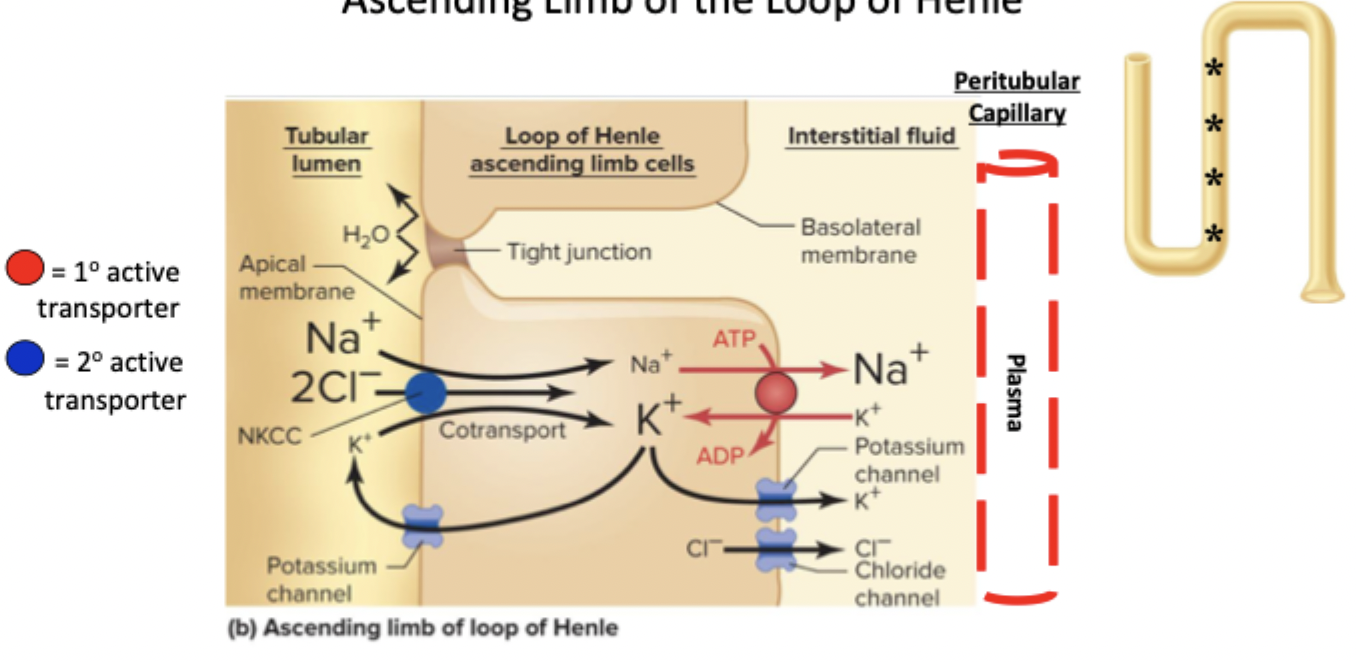
Describe the mechanism of Na+ reabsorption in the ascending limb of the loop of henle
Na+/K+ ATPase takes Na+ out to capillary, creates gradient
Na+ comes in through NKCC channel
Basolateral needs K+ and Cl- channels
Apical needs K+ channel
Describe the mechanism of Na+ reabsorption in the cortical collecting duct
Na+/K+ ATPase creates gradient
Na+ and K+ channels in the apical membrane
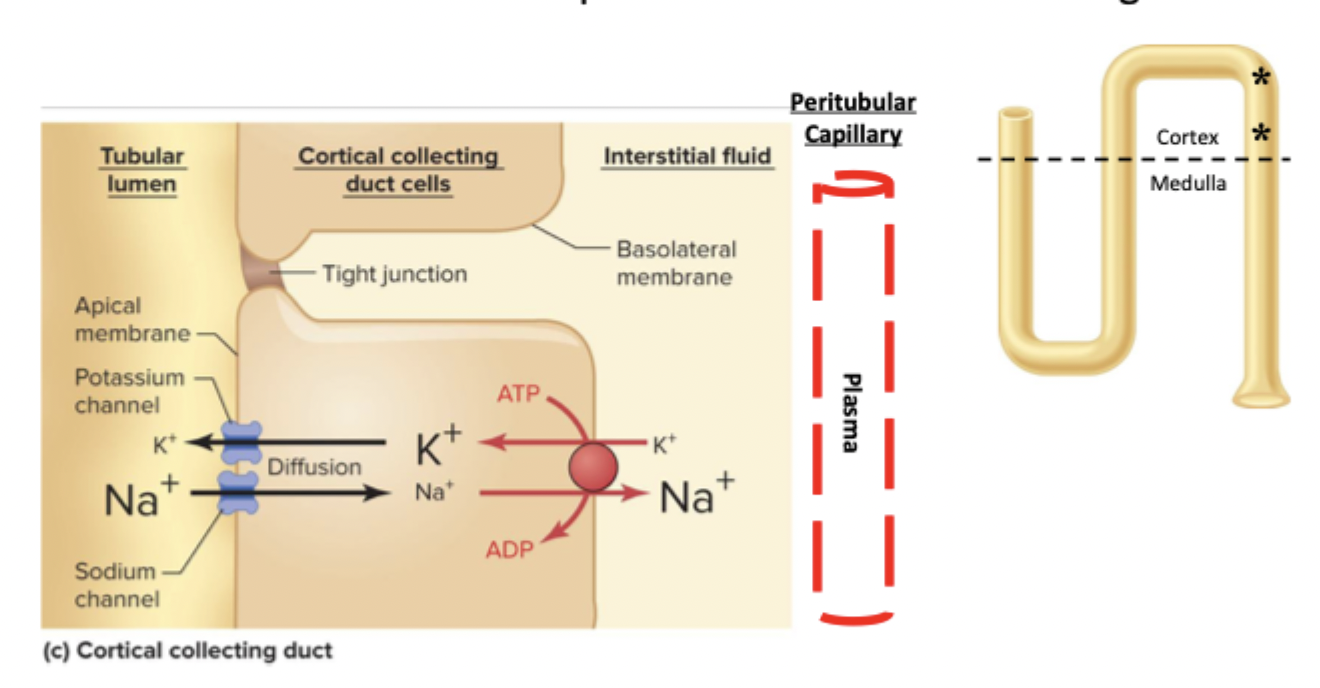
How much Na+ reabsorption occurs in each location and is it regulated
Proximal tubule - 65%, non regulated
Ascending limb - 25%, non regulated
Cortical collecting duct - 10%, regulated by aldosterone
Define aldosterone
A steroid hormone that builds more Na+ and K+ channels and Na+/K+ ATPases
What are the water route types and where do they occur
Paracellular - main water route in proximal tubule (65%)
Transcellular - main water route in collecting ducts where it requires aquaporins

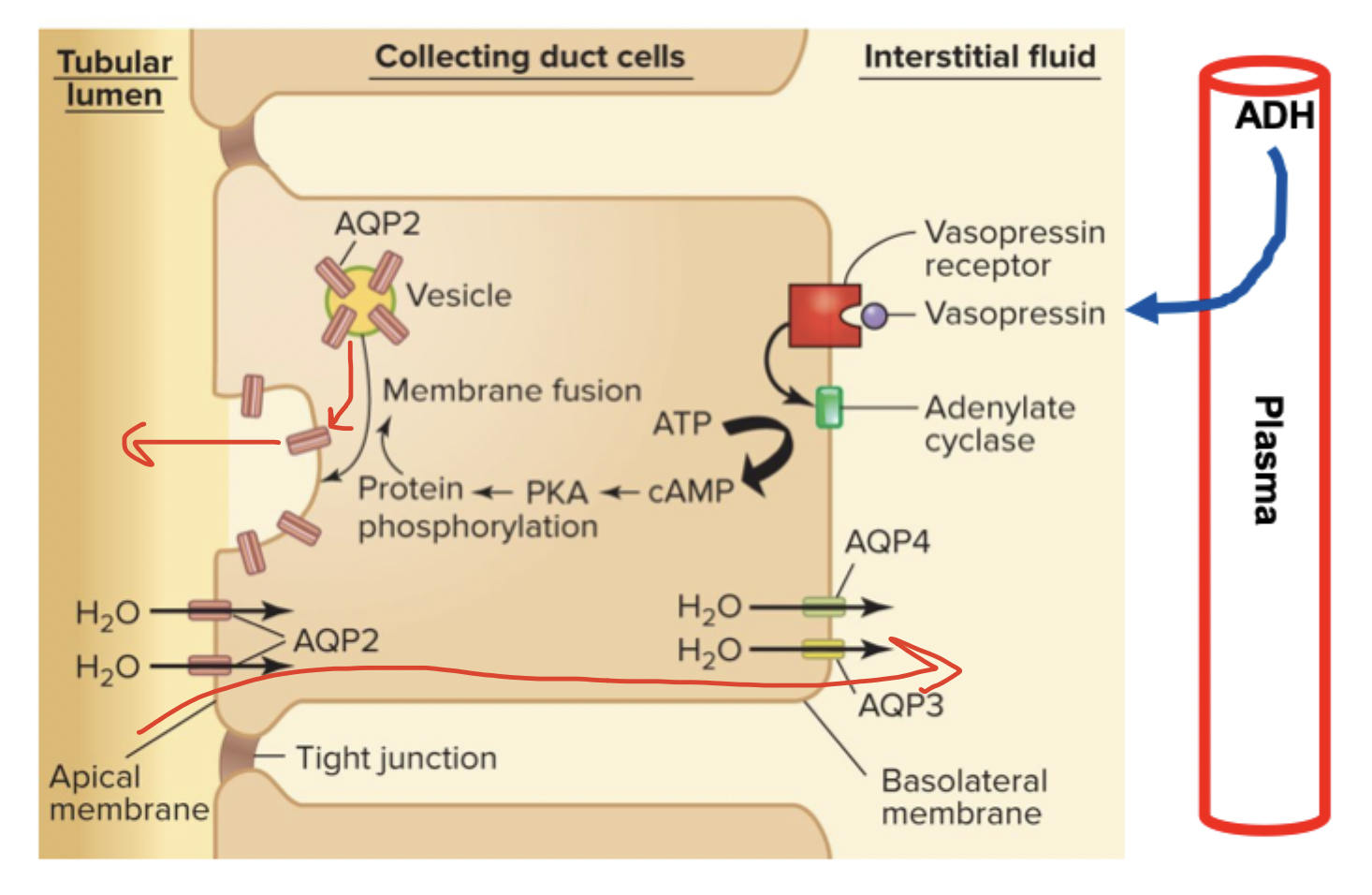
Define ADH
Vasopressin
Induces aquaporin insertion into apical membranes of collecting duct, increasing water reabsorption
Increases permeability of urea by activating urea transporters, regulates osmolarity
Explain ADH mechanism
ADH is secreted from plasma → binds to receptor on basolateral → signal cascade → AQP2 vesicle with aquaporins fuses to apical membrane → more water transport → higher water reabsoprtion
Define and explain the renal medullary gradient
A gradual increase in osmolarity of kidney tissue from cortex to inner medulla
Only juxtamedullary nephrons with long loops of Henle create the gradient
Created by countercurrent multiplier system and urea recycling
Vasa recta circulation maintains the gradient
Explain the concurrent multiplier system of juxtamedullary nephrons
Filtrate enters loop from proximal tubule →
Descending limb, permeable to water but not NaCl →
Bottom of loop equilibrates (is most osmotic) →
Ascending limb, impermeable to water and pumps NaCl via NKCC → flows out
Multiplier due to the increasing osmolarity as fluid goes down and then decreasing osmolarity as it goes up

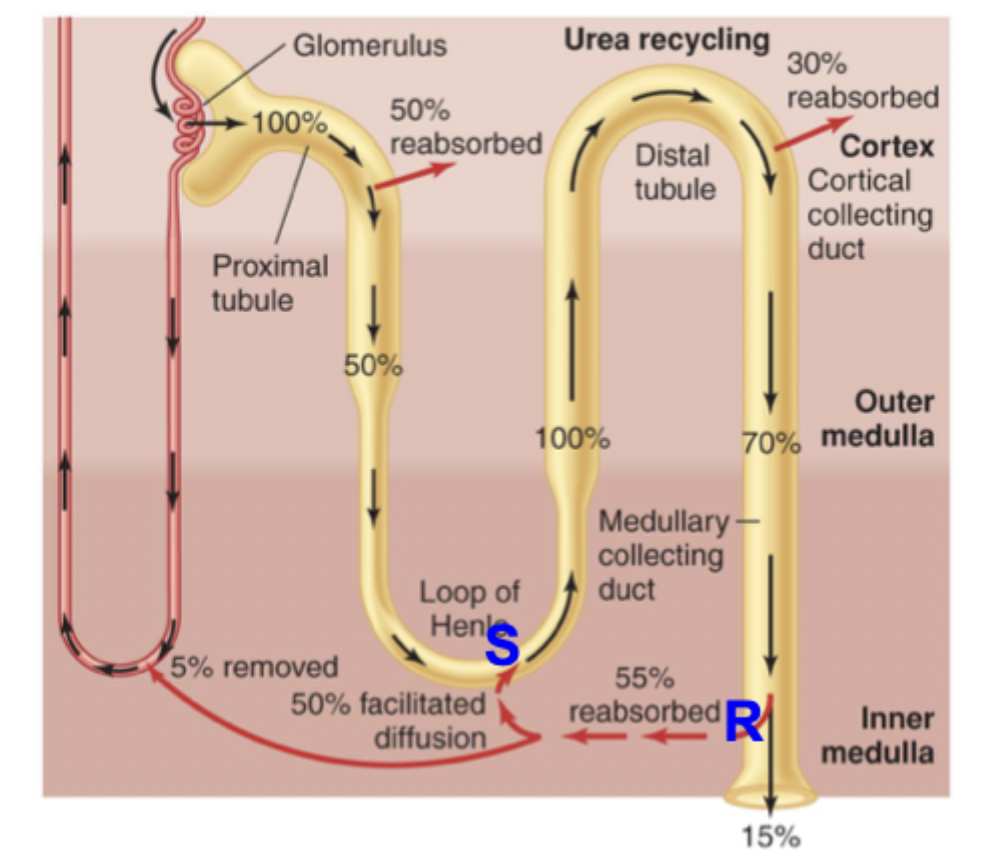
Explain urea recycling
Urea is filtered at glomerulus → water leaves in proximal tubule and descending limb, making urea more concentrated → filtrate reaches medullary collecting duct → ADH increases permeability of urea → accumulates in medulla → some diffuses into loop of henle → flows to duct again and recycles
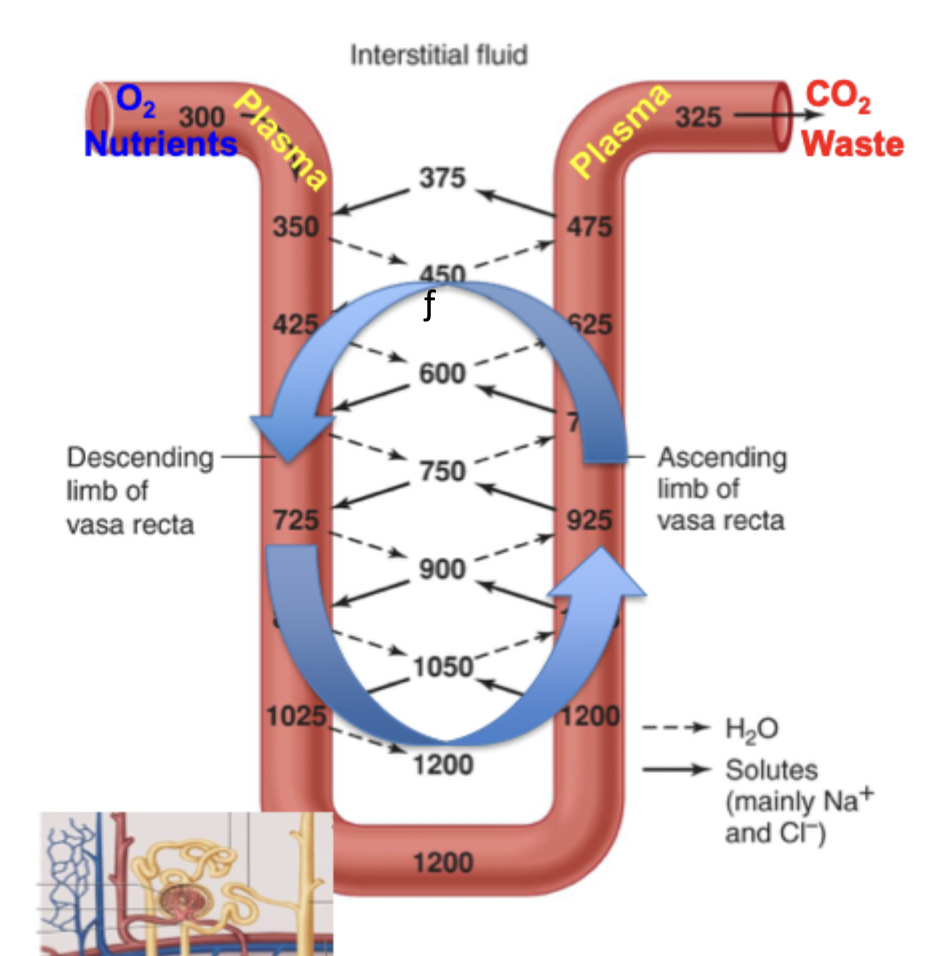
How does the vasa recta maintain the renal medullary gradient
Reabsorbs water and solutes to circulation without washing out gradient, exchanges between ascending and descending
Has extremely small blood flow
Describe the two ways of regulating renal sodium
Regulating the filtered load by changing GFR (less common, occurs with large MAP change)
Regulating the rate of reabsorption (more common, for both large MAP change and differences in ingestion)
Explain control of GFR to regulate renal sodium
A decrease in plasma volume lowers GFR, reducing H2O and Na+ excretion, kidneys want to retain it
Explain the RAAS control of renal sodium
When JG cells sense ↓ BP, ↓ fluid volume, ↑ B1 sympathetic → kidneys secrete renin, activating angiotensinogen into angiotensin I
ACE converted angiotensin I into angiotensin II which increases vasoconstriction and aldosterone release (more Na+ and H2O retention) → both increases blood pressure
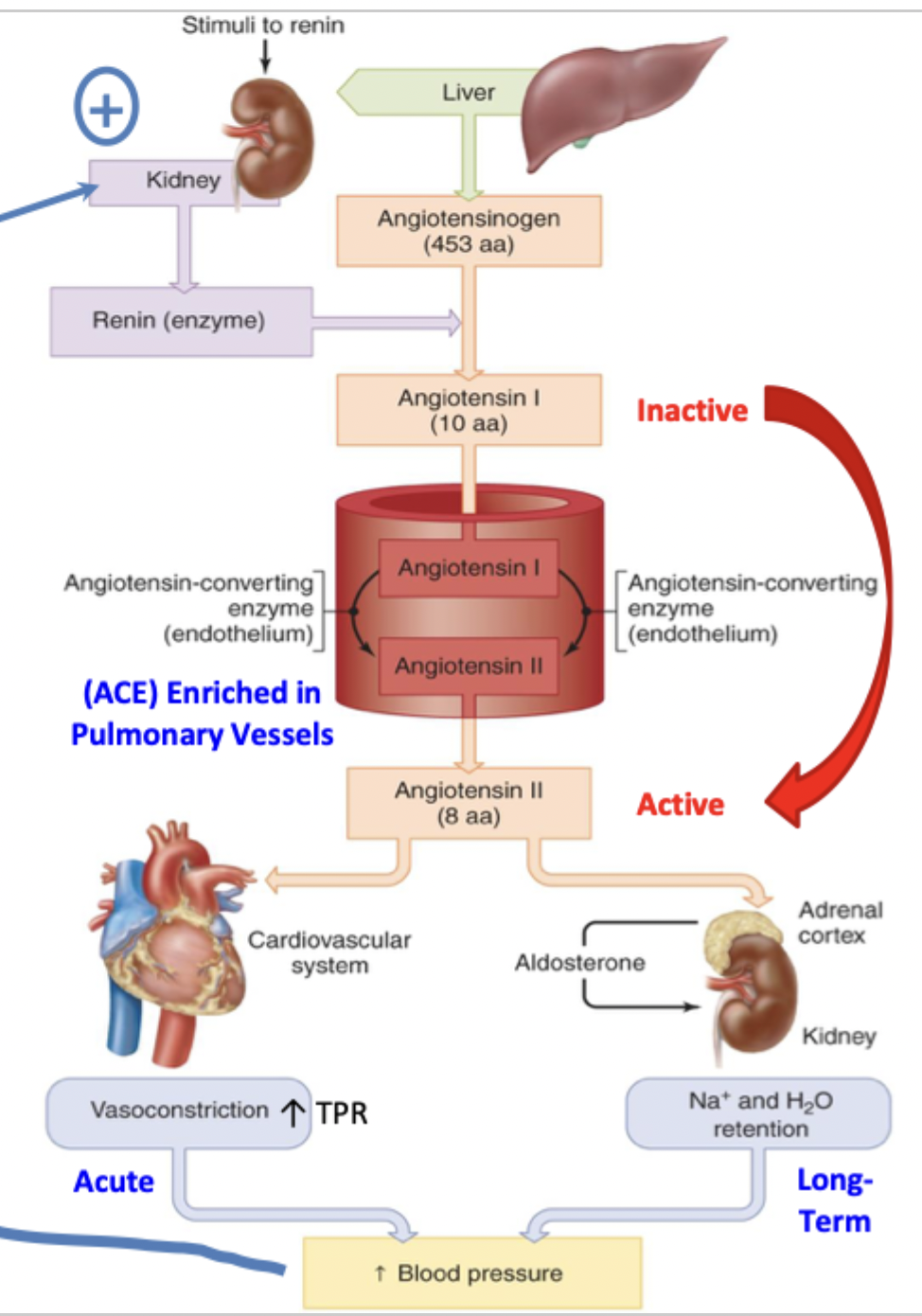
Explain common hypertension medications
ACE inhibitors - block conversion of angiotensin I → angiotensin II
Ang II blockers - blocks angiotensin II from binding to receptors, stops vasoconstriction
Aldosterone receptor blockers
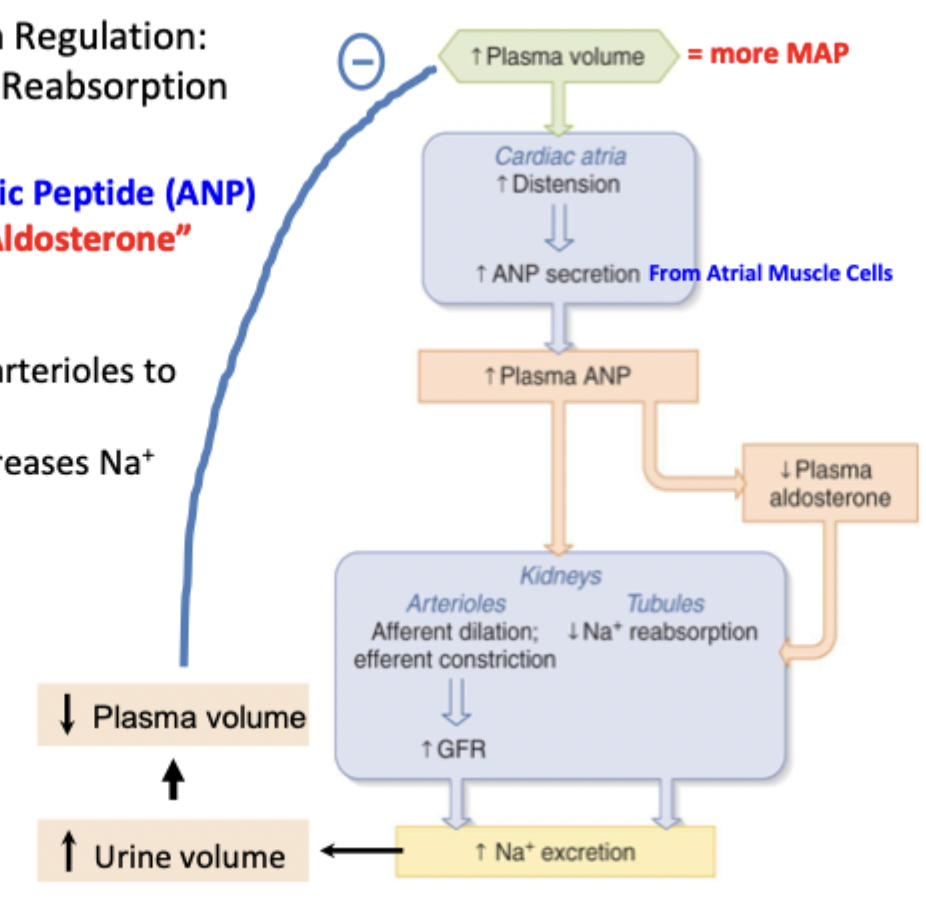
Define atrial natriuretic peptide (ANP)
Secreted when increases plasma volume and MAP causes distension of atria
The anti-aldosterone, alters arterioles to increase GFR and increase Na+ excretion
Explain osmoreceptor control of ADH when extra-hydrated vs dehydrated
Extra-hydrated - lower osmolarity → lower firing of osmoreceptors → less ADH → less permeability and H2O reabsorption → more H2O excretion
Dehydrated - higher osmolarity → higher firing of osmoreceptors → more ADH → more permeability and H2O reabsorption → less H2O excretion
Explain baroreceptor control of ADH (low plasma vol)
Low plasma volume → low blood vessel pressures → baroreceptors stretch and fire less → posterior pituitary releases ADH → increases H2O permeability and reabsorption → less H2O excretion

Define diabetes mellitus
Osmotic diuresis
Failure to reabsorb glucose → huge amount of glucose in urine causes H2O to be retained in urine due to osmotic following of glucose
Define diabetes insipidus
Water diuresis
Failure of posterior pituitary to release ADH or failure of kidney to respond to ADH → H2O permeability is low, increased water loss
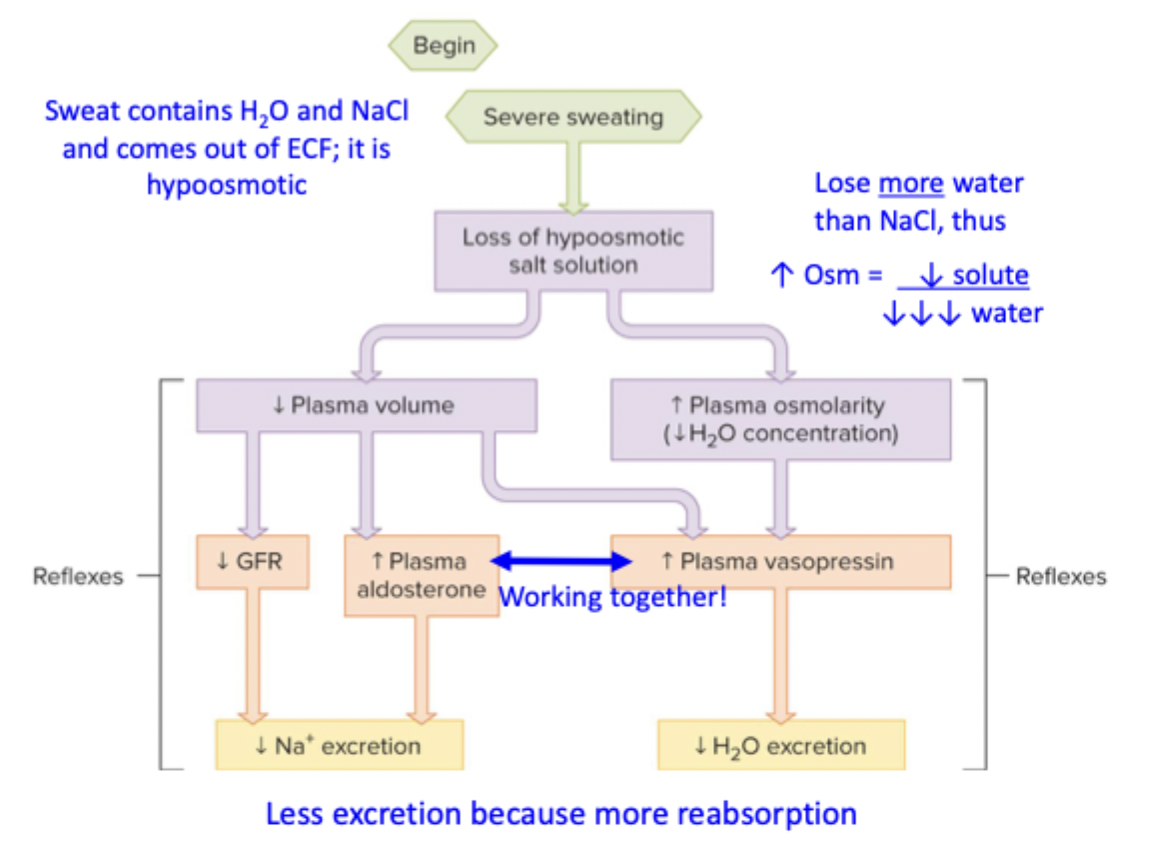
How does sweating affect excretion
Sweat contains H2O and NaCl and loses hypoosmotic salt solution
Lowers plasma volume → lowers Na+ excretion
Increases plasma osmolarity → increases ADH → less H2O excretion
What are some things that lead to thirst
Dry mouth/throat
Metering of water intake by GI tract
Increased plasma osmolarity
Decreased blood volume
How does caffeine and alcohol affect the renal system
Caffeine dilates afferent arterioles
Alcohol inhibits ADH secretion
Both cause the loss of more water
What are the intracellular and extracellular fluid [K+] controlled by + values
Intracellular - Na+/K+ ATPase (150 mM)
Extracellular - kidneys (5mM)
What are the ions that experience filtration, reabsorption, and secretion
K+ and Cl-
Describe reabsorption of K+ in the proximal tube
It is reabsorbed paracellarly by following H2O into the ISF and into the capillary
65% of K+ reabsorption occurs here
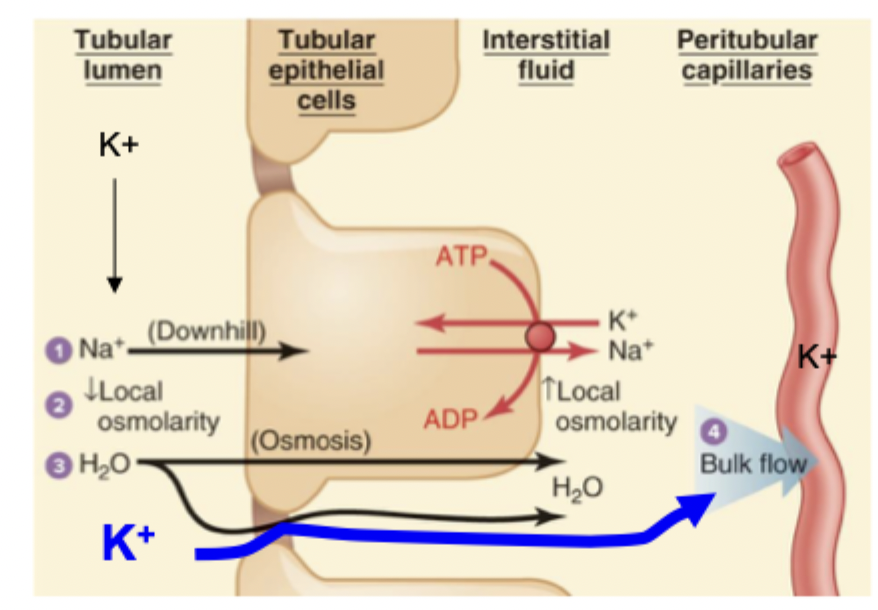
Describe reabsorption of K+ in the ascending loop of Henle
K+ is reabsorbed with the NKCC transporter. Cotransports in with the Cl- and goes through a leak channel into the capillary

Describe regulation of K+ in the coritcal collecting duct
There is K+ secretion as Na+/K+ ATPase is in the basolateral and apical membranes.
K+ follows a gradient from ISF → duct cells → tubular lumen
Regulated by aldosterone

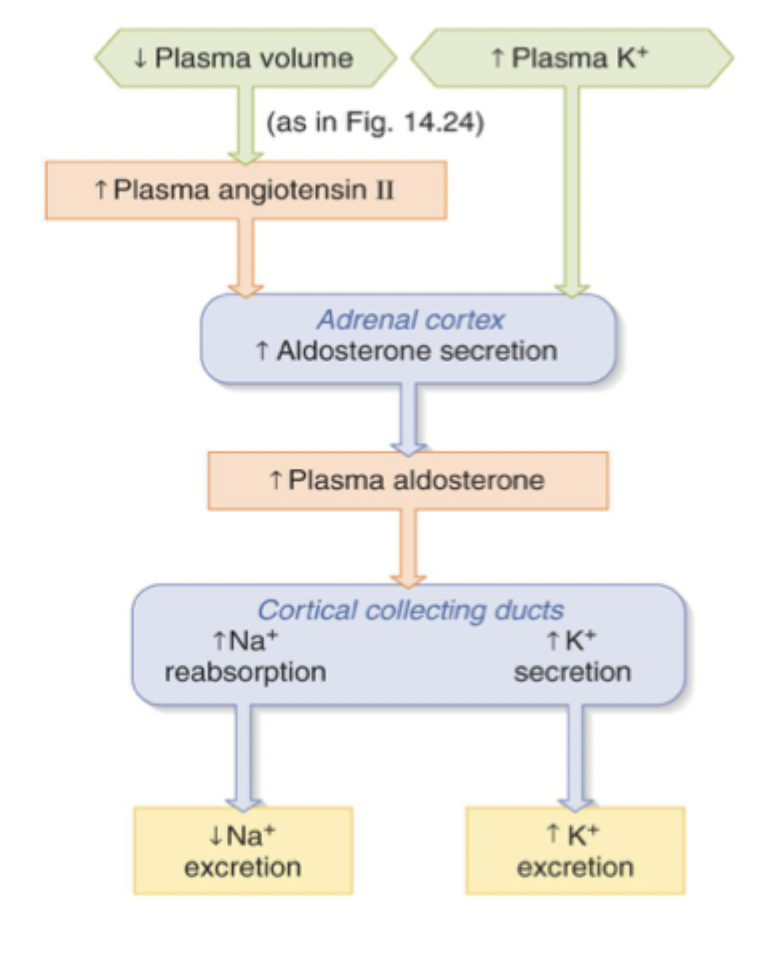
Summarize aldosterone control of Na+ and K+
Aldosterone increases due to…
↓ Plasma volume → ↑ angiotensin II
↑ Plasma K+
Then inserts more K+ and Na+ channels, allowing for Na+ reabsorption and K+ excretion
Summarize the functions of each part of the renal tubules
Glomerulus/Bowman’s capsule - filtration of plasma
Proximal tubule - bulk reabsorption, secretion of solutes
Loop of Henle - establishes medullary osmotic gradient
Descending - bulk reabsorption of water
Ascending - reabsorption of Na+ and Cl-
Cortical collecting duct - fine tuning of reabsorption/secretion
What is the normal pH in the body
7.4
How does respiration and the kidneys adjust pH
Respiration - rapidly adjusts pH by changing CO2 levels
Kidneys - slowly adjusts pH by changing bicarb levels
What are sources of hydrogen ion gain?
From CO2
Catabolism of organic molecules
Loss of bicarb in diarrhea or urine
What are sources of hydrogen ion loss?
Anabolism of organic anions
Loss of H+ in vomit (stomach acid = HCl)
Loss in urine
Hyperventilation
How much bicarbonate is reabsorbed at rest
100%
Explain how bicarb is reabsorbed in the proximal convoluted tubule
H2O + CO2 makes bicarb + H+
Bicarb → capillary
H+ → lumen → combines with a filtered bicarb in lumen to make H2O and CO2 → that CO2 can go back into the cell to start over process

How do you make more bicarb using HPO42-
H2O + CO2 makes bicarb + H+
Bicarb → capillary
H+ → lumen → combines with filtered HPO42- → H2PO4- → excreted
Simultaneously removes acidity and creates more buffer in capillary

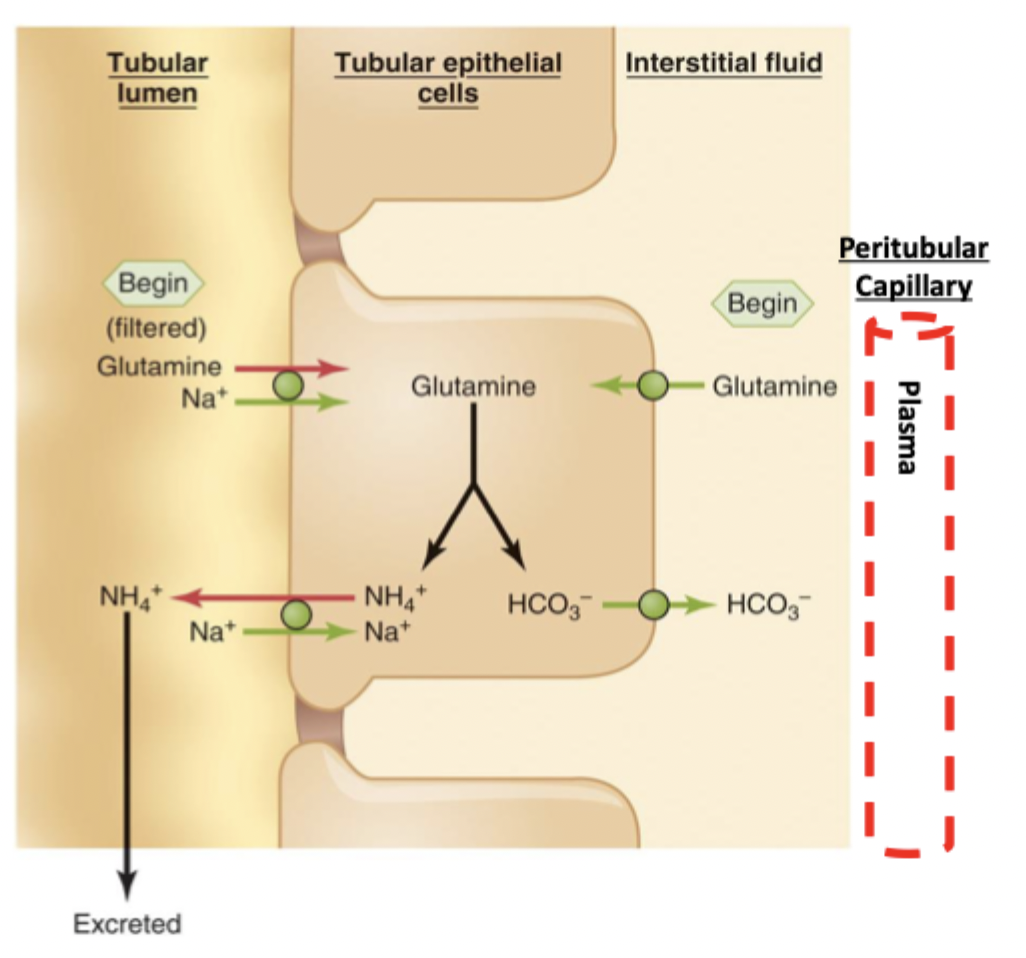
How do you make new bicarb with glutamine and ammonium
Glutamine enters cell either from
Capillary
Filtered in through lumen, cotransports with Na
→ breaks down into NH4+ and bicarb → bicarb goes to capillary → NH4- goes out, Na+ goes in via countertransporter → NH4+ is excreted
Removes acid (NH4+)
Describe cause, result, and compensation of respiratory acidosis
Cause: ↑ CO2 (hypoventilation)
Result: ↑ H+
Compensation: renal makes ↑ bicarb
Describe cause, result, and compensation of respiratory alkalosis
Cause: ↓ CO2 (hyperventilation)
Result: ↓ H+
Compensation: renal makes ↓ bicarb (excretes)
Describe cause, result, and compensation of metabolic acidosis
Cause: ↑ H+ (from more lactic acid or loss of bicarb in diarrhea)
Result: ↓ bicarb
Compensation: more ventilation to ↓ CO2
Describe cause, result, and compensation of metabolic alkalosis
Cause: ↓ H+ (vomiting)
Result: ↑ bicarb
Compensation: less ventilation to ↑ CO2