Chapter 2 - Water, Weak Bonds, and the Generation of Order Out of Chaos
 Call Kai
 Learn
Learn Practice Test
 Spaced Repetition
 Match
Match Flashcards
 Knowt Play
1/72

There's no tags or description
Looks like no tags are added yet.
Name | Mastery | Learn | Test | Matching | Spaced | Call with Kai | Chat |
|---|
No analytics yet
Send a link to your students to track their progress
73 Terms
What is Brownian motion?
The movement of molecules powered by random fluctuations of environmental energy
- Initiates many biochemical interactions
What is a water molecule made up of?
Two hydrogen atoms covalently bound to an oxygen atom
- Electrons are not shared equally
- Oxygen atoms have 8 protons and hydrogen atoms have 1 each
- Having more protons makes the oxygen atom attract electrons more strongly
- Oxygen end of the molecule becomes slightly negative and the hydrogen end becomes slightly positive

What makes a covalently bonded molecule polar?
Having a slight potential charge
- Slightly charged regions can attract other polar or charged molecules
How do water bonds associate?
Via weak hydrogen bonds (weak electrostatic attractions)
What effect does the polarity of a water molecule have?
- Allows formation of hydrogen bonds between water molecules
- Accounts for the cohesiveness of water
- Accounts for the ability to dissolve many important biochemicals
What makes a molecule polar?
Unequal sharing of electrons and asymmetry preventing charges from canceling out
What makes a molecule nonpolar?
Equal sharing of electrons
What makes a molecule amphipathic?
Molecules that have both hydrophobic and hydrophilic regions, such as phospholipids
What are electrostatic interactions?
Interactions between distinct electrical charges on atoms
What equation defines the energy of electrostatic interaction between two charges?
Coulomb's Law: E = k*q1*q2 / Dr
q1 & q2: charges on the ions
D: dielectric constant
- 1 in a vacuum and 80 in water
- Water weakens electrostatic interactions
r: distance between two ions
k: proportionality constant
Why does water weaken electrostatic interactions?
Has a very high dielectric constant, allowing it to act as an effective electrical insulator between particles, reducing the electrostatic force
When can hydrogen bonds occur?
Whenever hydrogen is covalently bonded to an electronegative atom
How many hydrogen bonds does each H2O molecule form in liquid?
An average of 3.4 other molecules
How many hydrogen bonds do H2O molecules form in solids?
4 hydrogen bonds
What is a dipole?
The separation of partial positive and negative electrical charges between two bonded atoms due to unequal electron sharing
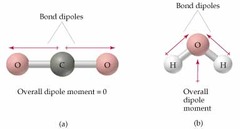
What are van der Waals interactions/London dispersion forces?
Distance-dependent weak attractions and repulsions between transient dipoles
- Transient asymmetry in the electron distribution of one molecule will induce complementary asymmetry in a nearby molecule
What is van der Waals radius?
The measure of how close an atom will allow another to approach
When does the energy of a van der Waals reaction rise?
When electron-electron repulsion occurs as a result of atoms moving closer together at the van der Waals contact distance
How do hydrogen bonds aid in DNA metabolism?
- They are weak enough to be broken by the enzymes of DNA metabolism, thereby allowing access to genetic information
- Hydrogen bonds between Adenine and Thymine and between Guanine and Cytosine base pairs stabilize the DNA double helix
What does it mean if a substance is hydrophilic?
- Can dissolve in water
- Polar molecules and particles with positive or negative charges are hydrophilic
- Water can adhere to it
What does it mean if a substance is hydrophobic?
- Does not have negative or positive charges and is nonpolar
- All lipids are hydrophobic
- Dissolve in other solvents
What is the hydrophobic effect?
- The exclusion of nonpolar substances/hydrophobic substances from an aqueous solution
- Nonpolar molecules aggregate to avoid contact with hydrophilic molecules, particularly water
- Inability of water to dissolve nonpolar molecules
- Molecules cluster together
- Polar regions arrange to maximize interactions with each other and the solvent
What drives the hydrophobic effect?
The increase in the entropy of water that results when hydrophobic molecules come together
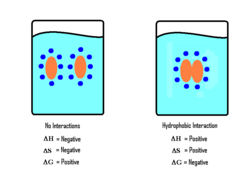
What is entropy?
The measure of unusable energy, disorder, or randomness
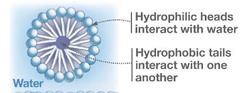
What is an amphipathic molecule?
Molecule with both hydrophilic and hydrophobic regions
- Ex. phospholipids
How do polar, hydrophilic regions react with H2O?
Favorably reacts and tends to dissolve
How do nonpolar, hydrophobic regions react with H2O?
Tends to avoid contact and cluster together
What are micelles?
Thermodynamically stable structures of amphipathic compounds in water
What are functional groups?
Arrays of atoms that have distinctive chemical properties
Aromatic functional group

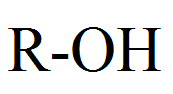
Hydroxyl
Aldehyde

Ketones

Carboxylic acid

Amine

Organic phosphate
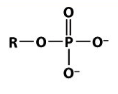
Thiols

What is pH?
The measure of H+ (hydrogen ion) concentration of a solution
What is the equilibrium constant for the dissociation of water?
Keq
Keq = [H+][OH-]/[H2O]
What is the ion product of water constant?
Kw
Kw = Keq x [H2O]
Can be simplified to --> Kw = [H+][OH-]
What is the equation for defining the pH of any solution?
pH = log10(1/[H+]) = -log10[H+]
What do acids ionize to form?
A proton and a base
What is a conjugate base? [A-]
A base formed by removing a proton (H+)/ionization of an acid
What is a base?
A proton acceptor or substance that reduces the hydrogen ion [H+] concentration of a solution
What is a conjugate acid? [HA]
An acid is formed when a base accepts/binds a proton
What is an acid?
A proton donor or substance that increases
hydrogen ion concentration in a solution
What does ionization equilibrium look like for a weak acid?
HA ->
What is the equilibrium constant for the ionization equilibrium reaction?
Ka = [H+][A-]/[HA]
What does a larger Ka equate to?
A strong acid
What does a low Ka equate to?
A weak acid
What is the pKa of an acid?
The pH at which the acid is half dissociated and thus has the best buffering capacity
log(1/Ka)
What is the equation for finding pKa?
pKa = log 1/Ka = -log Ka
What is the Henderson-Hasselbalch equation?
Describes the shape of the titration curve of any weak acid
pH = pKa + log [A-]/[HA]
What does a low pKa value mean?
Stronger acid and stronger tendency to dissociate a proton
When does pH equal pKa?
When [A-] = [HA], log [A-]/[HA] equals 0 and pH = pKa
When does [A-] predominate?
When pH > pKa
When does [HA] predominate?
When pH < pKa
What is a buffer?
A substance that minimizes/resists changes in pH when small amount of H+ (acid) or OH- (base) are added
- Consists of a weak acid (proton donor) and its conjugate acid (proton acceptor)
When is a buffer most effective?
At a pH near its pKa
What is buffer capacity?
The amount of acid or base that can be added to a buffer solution before undergoing a significant change in pH
What is a conjugate acid-base pair?
Two species that differ by one proton
- One proton acceptor and one proton donor
- Resists changes in the pH of a solution, acting as a buffer
What is a tendency of a strong acid?
Losing its proton
What is a titration curve?
A graph that shows how pH changes when an acid or base is added to a solution
- Plot of pH against the amount of NaOH (strong base) added
Why is the maintenance of intracellular pH vital to all cells?
- Solubility of polar molecules depends on H-bond donors and acceptors
- Equilibrium between CO2 gas and dissolved HCO3- depends on pH
- Enzyme-catalyzed reactions have optimal pH
What does in vivo mean?
In the living body
What does in vitro mean?
Outside the body; in a test tube
What are buffer systems in vivo based on?
- Phosphate, PO4^3- (concentration in millimolar range)
- Bicarbonate, HCO3- (important for blood plasma)
- Histidine, C6H9N3O2 (efficient buffer at neutral pH)
What are buffer systems in vitro based on?
Sulfonic acids of cyclic amines
-HEPES
-PIPES
-CHES
What does blood plasma transport?
- Carbon dioxide from the organs to the lungs
- Soluble products of digestion from the small intestine to other organs
- Urea from the liver to the kidneys
- Water (95%)
What is glucose?
- Polar molecule so it is very soluble
- Transported by blood plasma
- Major respiratory substrate that is readily broken down in respiration, and the energy released is used to make ATP
What is oxygen? Characteristics?
- A non-polar molecule
- Soluble in water
- Can saturate water at relatively low concentrations
- Solubility decreases as temperature increases
- Little oxygen can be carried by blood plasma at body temp (37°C)
- Majority of oxygen is carried by hemoglobin in RBC
- Has 4 binding sites on hemoglobin
What percent of the body is made up of water?
60-70%
How does water act as a coolant?
- Removal of water in the form of perspiration helps cool down the body, excess heat energy is removed from the body
- Since water makes up 60-70% of the body, cooler blood from some parts of the body can be circulated to other parts to cool them down