INTRODUCTION OF PATHOPHYSIOLOGY
 Call Kai
 Learn
Learn Practice Test
 Spaced Repetition
 Match
Match Flashcards
 Knowt Play
1/75

There's no tags or description
Looks like no tags are added yet.
Name | Mastery | Learn | Test | Matching | Spaced | Call with Kai | Chat |
|---|
No analytics yet
Send a link to your students to track their progress
76 Terms
WHAT IS PATHOPHYSIOLOGY?
•Pathophysiology involves the study of
anatomy or physiologic changes in the body
that result from disease processes.
•As a disease develops, the changes in the normal
anatomy and/or physiology of the body
may be obvious or maybe hidden, occurring at the
cellular level.
What is Homeostasis?
:
•The maintenance of a relatively stable
internal environment regardless of external
changes.
Explain a negative feedback loop
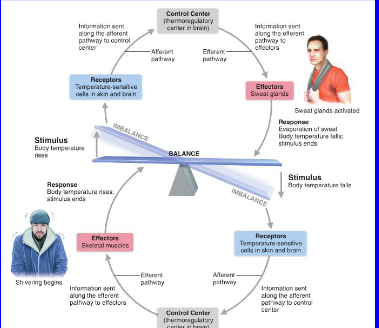
What impacts “normal” limits?
body temp, blood pressure…
Normal limits are represented by____
BP:
HR:
RR:
TEMP:
RANGE
120/80
60-100bpm
12-20
97.8-99
What are the locations for checking temps?
Oral, rectal, axillary, temporal and frontal
____ is the primary focus in health care
Prevention
What is used to develop more effective preventive programs?
Know causes of conditions and disease along with predisposing.
What are some examples of prevention in healthcare?
Routine vaccination programs
Screening programs
community health programs
Health research had lead to new____
therapies
What are the 3 stages of health research?
Basic science
Small number of human subjects
Large number of patients
Further explain:
Basic science
Small number of human subjects
Large number of patients
RESEARCHERS WORK TO
IDENTIFY A TECHNOLOGY THAT WILL WORK TO
LIMIT OR PREVENT THE DISEASE PROCESS
•CARRIED OUT IN A LAB – REQUIRES CELL cultures
AND/OR ANIMALS
TO DETERMINE IF THERAPY IS SAFE FOR HUMANS
LARGE NUMBER OF PATIENTS WITH THE DISEASE OR
at risk ARE ENROLLED IN A CLINICAL TRIAL
What is a double blind study?
•RESEARCH SUBJECT AND THE PERSON ADMINISTERING THE
TREATMENT DO NOT KNOW IF THE SUBJECT IS RECEIVING A PROVEN TREATMENT OR PLACEBO
IF IT MAKES IT TO THE 3 RD STAGE AND
RESULTS ARE POSITIVE (PATIENTS
ARE REACTING THE WAY THEY
SHOULD), THEN WHAT IS THE NEXT
STEP?
“EVIDENCE-BASED RESEARCH FINDINGS”
what is a “EVIDENCE-BASED RESEARCH FINDINGS” ?
ALL DATA/RESEARCH IS COLLECTED AND PASSED ON
TO A regulatory body SUCH AS FOOD AND
DRUG ADMINISTRATION
•THEY THEN DECIDE THE WHAT HAPPENS WITH THIS
THERAPY
What is the ANTIRETROVIRAL?
the first ANTIRETROVIRAL agent
working against or targeted against
retroviruses , especially HIV
What is a retrovirus?
A virus that is composed not of DNA but of RNA. Retroviruses have an enzyme, called reverse transcriptase , that gives them the unique property of transcribing their RNA into DNA after entering a cell. The retroviral DNA can then integrate into the chromosomal DNA of the host cell, to be expressed there. HIV is a retrovirus
How many stages did AZT under go?
3 stages.
When AZT was being tested, why did they use the drug?
THOSE IN THE TRIAL THAT WERE TAKING AZT WERE
outliving THE GROUP THAT WAS NOT TAKING THE
DRUG
THEY THEN OFFERED THE DRUG TO BOTH GROUPS
what is gross anatomy (and cellular and microscopic level)?
A DISEASE OR ABNORMAL CONDITION USUALLY
INVOLVES CHANGES AT THE ORGAN OR SYSTEM ….
What is a Biopsy?
EXCISION OF VERY SMALL AMOUNTS OF living TISSUE
What is a autopsy?
surgical SPECIMENS OR
EXAMINATION AFTER DEATH
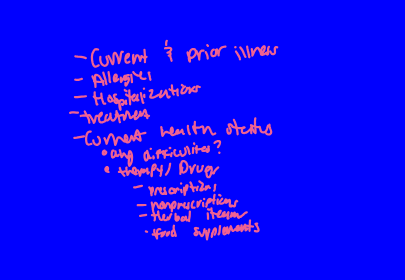
What are some medical history question to ask a patient?
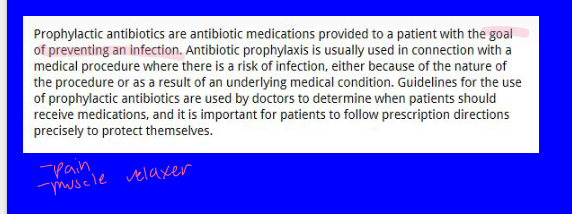
What is PROPHYLACTIC MEDICATION?
USED TO PREVENT
INFECTION OR EXCESSIVE BLEEDING
What is a symptom?
SUBJECTIVE EVIDENCE OF A DISEASE/
CONDITION
•only the patient can perceive them.
What is a sign?
OBJECTIVE EVIDENCE OF DISEASE/ CONDITION
•apparent to the patient, physical and others
What is a diagnosis?
THE IDENTIFICATION OF A SPECIFIC DISEASE
THROUGH EVALUATION OF signs AND
SYMPTOMS, laboratory tests
•USUALLY NEED MORE THAN 1 TO VERIFY A
DIAGNOSIS
What is etiology?
CONCERNS THE CAUSATIVE FACTORS IN A PARTICULAR DISEASE (what caused the disease?)
What are some etiology factors?
• congential DEFECTS
• INHERITED/GENETIC DISORDERS
• MICROORGANISMS (VIRUSES/BACTERIA)
• IMMUNOLOGICAL DYSFUNCTION
• degenerative CHANGES
• MALIGNANCY
• BURNS
What does idiopathic mean?
•WHEN THE CAUSE OF A DISEASE IS UNKNOWN
What does iatrogenic mean?
•THE TERM USED WHEN A treatment, A PROCEDURE, OR
AN error MAY CAUSE A DISEASE
What are PREDISPOSING FACTORS?
•TENDENCIES THAT PROMOTE DEVELOPMENT OF A
DISEASE IN AN INDIVIDUAL
•INDICATES A HIGH RISK FOR A DISEASE
•SPECIFIC PREDISPOSING FACTORS:
EX: asbestos( causes lung cancer)
What is pathogenesis?
DEVELOPMENT OF A DISEASE OR THE SEQUENCE OF
EVENTS INVOLVED IN THE TISSUE CHANGES RELATED
TO THE SPECIFIC DISEASE PROCESS
What does onset mean?
•first appearance of the sign and symptoms an
illness appear quick
What does acute mean?
SHORT-TERM ILLNESS THAT DEVELOPS QUICKLY
• MARKED SIGNS – MAYBE HIGH FEVER OR SEVERE PAIN
What does chronic mean?
•A MILDER DISEASE CONDITION DEVELOPING
gradually
PERSISTS A LONG TIME
•CAUSES MORE permanent TISSUE
DAMAGE
What is a lesion?
A SPECIFIC LOCAL CHANGE IN THE TISSUE
•EXAMPLES:
• LIVER CELLS CHANGE WHEN VIEWED FOR PATHOLOGIC CHANGES
• A blister/pimple IS OBSERVED ON THE SKIN
What is a syndrome?
A COLLECTION OF SIGNS AND SYMPTOMS, OFTEN
Affecting MORE THAN 1 organ
DOWN’S SYNDROME
• congenital heart defects
• Respiratory problems
• hearing problems
• Alzheimer's disease
• childhood leukemia
• Epilepsy
• thyroid conditions
DIAGNOSTIC TEST
What is the purpose of laboratory tests?
THAT ASSIST IN THE
diagnosis AND/OR MONITORING OF A SPECIFIC
DISEASE
What is remission?
THE MANIFESTATIONS OF THE DISEASE subside
What is Exacerbation
signs increase
What is a PRECIPITATING FACTOR?
A CONDITION THAT TRIGGERS AN acute episode
What is a complications?
NEW secondary OR ADDITIONAL PROBLEMS THAT
ARISE AFTER THE ORIGINAL DISEASE BEGINS
•EXAMPLE – AFTER DEALING WITH CHRONIC
CONSTIPATION/IMPACTED COLON THE PATIENT
DEVELOPS A colonic perforation
What are the purpose of therapy or therapeutic interventions?
TREATMENT MEASURES (SURGERY, DRUGS,
PHYSIOTHERAPY, ETC...) USED TO PROMOTE
recovery OR SLOW PROGRESS OF A DISEASE
What is a PROGNOSIS?
THE probability FOR RECOVERY OR OTHER OUTCOMES
BASED ON
• AVERAGE OUTCOMES
• SIZE OF CLINICAL GROUP
What is MORBIDITY?
Disease RATES WITHIN A GROUP
•THE INCIDENCE OF A DISEASE – SUCH AS THE
NUMBER OF STROKE PATIENTS HAVE BEEN
DECLINING OVER THE PAST 5 YEARS
What dose mortality mean?
RELATIVE NUMBER OF DEATHS RESULTING FROM A
PARTICULAR DISEASE
What is EPIDEMIOLOGY?
THE SCIENCE OF tracking THE PATTERN
OR OCCURRENCE OF DISEASE
INCLUDES:
•DATA ON transmission
•Distribution OF DISEASE
•ENVIRONMENTALLY RELATED DISEASES
What is a Epidemic?
A HIGHER THAN EXPECTED NUMBER OF CASES OF AN
infectious DISEASE WITHIN A GIVEN AREA
What is pandemic>
INVOLVES A HIGHER NUMBER OF CASES IN MANY REGIONS OF THE GLOBE
What is INCIDENCE?
•INDICATES THE NUMBER OF NEW CASES IN A GIVEN
population NOTED WITHIN A STATED TIME PERIOD
What is PREVALENCE?
THE NUBMER OF NEW AND OLD OR EXISTING CASES WITHIN
A SPECIFIC POPULATION AND TIME PERIOD
Communicable diseases are…..
•infections THAT CAN BE SPREAD FROM 1
PERSON TO ANOTHER
•NEEDS TO BE REPORTED TO HEALTH AUTHORITIES
What is atrophy?
Shrinkage in the size of the cell by the loss of
cell substance. When a sufficient number of
cells is involved, the entire tissue or organ
diminshies in size. Cells are not
dead.
What is atrophy?
1- Decreased workload (e.g., immobilization of a
fractured limb to permit healing)
2- Loss of innervation
3- Diminished blood supply
4- Inadequate nutrition
5- Loss of endocrine stimulation
stimulation
6- Aging.
What is hypertrophy?
Hypertrophy is an increase in the size of cells
and consequently an increase in the size of the
organ.
•Hypertrophy can be caused by additional tissue in the tissue
Hypertrophy and hyperplasia (increased
number of cells) can also occur together, and obviously
both result in an enlarged (hypertrophic) organ
what is hyperplasia?
Hyperplasia constitutes an increase in the
number of cells in an organ or tissue.
•Hyperplasia could be pre-canancerus.
What is a metaplasia?
When 1 mature cell type is replaced by a
different mature cell type
It might be protective adaptive mechanism e.g.
cigarette smoking but it involves
loss in function.
What happens in smokers lungs?
In smokers the stratified
squamous epithelium
replaces the ciliated
columnar epithelium.
It is now a stronger
barrier, it now has
decreased defenses
because cilia is no
longer present.
What is the purpose of
the cilia?
What are ways of cell damaged and necrosis?
ischemia, or deficit of oxygen in the cells, due
to respiratory problems or circulatory obstruction;
physical agents, excessive heat or cold
radiation exposure;
mechanical damage such as pressure or tearing of
tissue
chemical toxins or foreign substances;
microorganisms such as bacteria, viruses, and
parasites;
nutritional deficits;
and imbalance of fluids or electrolyte
What is ischemia?
or deficit of oxygen in the cells, due
to respiratory problems or circulatory obstruction
What is the most common cause of injury is cell damage and necrosis?
ischemia where sensitive cells suffer
hypoxia (reduced oxygen in the
tissue)
What is hypoxia?
reduced oxygen in the
tissue
In ischemia, how does it effect your cells?
interferes with energy (ATP) production
•loss of the sodium pump
•increase in sodium ions inside the cell
•cell swelling & rupture
What is cell lysis?
releases destructive lysosomal
enzymes into the tissue, which cause
inflammation (swelling, redness and pain) as well
as damage to nearby cells.
During cell lysis what does it do to your body?
The enzymes released from the dead cells can
diffuse into the blood, providing helpful
clues in blood tests that indicate the type of cells
damaged.(e.g. diagnostic test of myocardial
infarction)
Irreversible cell injury 1: NECROSIS
What is necrosis?

denotes death a group of cells. It
is characterized by cell swelling,
denaturation of cytoplasmic proteins, and enzymatic
digestion of the cell.
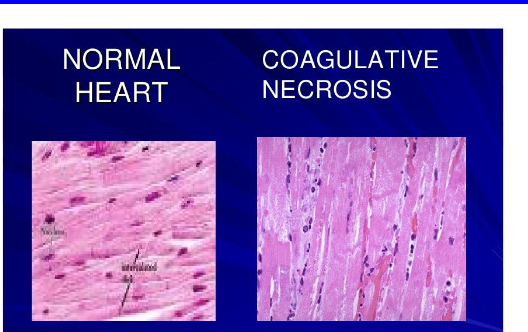
What is Coagulative necrosis?
When the cells protein are altered or denatured
(similar to the coagulation that occurs when cooking
eggs)
•Cells retain some form for a time after death
•Example
•Tissue of the heart goes through this after a heart attack
due to the lack of oxygen

What is Liquefactive necrosis?
the process by which dead cell liquefy under
the influence of certain cell enzymes
•the central nervous system – brain – when
brain tissue dies.
What is Gangrenous necrosis?
An area of necrotic tissue that has
been invaded by bacteria
Gangrenous necrosis provides a _____ for infection.
medium
-Gangrenous necrosis causes what to buildup, and then reduces…
Can cause gases to buildup within tissue
and further reduce blood supply
-Gangrene tissue must be frequently
removed surgically to prevent the
spread of infection to other parts of the
body
What is caseous necrosis?
form of coagulation necrosis
•Thick, yellowish,
“cheesy” substance forms
What diseases is example of Caseous necrosis?
Tuberculosis
What can happen if tuberculosis is not treated?
If TB is not treated and the
infection continues to spread,
the area may undergo
liquefaction necrosis – forming
a cavity.
What is fat NECROSIS?
When fatty tissue is broken down info
fatty acid in the presence of infection or
certain enzymes
•The released fatty acids combine with calcium
to produce grossly visible chalky white areas
•The compounds may increase
inflammation