physics (unit three)
 Call Kai
 Learn
Learn Practice Test
 Spaced Repetition
 Match
Match Flashcards
 Knowt Play
1/103

There's no tags or description
Looks like no tags are added yet.
Name | Mastery | Learn | Test | Matching | Spaced | Call with Kai | Chat |
|---|
No analytics yet
Send a link to your students to track their progress
104 Terms
the suvat equations
v=u+at
v²=u²+2as
s=ut+0.5at²
is speed or velocity a vector quantity?
velocity - requires direction
when does maximum height occur in terms of velocity?
when v=0m/s²
A projectile is fired from ground level with an initial vertical velocity of 35 m/s. How long will the projectile spend in the air?
initial velocity (u=35), the acceleration (a=−9.8), the displacement is (s=0) since it lands back at ground level. therefore s=ut+0.5at²
=7.14s
A tennis ball is hit with a velocity of 16ms-1 at angle of 30° to the horizontal. When the ball is hit, it is 70cm above the ground. The tennis ball is trying to clear a 350cm high fence that is 11m away. Will the ball clear the net?
yes; s= u(x) + t
s(y)= ut + 0.5at²
total s(y)= ans + 0.7
therefore s(y)= 3.96m, will clear the fence
The potential energy stored in the spring is expressed by Ep=150x², p=150, x² is the distance that the spring is compressed by. A projectile with mass 0.2kg is launched straight upward using this device.
If the spring was compressed 0.3m before launching the projectile, calculate the time the projectile takes to reach maximum height.
use Ke= 0.5mv²
use v= u + at
therefore, t=1.19s
A baseball is hit with a velocity of 28ms1 at an angle of 30 degrees to the horizontal at an initial height of 1.0m above the plate.
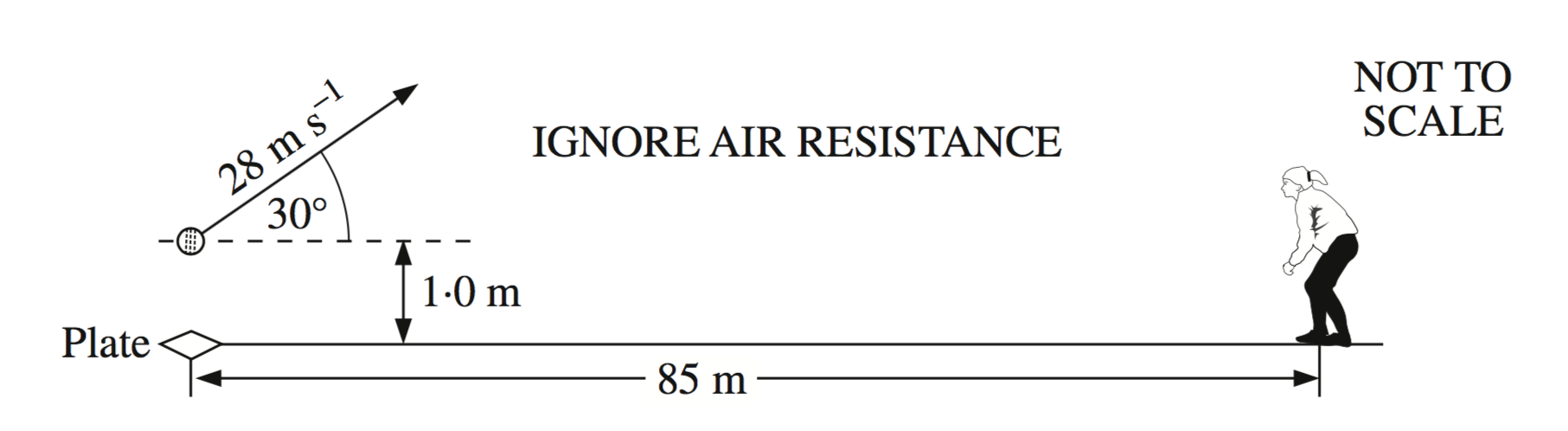
The ball is hit directly towards a stationary outfielder who is 85m from the plate. At the instant the ball is hit, the outfielder begins to run towards the plate with constant acceleration.
What is the magnitude of her acceleration if she catches the ball when it is 0.50m above the ground? Ignore air resistance in your calculations.
use v² = u²+2as
use v = u + at
range = u(x)t
range = 70.137m
how to calculate the accelerating force on an inclined plane
Fa=mgsin(theta)
Consider the following free body diagram of a 10kg box at rest.
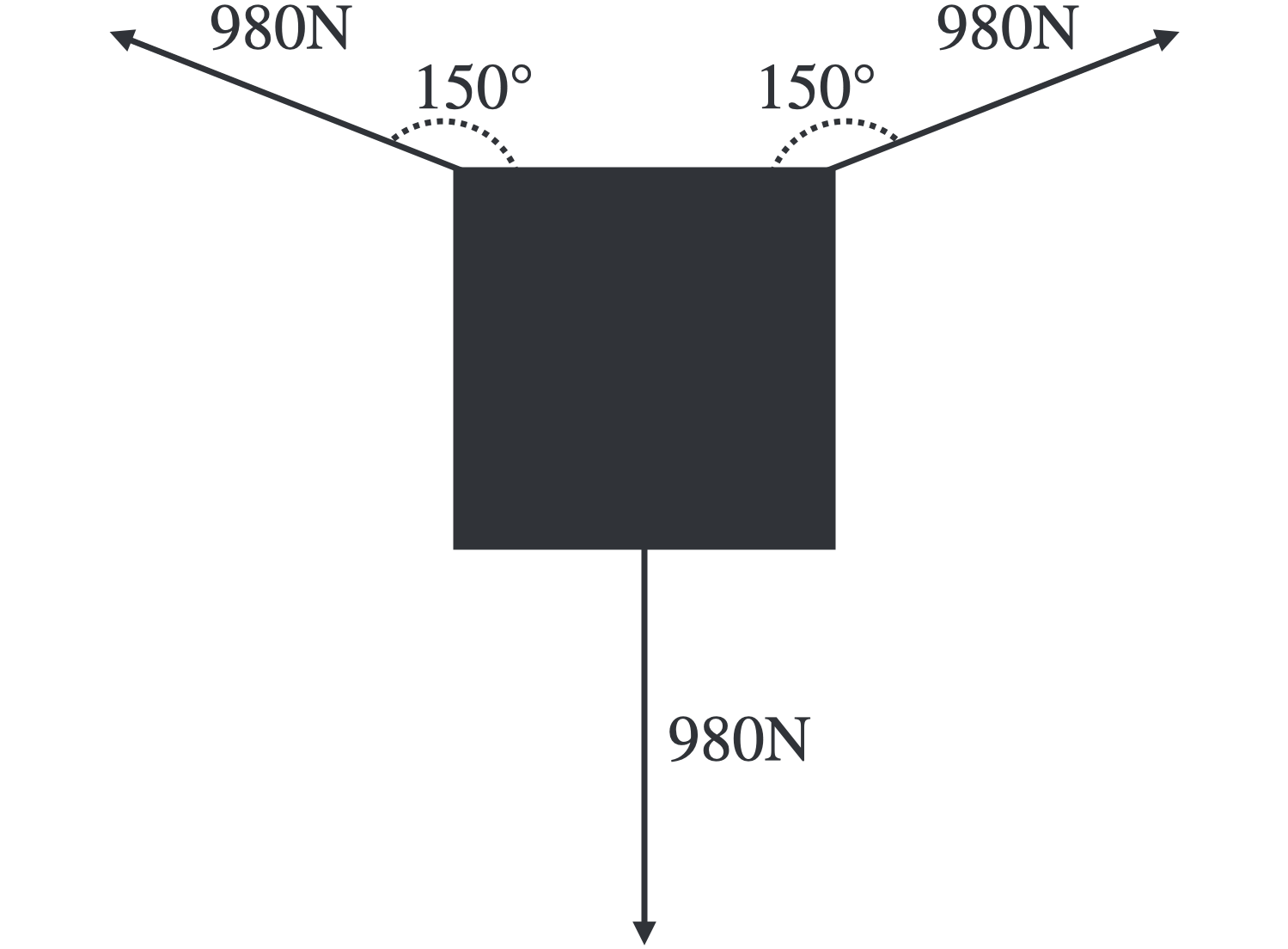
Evaluate whether or not the box will begin to move.
Fnet=0, therefore no movement will occur.
A box is initially at rest on a frictionless inclined plane. The distance from the box to the bottom of the incline is 45 cm, and the incline is at an angle of 16°16°16, °.
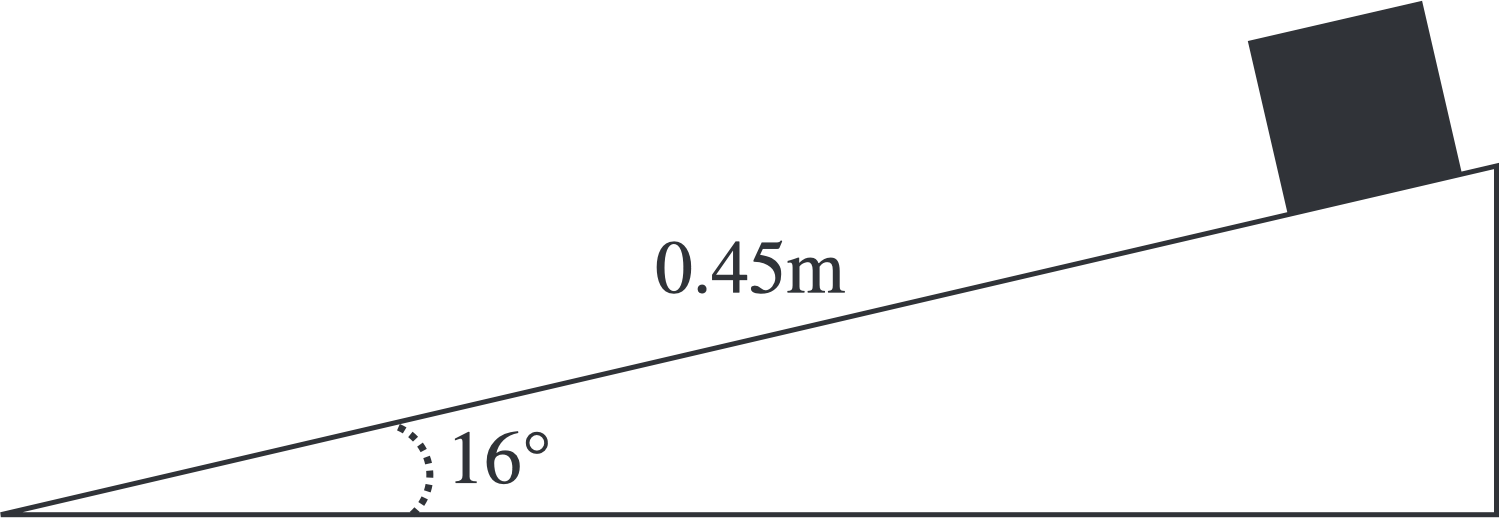
Calculate the time taken for the box to reach the bottom of the inclined plane.
Fnet=Fparallel
ma=mgsin(theta)
s=ut+0.5at²
t=0.58s
what is the relationship between period and frequency?
T=1/f
how to find velocity in circular motion
v=(2pir)/T
what is the relationship between acceleration, velocity and radius
a=v²/r
(think F=ma)
how to find maximum velocity in circular motion
v(0)=(Fr/m)^1/2
A particular road has a limiting friction of 15000N. If a car of mass 400kg is driving on this road around a roundabout, at a distance of 9m from the centre, what is the maximum possible velocity the car can travel at without sliding off the road?
v(0)=(Fr/m)^1/2
therefore v=18.4m/s
A 1000kg car travelling at a constant 40kmh-1 passes through a circular dip of radius 80m.
At the very bottom of the dip, what is the net force on the car?
=1540N upward
A 0.5 kg steel ball is attached to the top of a pole using a string. The ball is swung around the pole in a circle with a radius of 2 m. The ball swings at a constant height, 1.5 m below the top of the pole.
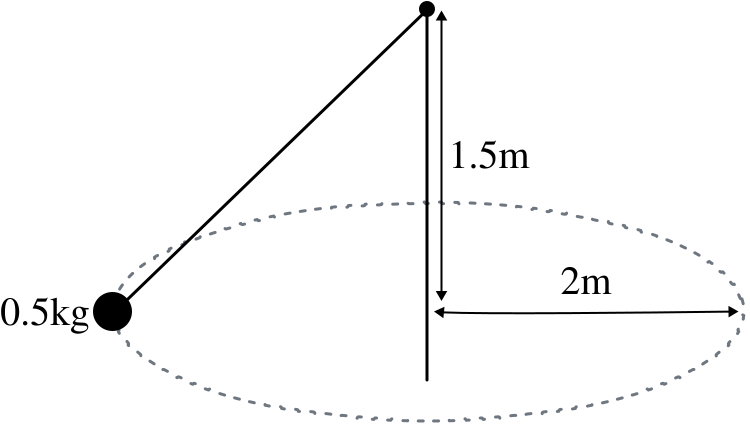
Calculate the magnitude of the tension force in the string.
T(y)=-mg
tan(theta)=1.5/2
sin(theta)=T(y)/T
T=8.16N
Cars A and B are moving in a circle around a horizontal dual-lane roundabout at a constant speed of 30 kmh-1. Car A is in the inside lane and Car B is in the outside lane.
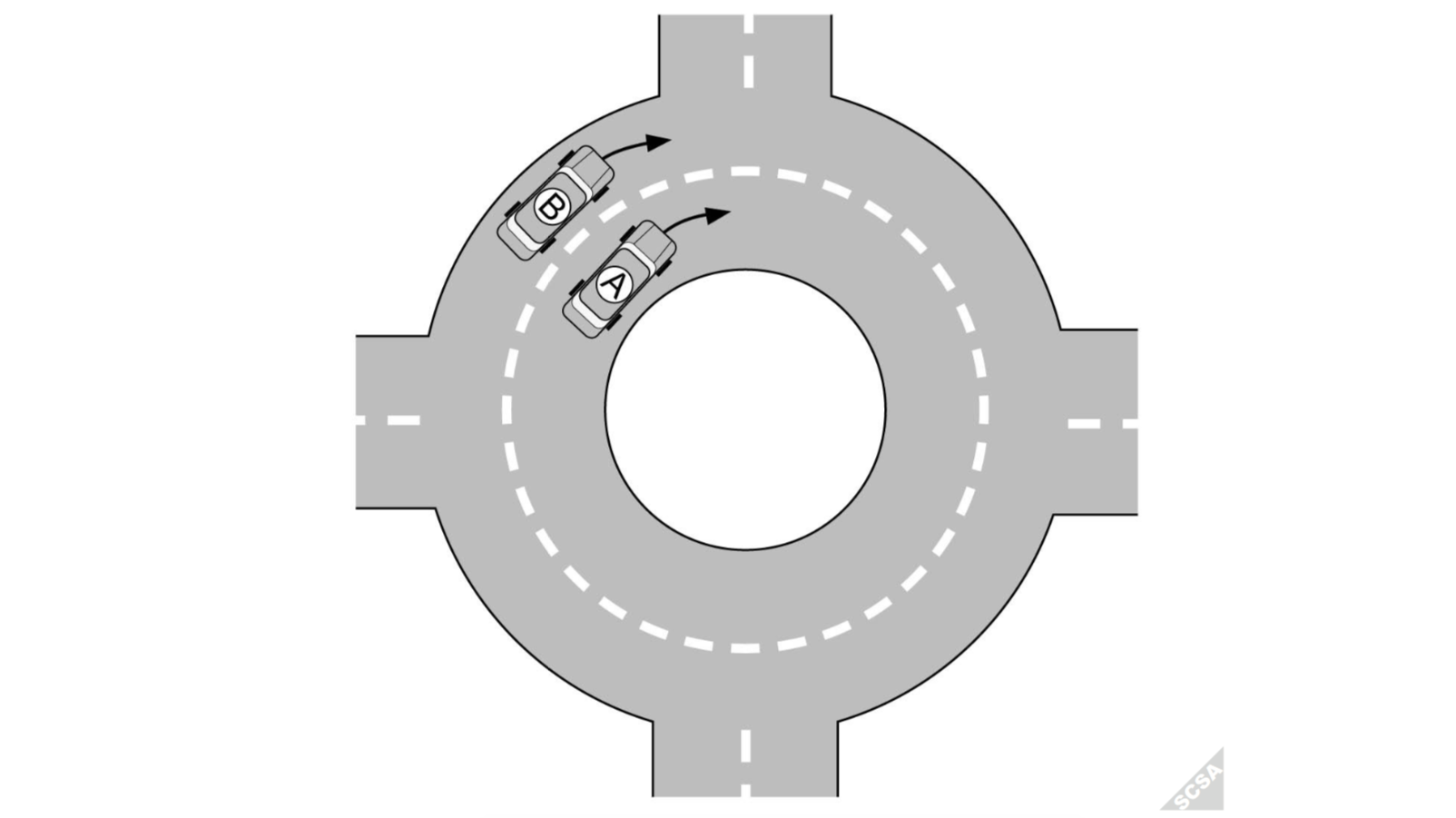
Compare the acceleration of cars A and B. Include an equation in your answer.
a=v²/r
Since the radius of the path of Car B is greater than Car A, the centripetal acceleration for Car B will be smaller than Car A.
However, for both vehicles, the centripetal acceleration will act in the same direction, towards the centre of their circular path.
A frictionless roller coaster has a hump and dip. The hump is shaped as the segment of a circle. The circle it is taken from has a diameter of 13 m. The hump itself has a height of 6 m. Following the hump is a 4.5 m dip with a diameter of 9 m. This is shown below.
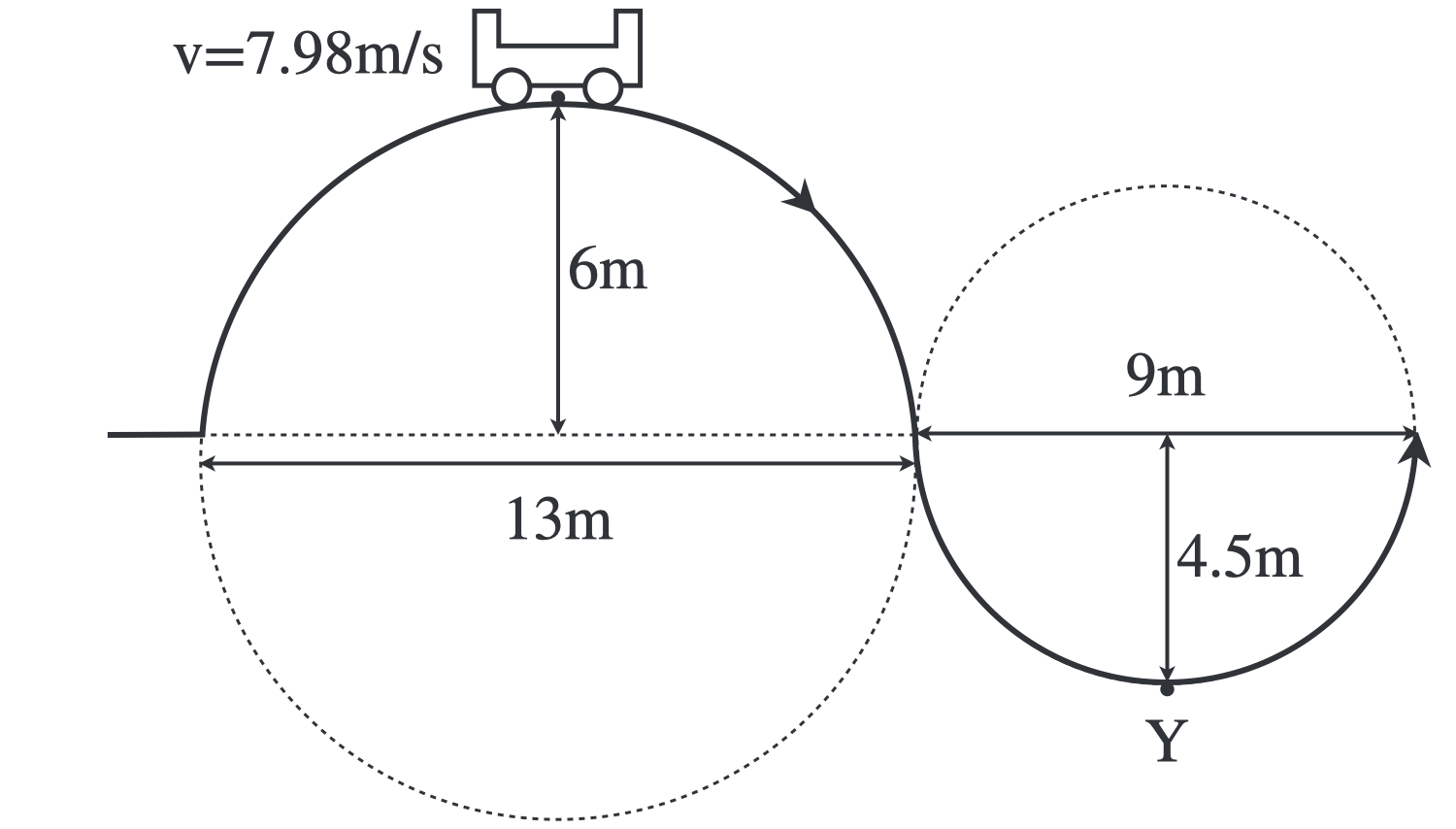
The rider and cart have a combined mass of 250kg. The cart has a speed of 7.98ms-1 at point X, before rolling down the dip toward point Y.
Calculate the normal force the cart experiences at point Y.
Fc=FN+Fw
Ke=0.5mv²
h(net)=10.5m
delta Ke = delta potential energy, Ek=mgh
v=16.416m/s
Fc=14971.3
Fw=-mg
Fc=FN+Fw, Fn=14971N
what are the two formulas to find g? (gravitational fields)
F=gm (think F=ma)
g=GM/r²
what is the gravitational constant?
6.67×10^-11
Two stars, A and B, of equal mass, separated by a distance x, interact gravitationally such that the speed of A is constant.
Derive an expression for the speed of star B.
F(g)=GM²/x²
Fc=mv²/r
Fx=mv²/(x/2)
Fc=Fg (orbit is maintained)
2mv²/x=Gm²/x
v=sqr. rt.(Gm/2x)
define orbit
the regularly repeating motion of a celestial object or spacecraft about a star or planet
in gravitational ellipses, what is gravitational force equal to?
centripetal force
what is kepler’s law? (formula)
T²/r³=4(pi)²/GM, where M is the mass of the central body
what is kepler’s first law?
planets travel in ellipses
what is kepler’s second law?
the line connecting a planet with the sun sweep out equal areas in equal times
A comet completes one orbit around Planet X every 20 days. The comet and planet have masses of 2000 and 4.5×10^15 tonnes respectively.
What is the distance between them, to two significant figures?
r=2.8×10^6m (remember to convert to seconds)
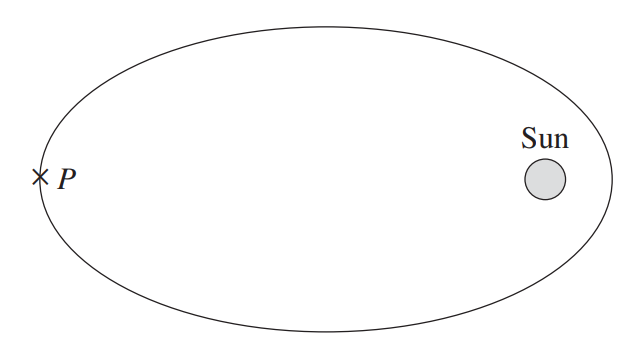
Account for the changes in velocity of the comet as it completes one orbit from position P.
The Sun applies a constant gravitational force to the comet. This force always has some component that is normal to velocity. As a result, the direction vector of the comet's velocity rotates clockwise at an inconsistent rate.
As the comet moves toward the sun, its gravitational potential energy (GPE) is converted into kinetic energy (KE) consistent with the law of conservation of energy. The increase in KE results in an increase in the magnitude of velocity as the satellite approaches the sun. As it returns to point P, the magnitude of the velocity decreases as its KE is converted into GPE.
The ISS has an orbital period of 90 minutes and a mass of 4.19x10⁵kg.
Calculate the gravitational force that Earth applies to the ISS.
Fg=3.76×10^6N
define an electrostatic charge
an stationary electrically charged object
what is the relationship between charge, force and electric field strength?
F=EQ
what is electric potential energy?
the energy of a charged particle due to its position in an electric field
qualitatively describe how potential and kinetic energy influence each other in electric fields
as an electric charge accelerates toward the attractive plate, its potential energy is converted into kinetic energy
what is the relationship between distance from the negative plate,
V=Ed
what direction do negative charges move in?
against the direction of the field
what is the unit for charge?
coulombs
When a positive charge is moved against the direction of an electric field, its electrical potential energy…
increases because work is done against the electric field.
what is the relationship between field strength, distance and potential energy difference?
V=Ed
what is Coulomb’s law?
F=kQq/r²
what is Coulomb’s constant?
9×10^9Nm²/C²
what is permittivity?
how easily the electric field can move through space
Two positive point charges are separated by a distance of 1.5 m. They each have a charge of 1.6 C.
Calculate the force between them.
F=1.024*10^10N
list the four interrelated equations relating to work and charge
Fd=QV (think F=EQ, V=Ed)
Fd=W
QV=W
QV=delta*U
(Fd=W=QV=delta*U)
what is the functional definition of an electron volt (eV)?
the energy requires to move one electron through a potential of one volt (so true)
A negative charge moving from a point of high electric potential to a point of lower electric potential gains...
kinetic energy
An object of mass 2kg and charge 4C is held in place inside an electric field with a strength of 0.2NC^-1.
When released, what is the magnitude of the acceleration it experiences?
F=Eq=4×0.2
F=ma
a=0.4ms^-2
A sphere of mass 12kg and charge of 2C is at rest with an electric potential of 12V. It is released from rest and travels freely to a point of no electric potential. Find its velocity.
W=QV=12×2
Ek=0.5mv²
v=2ms^-1
Two parallel plates separated by 2m have a voltage of 12V between them. A projectile with mass 2kg and charge 3C is launched from the negatively charged plate with a speed of 3ms^−1.
How far does it travel before stopping?
Ek=0.5mv²
W=QV
V=9/3=3
3/12=0.25
s=0.25×2=0.5m
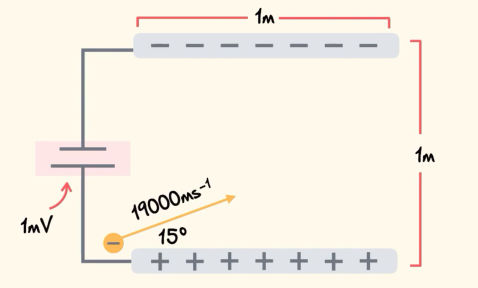
(i) what is the particle’s acceleration and (ii) will it clear the plate?
(i)
V=Ed
(10^-3)/1=E
F=ma=Eq
ma=Eq
a=1.6×10^8m/s²
(ii)
u(y)=19000sin15
u(x)=19000cos15
if the particle clears the plate, the vertical displacement should return to zero after the end of the plate.
s=ut+0.5at²
t=5.62×10^-5s
s=u(x)t
=1.03m>1m, therefore will clear the plate.
As a charged particle moves from one plate to the other in a uniform electric field, its acceleration decreases. (True or False)
False; here, acceleration is constant
Two oppositely charged plates are set up with a spacing of 2cm. One plate has a potential of +40mV and the other has a potential of -40mV. A proton is released from the positively charged plate with no initial speed.
How long does it take the proton to reach the negatively charged plate?
V=Ed
E=(0.04+0.04)/0.02
F=Eq
=6.41×10^-19N
F=ma
a=3.83×10^8m/s²
s=ut+0.5at²
t=1.02×10^-5s
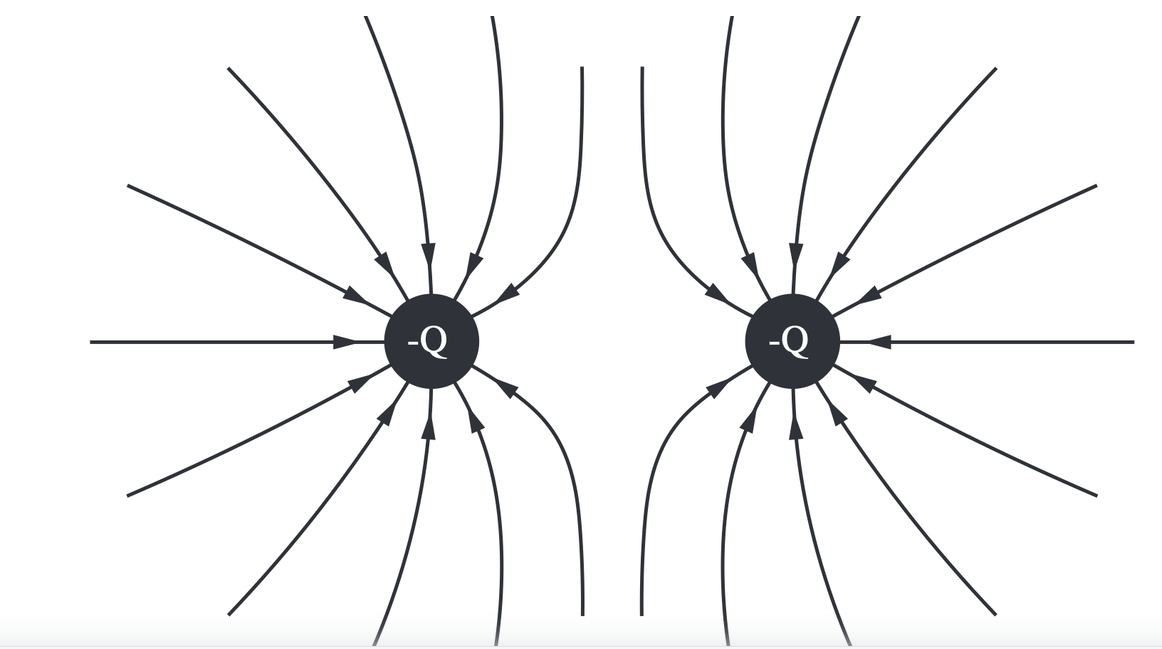
Sketch the electric field between two adjacent electrons. Include at least ten field lines.
which direction do magnetic field lines travel in?
north → south, the direction a positive charge will travel in
describe the right hand rule for magnetism
right thumb: current through the wire
curled fingers: magnetic field
define a magnetic field
a region in space where a magnetic material experiences a force
what direction do magnetic field lines take within a solenoid?
straight lines (inside the solenoid)
what is the formula for magnetic field strength in relation to a wire?
B=(u0*I)/2pir, in Tesla
what is u0 in the equation B=uo*I/2pir?
4pi*10^-7 Tm/A
what is the equation for magnetic field strength in solenoids?
B=nu0I A, where n=N/L
A solenoid of length 1.2 m and 500 turns, carries a current of 6 A. When viewed from the right, the current travels clockwise through the coils. What is the direction and strength of the magnetic field inside of the solenoid?
B=nu0I
=(500×4pi*10^-7×6)/1.2
=3.14×1^-3T
current travels clockwise, fingers curl away, thumb travels to the left

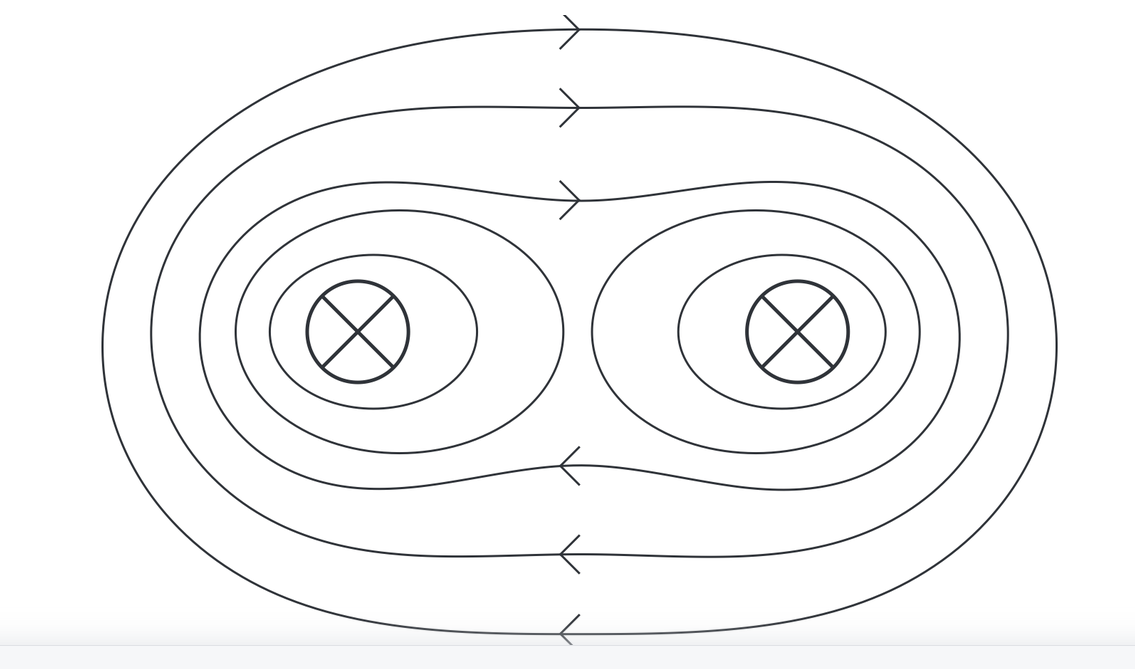
Sketch the magnetic field lines around the wires.
describe the right hand rule for direction of force in B-fields
fingers: B-field
thumb: current
palm: force
what is the formula for force in B-fields?
F=BILsin(theta), where L=length of the wire on which the force acts
what angle gives the maximum force in a B-field?
theta=90; min occurs when theta=0 or 180
A 60kg acrobat is balancing on a current carrying conductor of length 2m that is placed perpendicular to a 4T magnetic field. What current should flow through the rod to balance the acrobat?
W=mg
=588
F=BILsin(theta)
I=73.50A

A magnet rests on an electronic balance. A rigid copper rod runs horizontally through the magnet, at right angles to the magnetic field. The rod is anchored so that it cannot move. An open switch stops current passing through the copper rod. The scale reads 200g whilst the switch is open. Form an expression to calculate the balanced reading when the switch is closed.
right hand rule; magnet will try to push the rod upward with a force of BILsin(theta). The rod will force the magnet down with a force of BILsin(theta). convert force to mass by dividing by 9.81m/s². theta=90, therefore
0.2+BIL/9.81
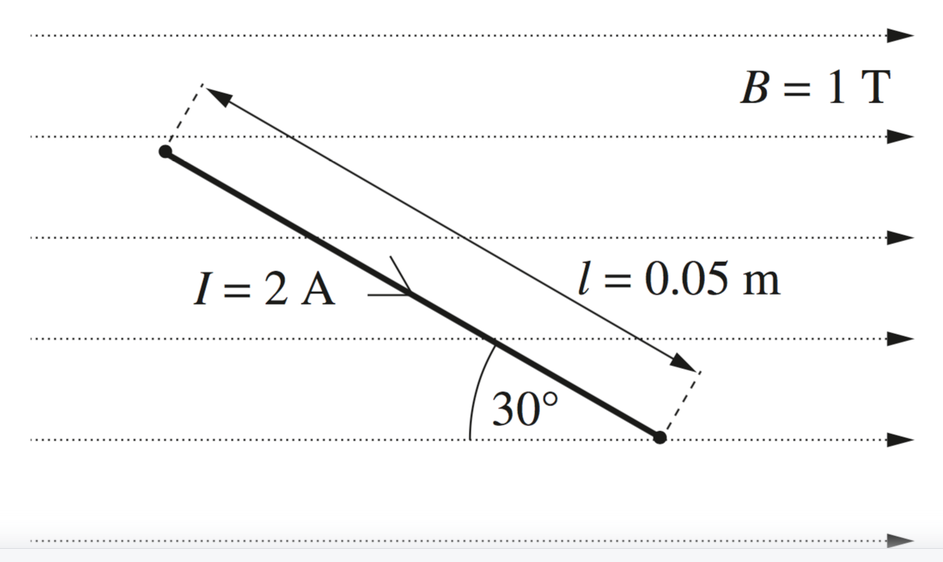
What is the magnitude of the force on the conductor?
F=BILsin(theta)
=0.05N
what is the relationship between a charged particle’s velocity and the length of the wire it travels through?
v=L/t
(think v=s/t)
what is the formula for current? (rate of flow of charge)
I=q/t
what is the formula for the force on a particle traveling through a magnetic field?
F=qvBsin(theta)
always consider whether the particle is moving perpendicular (force will act) or parallel (force will not act) to the field
describe the direction of force on a moving charge in a magnetic field (right hand rule)
thumb = charge
B-field = fingers
palm = force
for a negative charge, reverse thumb direction
can centripetal force and magnetic force be equated on a moving particle in a magnetic field?
yes
qvBsin(theta)=mv²/r
A particle is shot into a magnetic field with a speed of 60 m/s. The particle has a charge of 0.4 C and a mass of 2 kg. The magnetic field has a strength of 14 T. When the particle enters the magnetic field perpendicular to the field direction, it travels in a circular path. Calculate its path’s radius.
F=qvBsin(theta)
=336N
F=mv²/r
r=21.43m
A proton travels from right to left. It encounters an electric field with direction into the page. To prevent the proton's path from deviating, a magnetic field can be applied in the same region as the electric field. What direction should this field be in?
the electric and magnetic field forces must cancel each other out. the electric force points into the page, therefore, the magnetic field must exert a force out of the page. right hand rule; thumb points left with proton, palm faces us, fingers point down the page

describe the electron’s motion
The electron will travel in counterclockwise circles. Over time, the electron will radiate energy, its velocity perpendicular to the field will decrease, and the radius of its path will decrease. So the electron will travel counterclockwise whilst continuously spiraling inwards.

In a thought experiment, a proton is travelling at a constant velocity in a vacuum with no field present. An electric field and a magnetic field are then turned on at the same time. The fields are uniform in magnitude and direction and can be considered to extend infinitely. The velocity of the proton at the instant the fields were turned on is perpendicular to the fields. Analyse the motion of the proton after the fields have been turned on.
The electric field will cause the proton to constantly accelerate to the left of the page. At the same time, the magnetic field will give a constant centripetal force to the proton, causing it travel in anti-clockwise circles as viewed from the right. These two effects combined will cause the proton to take a path shaped like a spiral. But as time passes, the length of its spiral path will continue to increase as the proton covers more distance before completing one loop due to its velocity parallel to the field increasing. The proton will also lose energy as it releases radiation, causing its velocity perpendicular to the field to decrease. As a result, the radius the spiral will decrease over time.
what is magnetic flux density equal to?
magnetic field strength
what is the equation for magnetic flux?
fi=BAcos(theta) Wb
it is maximised when cos(theta)=1, therefore theta=0 or 180
A single loop of wire is placed inside a magnetic field with a magnetic flux density of 2 T. The area of the coil is 0.24 m2. The coil's area vector is at an angle of 50° to the magnetic field direction.
fi=0.3Wb
state faraday’s law
induced emf is directly proportional to the rate of change of magnetic flux
what is faraday’s law quantitatively?
emf=-N(deltaBA)/t V, where delta only applies to strength variation or area variation
A rod moves to the right through a magnetic field that is pointing into the page.
What is the direction of the magnetic force on the electrons in the rod?
thumb in direction of rod movement, fingers into the page, up, electrons are anti-direction, therefore downward force
define electromotive force
the potential energy difference created by separating charges (emf creates electrical potential energy by moving charges apart)
A rod moves to the right through a magnetic field that is pointing into the page.
What separation of charge occurs?
If a rod moves to the right through a magnetic field that points into the page, the EMF produced will mean that the top of the rod is positively charged, and the bottom is negatively charged.
A coil of wire is laid flat on a wooden table. The coil has 6 loops with a radius of 0.5 m. The magnetic field strength measured inside the coil is 4 T. When an electromagnet is switched on, the magnetic field strength inside of the coil increases to 20 T over a period of 0.1 s. Calculate the emf.
emf=753.98V
what is Lenz’ law?
the induced emf’s direction opposes the change in flux
A magnetic field is set up so that it points out of the page. A horizontal conductor is then dragged from the top of the page, to the bottom of the page.
On which side of the conductor will the negative charge accumulate?
right
The south pole of a magnet is pushed into the top of a solenoid. Which option correctly describes the direction of current and the magnetic polarity at the top of the coil?
The induced current has to create a magnetic field that repels the magnet, so as to reduce the relative motion. That means the induced current must create a magnetic south pole at the top of the solenoid. By the right hand grip rule, we point our thumb down and curl our fingers clockwise, so the current is directed clockwise.
describe the right hand rule for solenoids
thumb: north pole
curled fingers: current
describe how to apply the right hand rule to lenz’ law
the current opposes the B-field to counteract the change in flux; thumb: current
fingers: B-field
A square loop of wire is laid flat on the page. A magnetic field is suddenly switched on with field lines directed out of the page.
Which best describes the induced current in the loop of wire?
clockwise
A flat copper square with an area of 0.16m2 is travelling toward a magnetic plate. Before being launched, the magnetic field strength through the copper square was 0.5T. The magnetic field strength inside the square increases to 13T as it arrives at the magnetic plate 0.1s later.
What is the magnitude of the EMF induced in the copper square after 0.1s?
emf=20V
A conductor is dropped into a magnetic field from a height of 2m. The conductor has a mass of 4kg and hits the ground with a speed of 3ms-1.
As the conductor falls, how much energy is converted into electrical energy?
Eg=Ke+Ee (weight=kinetic energy + electrical energy)
mgh=0.5mv²+Ee
78.48=18+Ee
Ee=60.48J
give the three transformer equations
Vp/Vs=Np/Ns
P=IV
what material is a transformer’s core made out of?
iron
explain how transformers work (three points)
transformers are made of a primary and secondary coil wrapped around a soft iron core. alternating current is passed through their primary coil, leading to a changing magnetic flux through the core. the flux induces an emf in the secondary coil, as predicted by Faraday’s law, emf=-N delta fi / t. therefore, emf is proportional to the rate of change of the magnetic flux as well as the number of coils.
define step up and step down transformers
step up: increases voltage (Vs>Vp), more turns in the secondary coil (Ns>Np)
step down: opposite