Exam 1 Content (minus some cards)
 Call Kai
 Learn
Learn Practice Test
 Spaced Repetition
 Match
Match Flashcards
 Knowt Play
1/95

There's no tags or description
Looks like no tags are added yet.
Name | Mastery | Learn | Test | Matching | Spaced | Call with Kai | Chat |
|---|
No analytics yet
Send a link to your students to track their progress
96 Terms
what is total internal reflection
when light propagates from a region with a high index of refraction to one with a lower index of refraction
the sum of intensiites of the refracted and reflected rays equals…
the intensity of the incident ray
total internal reflection: when angle of incidence small and is less than critical angle
image A

total internal reflection: when angle of incidence increases but still less than critical angle
image B: see refraction line get closer to the horizontal normal

total internal reflection: when angle of incidence equals critical angle
the refracred propagates parallel to the interface (image c). angle of refraction will be 90

total internal reflection: when angle of incidence is greater than critical angle
we get no refraction at all. all incident intensity goes to the reflected ray

how do we find critical angle for total internal reflection

how are optic fibers an example of internal reflection
it gets its effect from series of total internal reflections between core and cladding

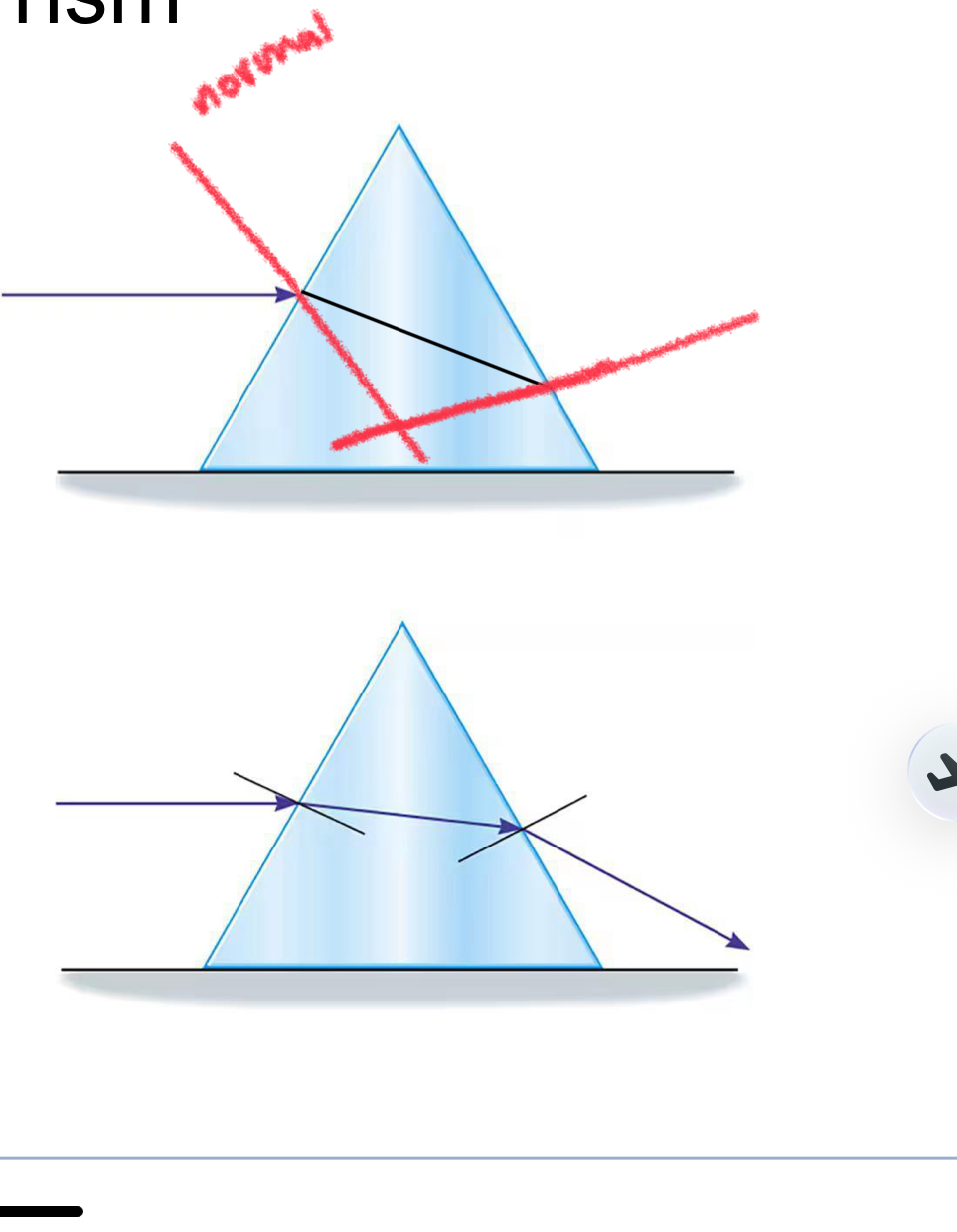
when a ray enters into the prism, it is reflected toward or away from the normal? what about when it leaves?
when it enters, it is bent toward. when it leaves, it is bent away from the normal because the sides of the prism are angled opposite directions
a pair of convex lense is converging or diverging
converging

double concave is converging or diverging
diverging

describe the thickness of the double convex vs double concave
double convex is usually thicker in the middle than the edges while double concave is thinner in the middle
do we use a C ray for diverging and converging lenses
no, this is not a sphere so there is no center of curvacture
what are the three principal rays for tracing with converging/convex lenses
Pray, Mray (midpoint of lens), and Fray (goes through front F ray)
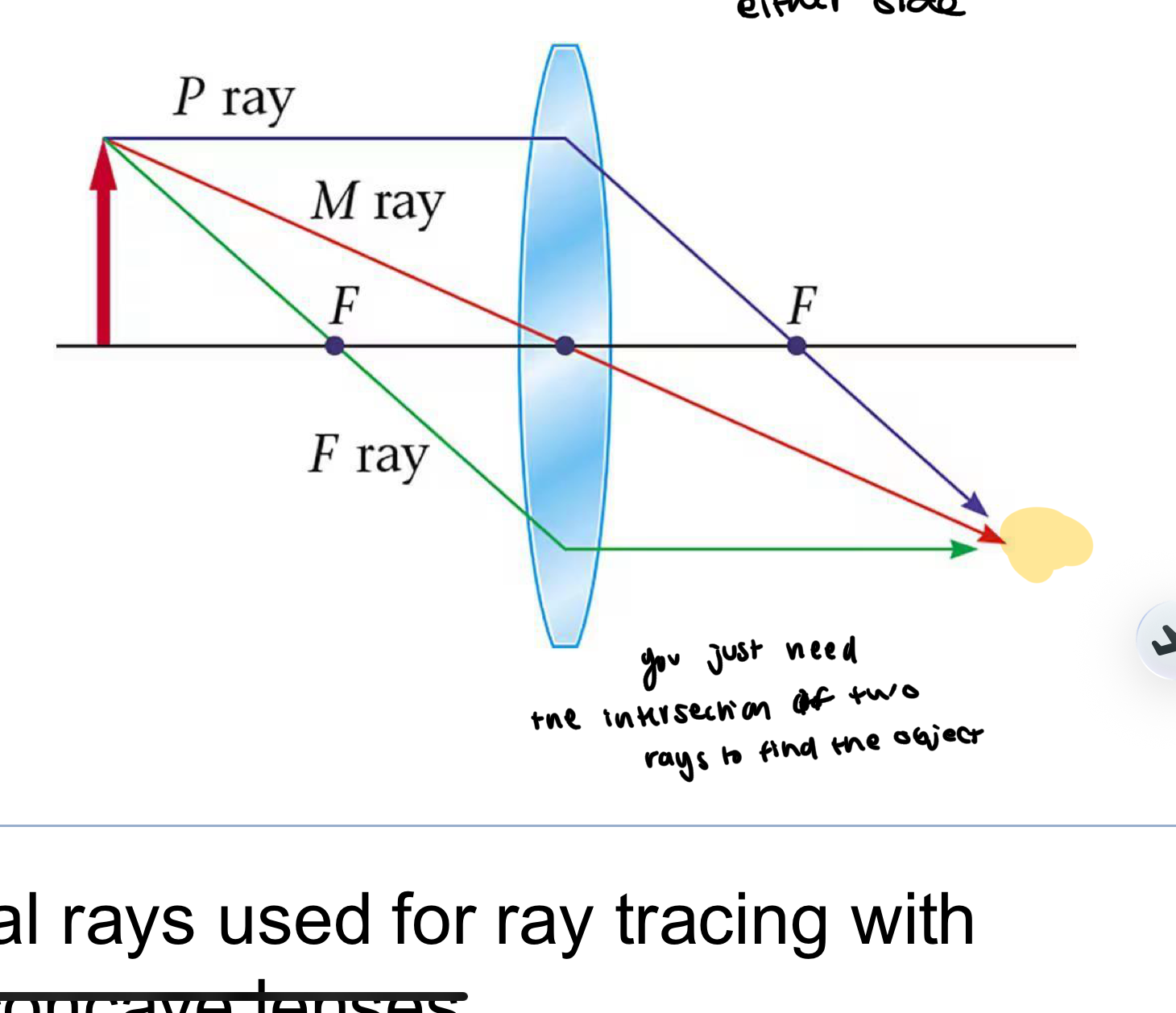
true or false: converging lenses have one focal point
there is one on each side
what rays do we use for diverging lens
M ray, P ray, and F ray (goes through back one)

for thomas young experiment, what were the results supposed to look like light was made of particles? did he see this?
but he did not see this, confirming light is not made of particles

what is superposition in waves
the net displacement caused by a combination of waves=the algebraic sum of the displacements caused by each individual wave. (think of constructive and destructive displacement)
constructive vs destructive wave interference
constructive: waves add to make a larger displacement
destructive: net displacement is reduced
Huygen’s principle
each of the two slits of Young’s experiment act as sources of light waves propagating outward in all forward directions. it follows that light from two sources can overlap, leading to interference
constructive or destructive: waves that are in phase and give a larger amplitude
constructive (first one)

constructive or destructive: waves that are half a wavelength out of phase
destructive (second photo)

if waves have equal amplitudes and destructive interference…
there sum will have a zero amplitude (second photo)
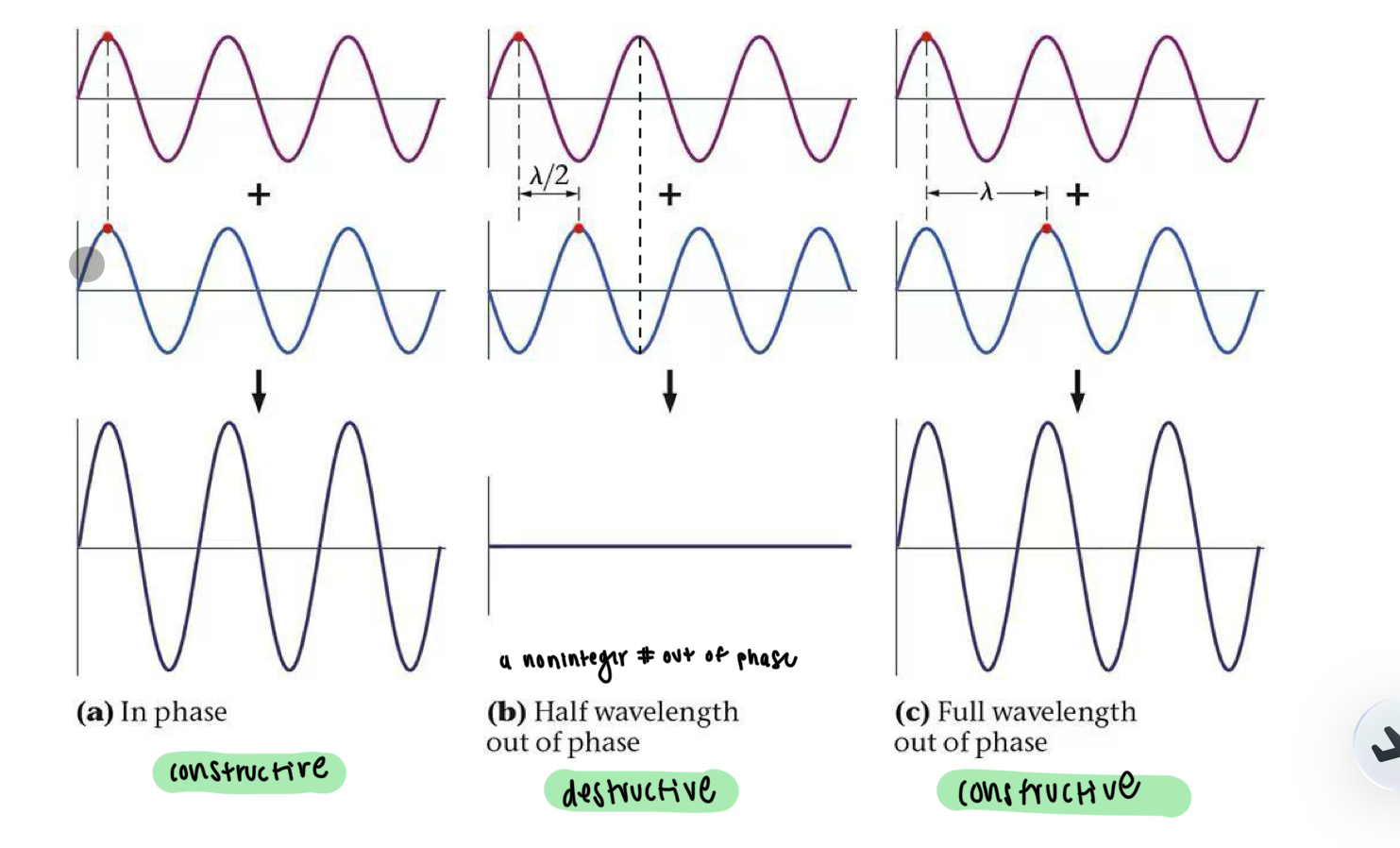
if waves are one wavelength out of phase, constructive or destructive
constructive
see end photo

we say waves interfere ____ when they are either in phase or out of phase by an integer number
constructive→more intense light
we say waves interfere ____ when they are an odd number of half wavelengths out of phase
destructive →reduction or absence of light
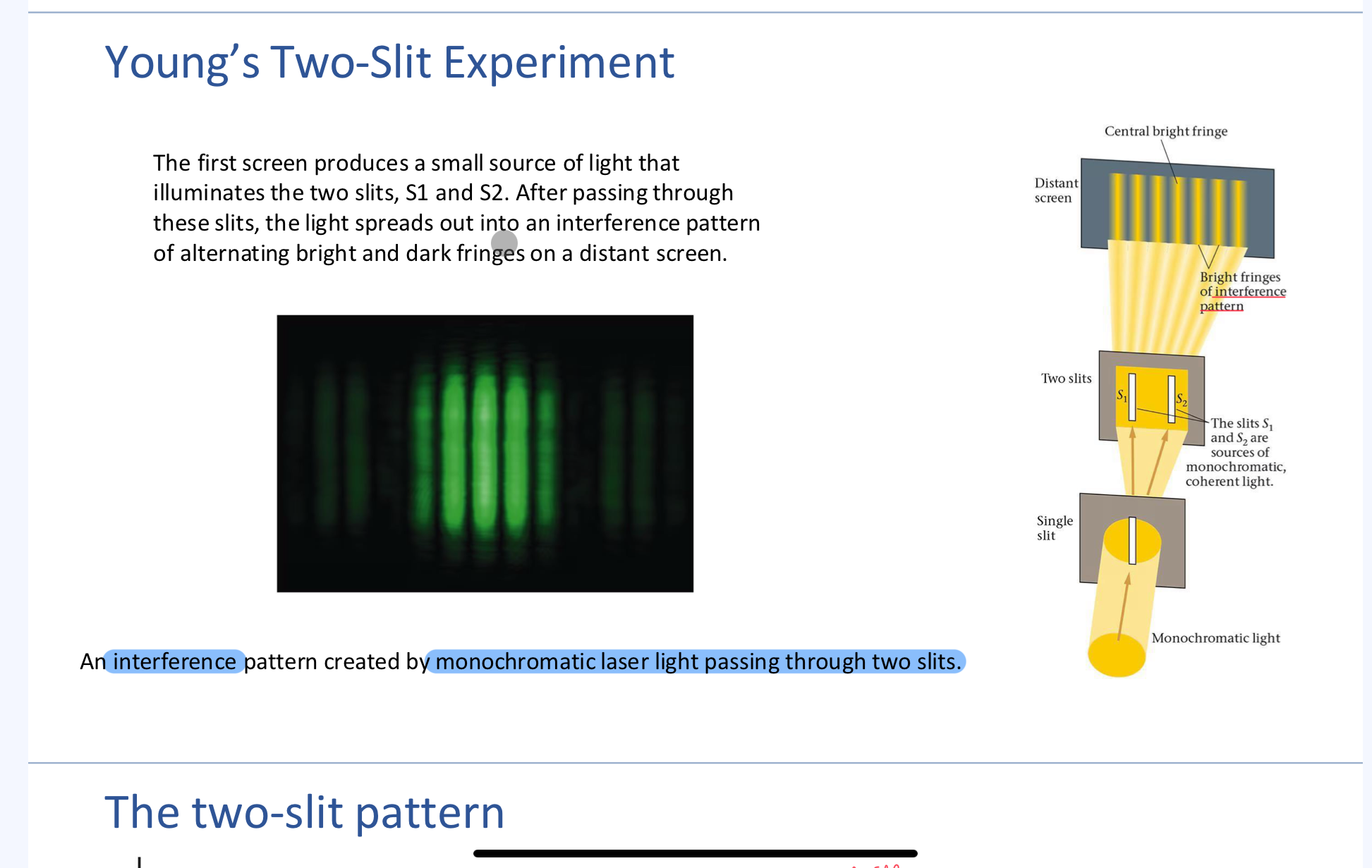
describe young’s double sit experiment set up and results
slits are separated by a distance on the order of wavelength of the light, light source as plane waves (monochromatic laser, and there should be diffraction occurring at the slits/bent light (spherical waves)
formula for dark and bright fringes

if we assume L » d, we can assume the two rays are ____ and make a new equation ____
L linear distance from central fringe
L and d run parallel
y (distance between central and top fringe) = Ltan(theta)

the separation of between fringes is directly related to
the wavelength of light
what can we assume for very small angles for inteference formulas (3 things)
sin(theta)= tan(theta) = theta (in radians)

monochromatic light that passes through two slits produces what kind of interference pattern
bright and dark fringes
what does the angle at which a bright or dark fringe occurs depend on?
the wavelength of the light and separation of the slits
what does the linear position of a fringe on a screen depend on?
the distance from the slits to the screen
what does the two slit pattern look like

what happens to a wave when it passes through a small opening
it will diffract, meaning waves will travel in different directions other than the original one
what is the diffraction pattern when a monochromatic light passes through a SINGLE slit
dark and light fringes will form, but notice how the central fringe is the largest fringe. we actually cannot assume the bright fringes are consistent in size

what is the formula for dark fringes in a single slit interference

math/fringe wise, what is the main difference between a single slit and double slit experiment
we can only make assumptions about dark fringes—there is no consistency among the light fringes in a single slit experiment. the dark fringes always occur and the minimum, and the intensity stays consistent
on close inspection, the shadow of a sharp edge is seen to consist of numerous fringes produced by what process
diffraction
how can we find the vertical/linear distance of the fringe (not L)
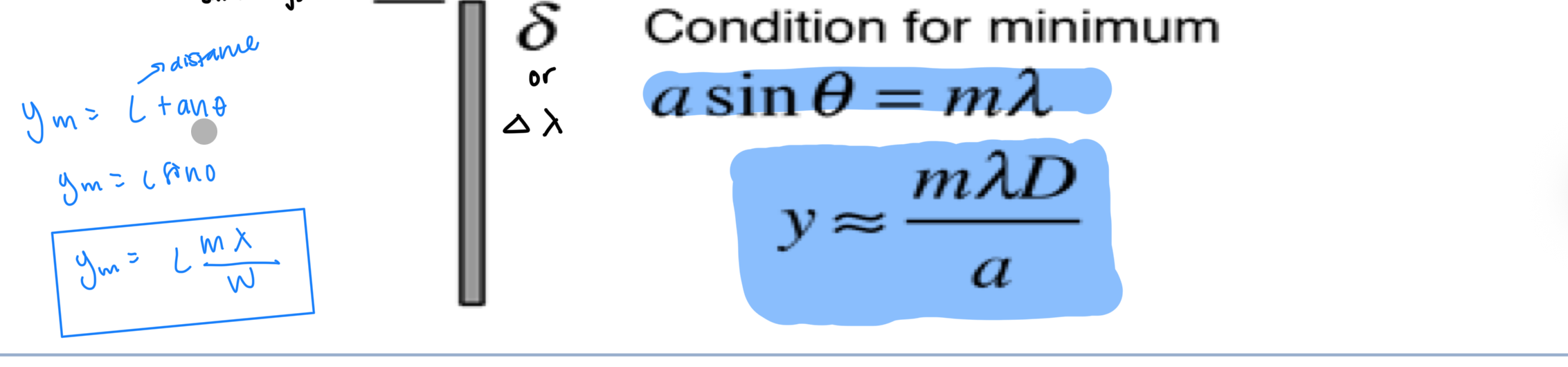

for information purposes (can see where a lot of the math stems from)
what can we assume about tan(theta) and sin(theta) for single slit
tan(theta)=sin(theta)= y/L
light and wave graph wise, how does a double slit diffraction differ from a single slit pattern
there is one bright central maxima and minima on each side followed by another maxima for a single slit. for double slit, there are multiple maxima and minima (but all under the same area as the central maxima for the single slit)

what is the definition of a diffraction grating
a series of many narrow lines or slits on a flat surface
for which fringe would we not see the diffraction of visible light
the central fringe
for a diffraction grating: as the number of slits grows, the peaks become _____ and ______
narrower and more intense

describe the wave diffraction pattern of constructive and destructive interference as the number of slits increases
the main waves are all still under the same area of the central maxima of single slit. the number of waves stays the same, but they become narrower and more intense
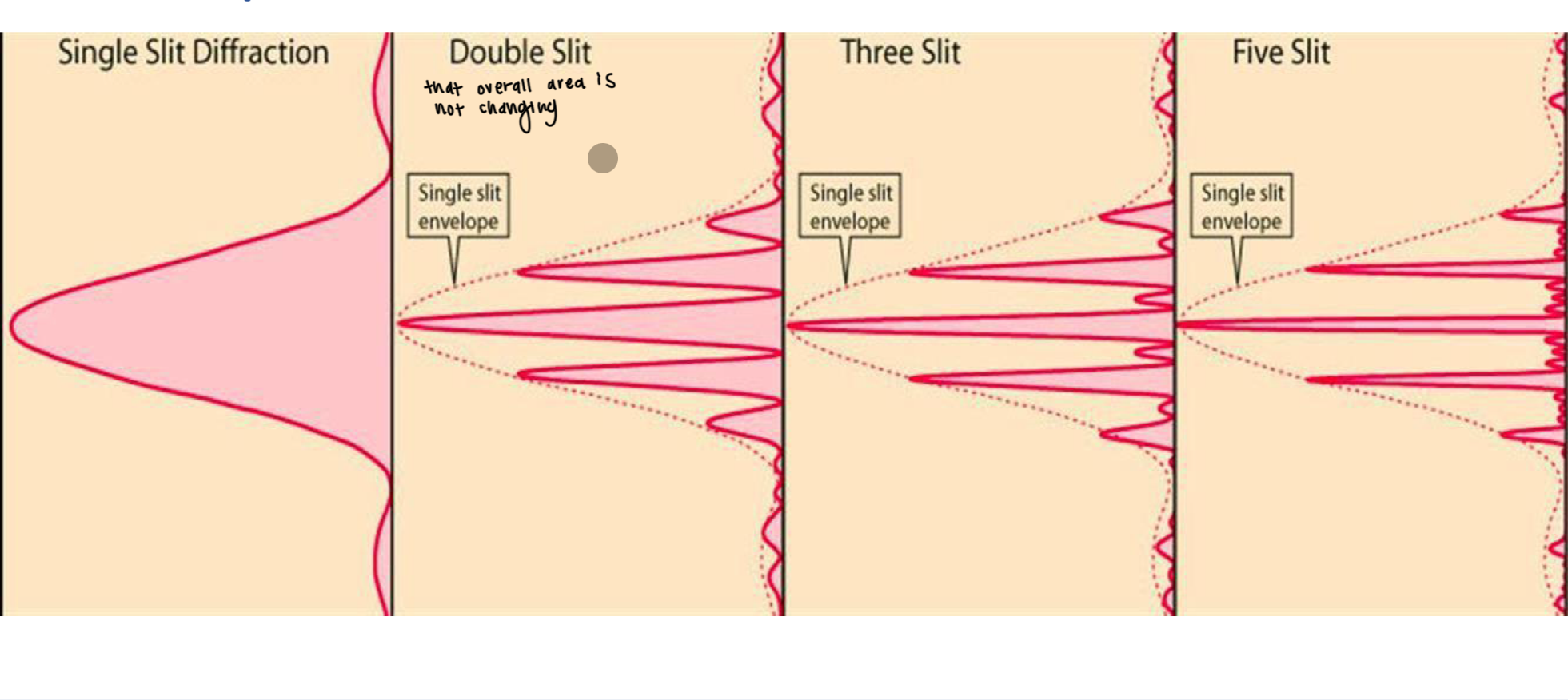

notice how for the 5 slit diffraction pattern, there are tiny maximas. do we count those?
nope! they are considered negligible
what is the formula we use for constructive interference in a diffraction grating (where the number of slits is more than one)
the same dsin(theta)=m(lambda) (where m is an integer)

how does the level of detail change as we increase the number of slits
the pattern becomes more detailed

in diffraction grating, what is N? how can you find d (distance of slit) from N?
N: the number of slits/cm or lines/mm for the diffraction grating (pay attention to units)
d=1/N
when we use white light, sometimes the diffraction grating gets separate colors. is this the same mechanism for prisms?
no, higher order spectra are more spread out (m=1, 2, or 3). when light goes through the slits, different colors bend a different angles→rainbow pattern. for prisms, it relies on refraction (changing the medium and bending of light from there; the different colors will interact with the medium differently)
is there a limit on how large m can be for a diffraction grating pattern?
yes, there is a limit, but it depends on the system
how can X ray diffreaction be used?
X ray diffraction pattern (1) can determine precise distance between various plans of atoms in a crystal. (2) the symmetry of the pattern determines the type of crystal structure
why do we use grating spectroscopes?
because the gratings spread light out over a wider angle than prisms
what is poisson’s bright spot?
a diffraction phenomenon: the shadow produced by a penny has define edges (thanks to diffraction in fringes), but there is a small bright spot of light in the center of the shadow (aka Poission’s bright spot). this is because the bending of light meets at this point (constructive)

diffraction occurs when we encounter either of these two things
a barrier or an opening
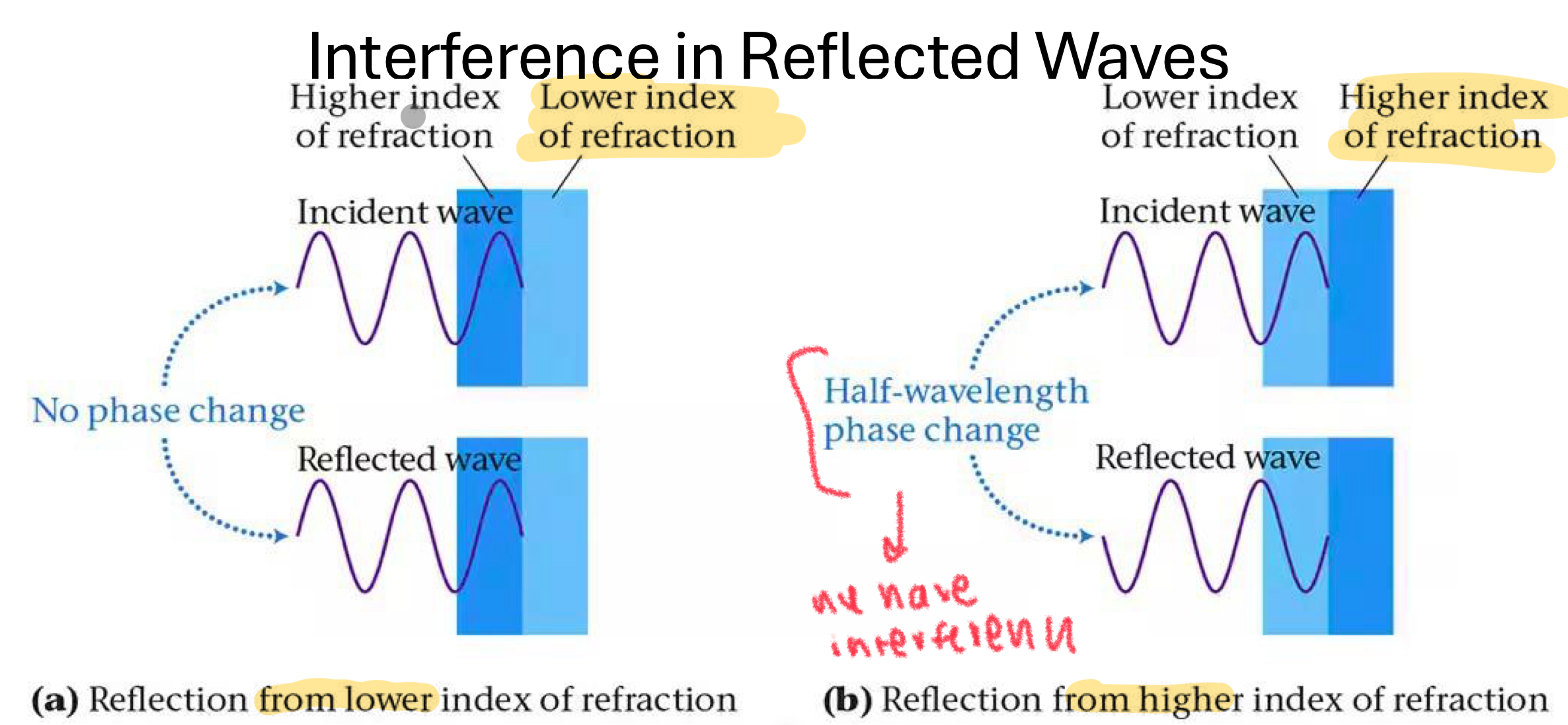
what happens to waves when we move from a higher index of refraction to a lower index
no phase change between the waves (look at photo a)
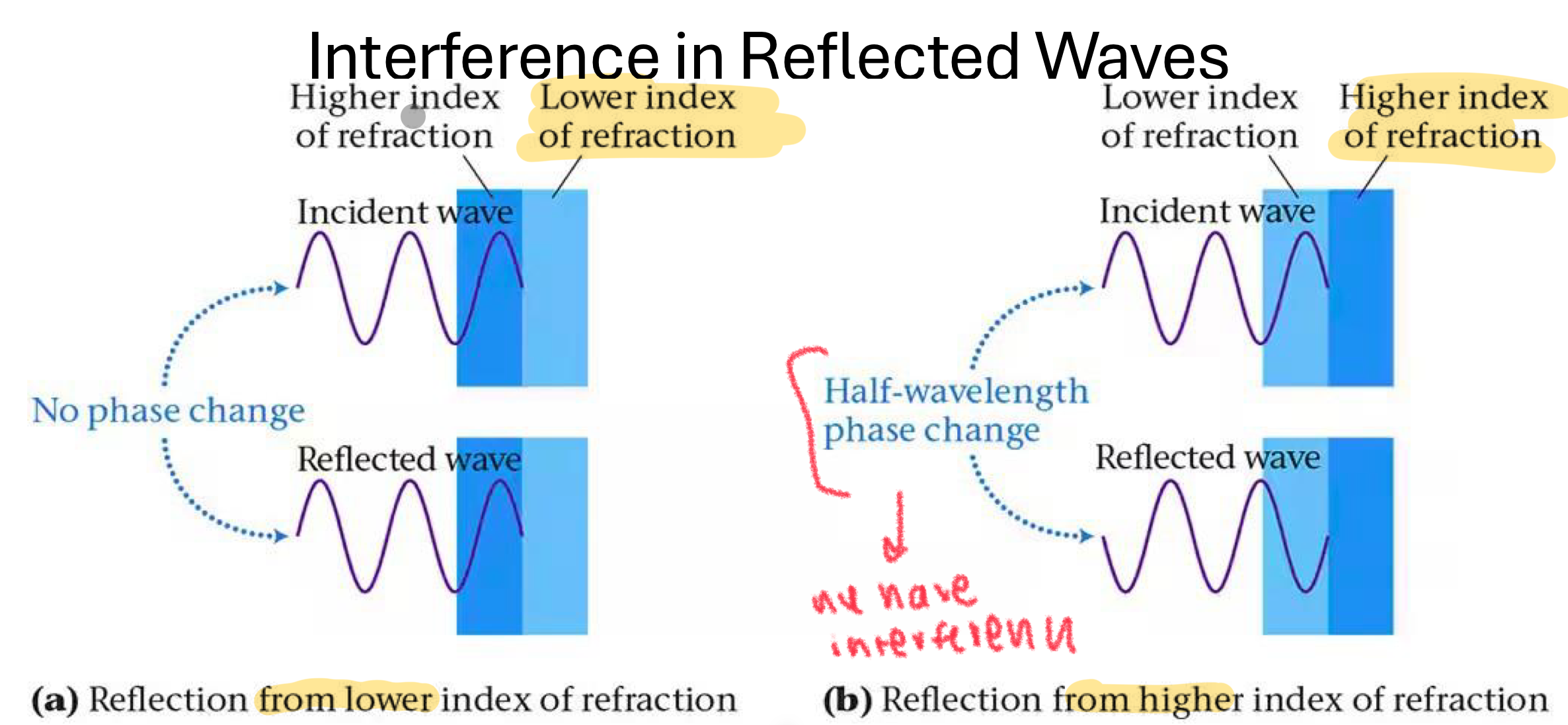
what happens to waves when they go from a lower index of refraction to a higher index of refraction
half wavelength phase change (there is interference)
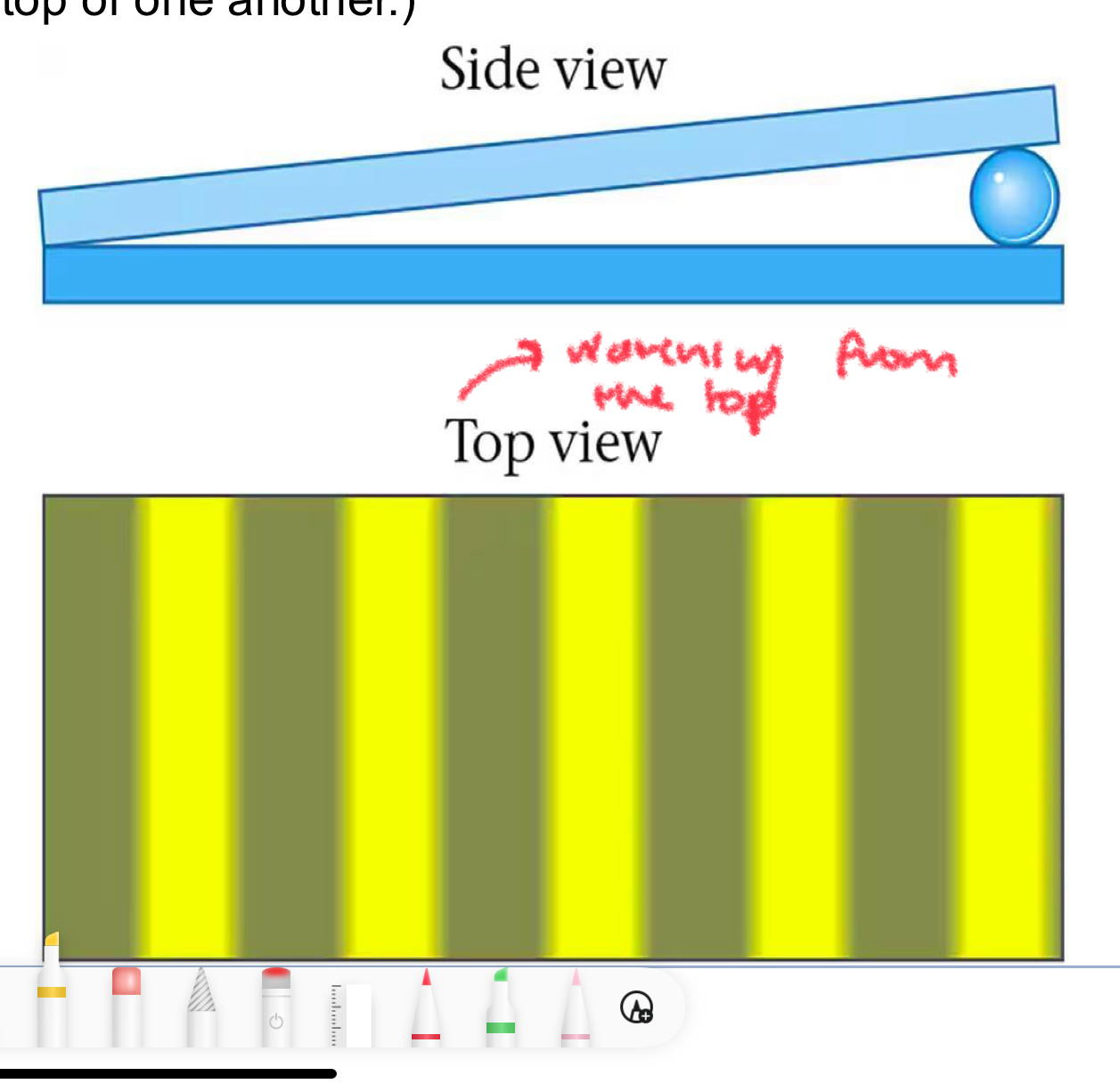
in an air wedge, what is the pattern of interference/what two rays are interacting? what does the side view and top view look like
ray 1: light reflected from the bottom surface of the top plate of glass
ray 2: light reflected from the top surface of the bottom plate of glass (they are kind of on top of each other in reality)
what are newton’s rings used to test? how?
the shape of a lens
how: the imperfections in the ring pattern indicate that there are slight distortions/displacements in the lens

how do we see interference in bubbles?
the swirling colors are created by interference. some wavelengths are eliminated from the reflected light while others are enhanced. which colors are removed or enhanced dpends on the precise thickness of the film in the region
what are circular apertures?
diffraction through a small circular aperture results in a circular pattern of fringes, but this does limit our ability to distinguish one object from another when they are very close together (think of car headlights appearing as one when far away and two when they are closer)
true or false: our pupils are circular apertures
true! this means we are limited on how well we can distinguish separate objects/light sources
What is Rayleigh’s criterion
it relates the size of the central spot to the limit at which two objects can be distinguished
if the dark fringe of one circular diffraction pattern passes through the center of a second diffraction pattern, the two sources responsible for the patterns will appear to be a single source (aka when they are too close together they appear as one)
if the first dark fringe from one source lies on the central bright fringe of the other, can they be separated?
no
what is the formula for dark fringes for a slit (context: rayleigh’s criterion) (what unit are the angles)
angle will be in radians
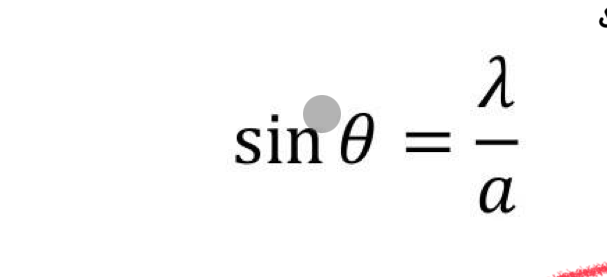
how do we find the minimum angle of separation of two point sources so they can remain separate?

how are minimum angle of separation and diameter of telescope related
inversely
what is the formula for Rayleigh’s criterion? and the minimum angle formula/small angle approximation

what variables/relationship does Rayleigh’s criterion establish?
the location of the first dark fringe determines the size of the central spot. the size of the spot increases with wavelength and decreases with size of aperture
what are the two types of telescopes
reflectors and refractors
how do refracting telescopes work?
they use lenses to bend light to focus it (it reminds me of converging lens)
what is the lens of a refracting telescope called? what is it used for?
the objective (it is responsible for refracting the light)
where is the aperture on a refracting telescope?
it is the diameter of the objective lens (the larger the aperture=gathering of more light)
give a brief description on how refracting telescopes work
the objective lens is placed at the end of the telescope facing the sky. it takes the parallel light coming from the star and focuses it to form an image
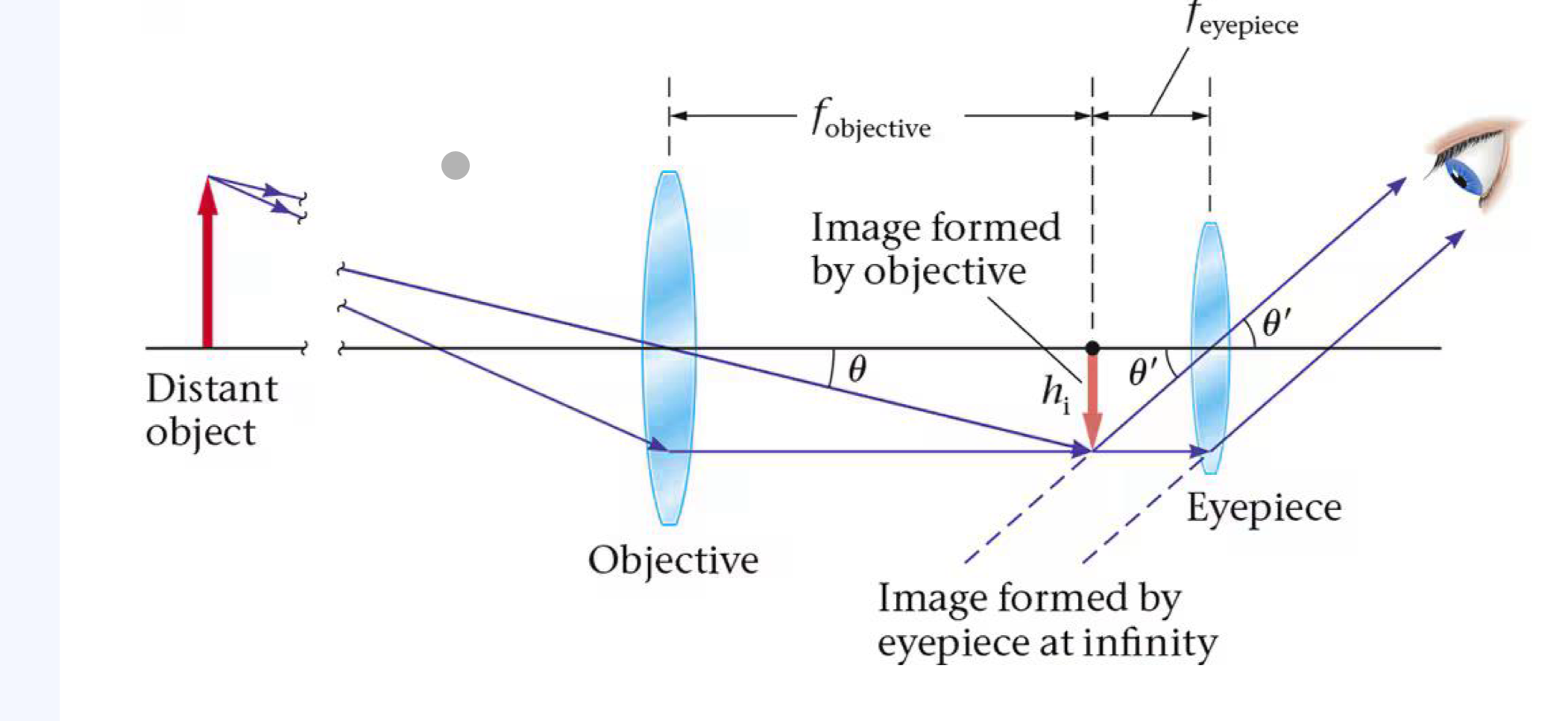
define local length
distance between the objective lense and the focal plane
how does focal length affect size and separation of the objects in the focal plane
the longer the focal length=increase in size and separation of objects in focal plane
how does magnification affect field of view?
an increase in magnification results in a smaller field of view
magnification formula for telescopes

what is the aperture size of the largest refracting telescope
1 meter
what is a problem with refractors (focus on focal length)
need to have large structure with long focal lengths to increase size and separation of objects
what is a limitation of lenses in telescopes
chromatic aberration
how can we fix chromatic aberrations
by using achromatic (red and blue) doublets
what are apochromats? what about super-apochromats?
apochromats: red, green, and blue
super-apochromats: even more color, super expensive, not really viable for professional lenses
what do reflecting telescopes use?
mirrors (primary and secondary mirrors)
define dispersion
separating of light into different colors according to wavelength
for a reflecting telescope, what is focal length determined by
the path the light takes reflecting off the mirror
what is an advantage to reflectors? (4)
they are inherently free of chromatic aberration because they don’t use lenses
they are more compact and lighter—the length of the telescope is smaller for the same focal length because of the setup
you can use a lot of small mirrors to make one big mirror
if one small mirror breaks, you can replace it
do reflecting telescopes still suffer from aberration?
yes, but a different type: spherical aberration
what are the two types of aberration?
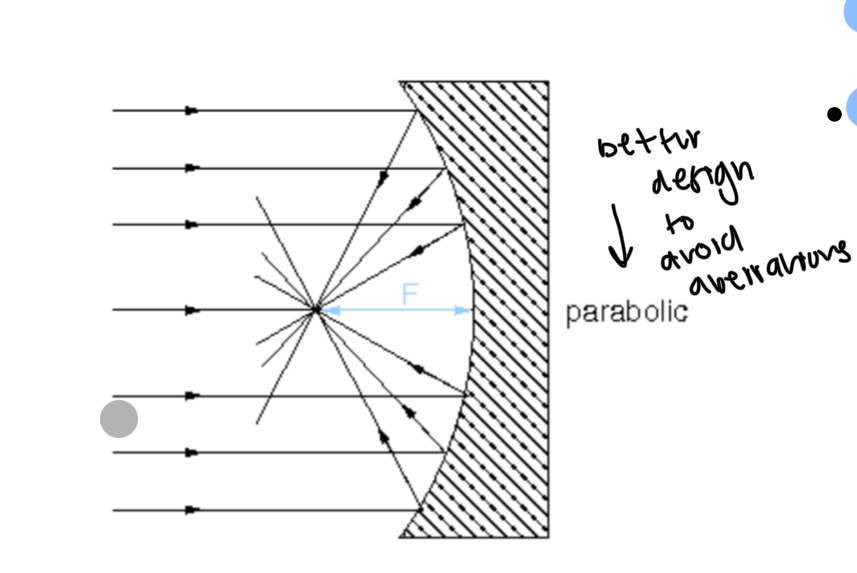
mirror aberration→spherical aberration (aka when physical shape of mirror causes light rays to focus at different distances)
lens aberration→chromatic aberration (aka the material’s refractive index varying for wavelength and splits colors into different focal points)

do refractors only suffer from chromatic aberration?
no, they also suffer from spherical aberration but chromatic is much worse
what is the best mirror shape to avoid aberrations?
parabolic
what kind of telescope is the Hubble Space Telescope? describe the famous problem it had (hint: type of aberration)
it is a reflector telescope, and it suffered from spherical aberration→manufacturing error of the hyperbolic mirror
why are most telescopes on remote mountaintops?
higher altitude=less atmosphere because Earth’s atmosphere degrades images (astronomical seeing limits resolution due to the atmosphere’s turbulence)
