Bio 1 eeee
 Call Kai
 Learn
Learn Practice Test
 Spaced Repetition
 Match
Match Flashcards
 Knowt Play
1/65

There's no tags or description
Looks like no tags are added yet.
Name | Mastery | Learn | Test | Matching | Spaced | Call with Kai | Chat |
|---|
No analytics yet
Send a link to your students to track their progress
66 Terms
What is the smallest fundamental unit of life?
The cell, the smallest unit capable of performing life’s basic functions.
Put the levels of biological organization in order from smallest to largest.
Atom → molecule → organelle → cell → tissue → organ → organ system → organism → population → community → ecosystem → biosphere.
Compare population, community, and ecosystem.
Population = members of one species in an area
community = multiple species in an area
ecosystem = the community plus its nonliving environment
What are the major characteristics of life?
Living things are made of cells, process information, use energy, grow, reproduce, respond to their environment, and evolve as populations over time.
What is the biosphere?
All parts of Earth where life exists, including all ecosystems.
What are the three domains of life?
Bacteria, Archaea, and Eukarya.
Which domains are prokaryotic, and which is eukaryotic?
Bacteria and Archaea are prokaryotic; Eukarya is eukaryotic.
Compare prokaryotic and eukaryotic cells.
Prokaryotic cells lack a nucleus; eukaryotic cells have a nucleus.
Who was Carl Woese, and what did he do?
He used conserved ribosomal RNA genes to help establish the three-domain system.
Put the scientific investigation process in order.
Observation/question → hypothesis → prediction → experiment → analysis → conclusion.
Compare an observation and a scientific question.
An observation is something noticed or measured; a scientific question asks what the scientist wants to investigate.
What is a hypothesis?
A testable explanation for an observation or scientific question.
Compare a hypothesis and a prediction.
A hypothesis explains why something happens; a prediction states what should happen if the hypothesis is correct.
What does testable mean?
Evidence can be collected to evaluate the hypothesis.
What does falsifiable mean?
Possible evidence could show that the hypothesis is incorrect.
Compare experiment, analysis, and conclusion.
Experiment = performs the test; analysis = examines the results; conclusion = states whether the results supported the hypothesis.
Does one experiment permanently prove a hypothesis?
No. Results can support or fail to support a hypothesis, but one experiment does not permanently prove it.
What are the three principles of original cell theory?
All organisms consist of cells; the cell is the basic unit of structure and function; all cells come from preexisting cells.
What did modern cell theory add?
Cells contain hereditary information as DNA, cells have basically similar chemical compositions, and energy flow and metabolism occur within cells.
Why is cell theory important?
It explains what organisms are made of and provides a framework for understanding how life functions at the cellular level.
What are the charges and locations of protons, neutrons, and electrons?
Protons are positive and in the nucleus; neutrons are neutral and in the nucleus; electrons are negative and outside the nucleus.
What determines an element’s atomic number?
Its number of protons.
What is an isotope?
An atom of the same element with the same number of protons but a different number of neutrons.
What creates an ion?
Gaining or losing electrons, which gives the atom a charge.
Compare valence electrons and inner-shell electrons.
Valence electrons occupy the outermost shell and participate in bonding; inner-shell electrons usually do not participate in bonding.
Why do atoms form chemical bonds?
Interactions involving valence electrons can make atoms more stable.
What is electronegativity?
An atom’s ability to attract shared electrons toward itself.
What is a covalent bond?
A bond formed when atoms share pairs of valence electrons.
Compare polar and nonpolar covalent bonds.
Polar covalent = electrons shared unequally; nonpolar covalent = electrons shared relatively equally.
What is an ionic bond?
The attraction between oppositely charged ions produced after electrons are transferred.
What is a hydrogen bond?
A weak attraction between a partially positive hydrogen and another electronegative atom.
Compare covalent, ionic, and hydrogen bonds.
Covalent bonds share electrons; ionic bonding involves electron transfer and ion attraction; hydrogen bonds are weak attractions involving partial charges.
Why is water polar?
oxygen is more electronegative than hydrogen, so oxygen pulls the shared electrons closer and creates partial charges.
What partial charges occur in water?
Oxygen is partially negative, and the hydrogen atoms are partially positive.
What bonds occur within and between water molecules?
Polar covalent bonds occur within a water molecule; hydrogen bonds form between separate water molecules.
Compare polar and nonpolar substances.
Polar substances have an unequal distribution of electrical charge; nonpolar substances do not have strongly separated charges.
What is a functional group?
A specific group of atoms that affects an organic molecule’s chemical properties and behavior.

How do you recognize an amino group, and how does it behave?
Look for –NH₂. It generally acts as a base by accepting a proton.

How do you recognize a carboxyl group, and how does it behave?
Look for –COOH or R–C(=O)–OH. It generally acts as an acid by donating a proton.

How do you recognize a hydroxyl group?
Look for –OH; it increases a molecule’s polarity and ability to interact with water.

How do you recognize a phosphate group?
Look for phosphorus bonded to several oxygen atoms; it often contributes negative charge and participates in energy transfer.
What are the four major biological macromolecule groups?
Carbohydrates, lipids, proteins, and nucleic acids.
Compare a monomer and a polymer.
A monomer is a small molecular building block; a polymer is a large molecule made from repeating monomers.
Which macromolecules are true polymers?
Proteins, nucleic acids, and polysaccharides are polymers. Lipids are not true polymers because they lack one repeating monomer.
Compare dehydration and hydrolysis.
Dehydration joins smaller molecules and releases water; hydrolysis uses water to break molecules apart.
What are lipids, and what are their three major groups?
Lipids are generally nonpolar compounds that do not dissolve in water. Major groups include fats, membrane lipids, and steroids.
Compare hydrophilic, hydrophobic, and amphipathic.
Hydrophilic = polar and attracted to water; hydrophobic = nonpolar and avoids water; amphipathic = has both regions.

What is the structure of a triglyceride?
One glycerol backbone joined to three fatty acids through dehydration reactions.
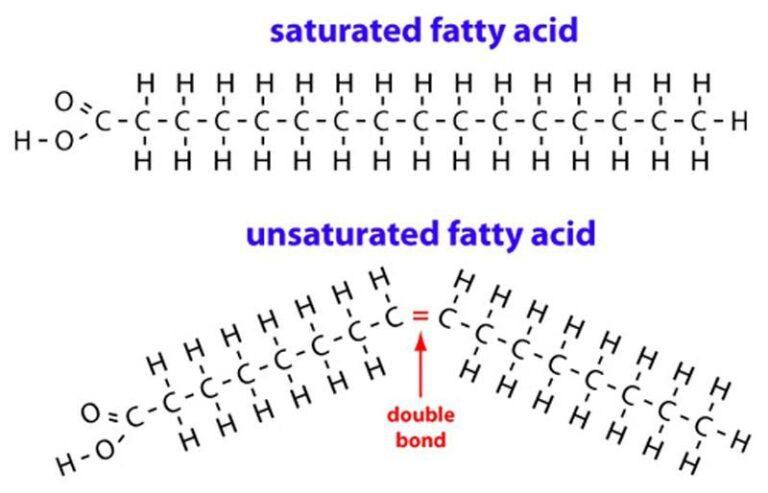
Compare saturated and unsaturated fatty acids.
Saturated fatty acids have no carbon–carbon double bonds; unsaturated fatty acids have one or more double bonds that can create kinks.

How does saturation affect a lipid’s physical state?
Straight saturated chains pack tightly and are often solid; kinked unsaturated chains pack loosely and are often liquid at room temperature.

What is the structure of a phospholipid?
An amphipathic lipid with a hydrophilic phosphate-containing head and hydrophobic fatty-acid region.
Why do phospholipids form bilayers and micelles?
Their hydrophilic regions face water while their hydrophobic regions gather away from water. Bilayers have two layers; micelles form rounded structures.

How can you recognize a steroid?

How can you distinguish a triglyceride, phospholipid, and steroid from their structures?
Triglyceride = glycerol plus three fatty-acid chains; phospholipid = phosphate-containing head plus hydrophobic region; steroid = four connected rings.
Compare monosaccharides, disaccharides, and polysaccharides
Monosaccharide = one sugar unit; disaccharide = two sugar units; polysaccharide = long chain of sugar units.
What is a glycosidic bond?
The bond that joins monosaccharides together.
What are the major functions of carbohydrates?
Immediate energy, energy storage, structural support, and cell identity or signaling.
Compare starch and glycogen.
Starch stores energy in plants; glycogen stores energy in animals.
Compare cellulose, chitin, and peptidoglycan.
Cellulose supports plant cell walls; chitin occurs in structures such as arthropod exoskeletons; peptidoglycan supports bacterial cell walls.
Compare glycoproteins and glycolipids.
Glycoprotein = protein plus carbohydrate; glycolipid = lipid plus carbohydrate. Both help with cell recognition and signaling.
How do carbohydrates act as cellular ID badges?
Carbohydrate chains on the outer cell surface help cells recognize and communicate with one another.
How do carbohydrates provide cells with usable energy?
Enzymatic reactions break down glucose, release its chemical potential energy, and use that energy to produce ATP.
What is metabolism?
The total collection of chemical reactions occurring within a cell or organism.
Compare cell, tissue, organ, organ system, and organism.
A cell is the basic unit of life; similar cells form a tissue; multiple tissues form an organ; organs work together in an organ system; all the organ systems together form an organism.
What is a biological macromolecule, and why do cells need macromolecules?
A macromolecule is a large biological molecule. Cells use macromolecules for structure, energy, information storage, and cellular activities.

What are the basic components of a phospholipid?
A phosphate-containing head that is hydrophilic and attracted to water
A backbone that connects the head to the tails
Fatty-acid tails that are hydrophobic and avoid water