3.1: UNDERSTANDING CRISIS AND DISASTERS
 Call Kai
 Learn
Learn Practice Test
 Spaced Repetition
 Match
Match Flashcards
 Knowt Play
1/37

There's no tags or description
Looks like no tags are added yet.
Name | Mastery | Learn | Test | Matching | Spaced | Call with Kai | Chat |
|---|
No analytics yet
Send a link to your students to track their progress
38 Terms
Crisis
● A situation faced by an individual, group or organization which they are unable to cope with by the use of normal routine procedures and in which stress is created by sudden change.
● A time of intense difficulty or danger.
Health crisis
Political crisis
Cultural crisis
Economic crisis
Natural event crisis
Different Types of Crisis
Emergency
a serious, unexpected, and
often dangerous situation
requiring immediate action
Continuum of Magnitude of Disaster
a cyclic life cycle used to organize how communities handle hazards
Predictable, handled locally
Emergency
Community disruption, Outside help needed
Disaster
Regional impact, Aid slow to arrive
Last: _______
Catastrophe, Extinction
Disasters
A sudden accident or a natural catastrophe that causes great damage or loss of life. Occurrence disrupting the normal conditions of existence and causing a level of suffering that exceeds the capacity of adjustment of the affected community.
(dus-) meaning "bad"
(aster) meaning "star"
The word DISASTER came from Ancient Greek prefixes:
unfavorable planetary positions.
The ancient Greeks used to blame calamities on ______________
Size
Degree of Uncertainty
Timing
Cause
Characteristics of Disasters
Size
scope, intensity, and duration
Degree of Uncertainty
expected or unexpected
Timing
time of day, day of week, season
Cause
natural or man-made
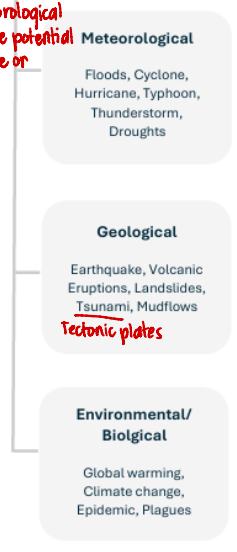
Natural Disasters
Large-scale or geological or meteorological events that have the potential to cause loss of life or property
Meteorological
Geological
Biological
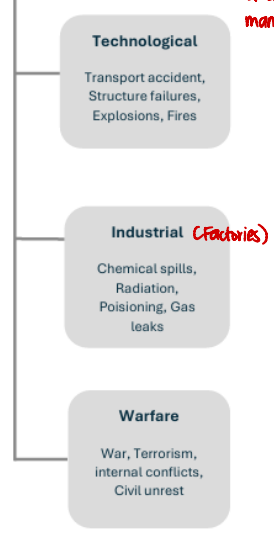
Man made Disasters
Element of human intent, negligence or error involving a failure of a man-made system
Natural hazards
can be categorised based on how quickly they occur and the severity of their impact
Slow Onset
these are hazards that develop gradually over weeks, months, or even years. They may not seem immediately dangerous, but their long-term impacts can be devastating
Rapid Onset
natural hazards that happen suddenly with little or no warning. Although they may not be as globally catastrophic as some events, they can still cause significant localized damage and pose high risks to life and infrastructure.
Catastrophic
these are sudden and extremely destructive events. These events cause massive destruction and loss of life in a very short period.
THE THREE LEVELS OF EFFECTS CAUSED BY NATURAL HAZARDS
Primary
Secondary
Tertiary
Primary
direct and immediate effects of a natural hazard, occur as a result of the hazard itself
Secondary
Indirect effects that happen because of the primary effects, often, they happen minutes to days after the main event
Tertiary
the long-term and lasting impacts of the disaster, they often develop months or years after the event.
Disasters and Their Psychological Impact
Disasters are not uncommon events; no two disasters are exactly alike, but certain characteristics tend to be associated with specific reactions among survivors.
● No two survivors are the same
● No two disaster experiences are the same
● No two response and recovery experiences are the same
Therefore, individuals’ perception of and responses to a shared event will differ
Solastalgia
Distress that is produced by environmental change impacting on people while they are directly connected to their home environment. (ALBERCHT ET AL. 2007)
“solace”
loss of comfort due to degradation of the inhabited environment
“algia”
group of feelings common to people who live in a degraded environment
Eco-guilt
Eco-anxiety
Eco-grief
3 ECOLOGICAL EMOTIONS
Eco-guilt
“self-criticism, self-examination, self-blame in environmental loss”
Eco-anxiety
“chronic fear of environmental doom”
nagiging motivating factor to advocate for change
Eco-grief
“grief felt in relation to experienced or anticipated ecological losses”
it is quite similar with solastalgia that can also be anticipated
ex. nabili na ng isang company yung lupa niyo & you heard na gagawin na siyang SM
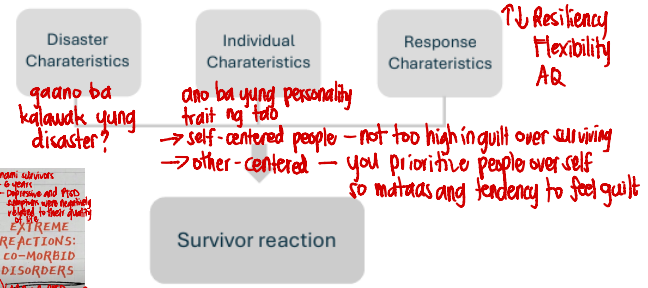
Predictors of Survivor Reactions
Any one survivor’s reaction will result from an interaction between the characteristics of the disaster, the individual, and the response.
Post-traumatic stress disorder and depression
Extreme reactions: co morbid disorders?
Post-traumatic stress disorder
also known as shell shock, coined during WW1. it includes tremors, loss of sight and hearing, and extreme fatigue
Southeast tsunami survivors, six, quality of life.
In Siqveland and his colleagues (2015) follow-up study of __________for ____
years, depressive and posttraumatic stress symptoms were negatively related to their ____________
Survivor’s Guilt
Exhibits various symptoms based on the reasoning for the trauma caused, often leading to feelings of deep sorrow, disbelief, and occasionally even a sense of accountability. It can be a symptom of post traumatic stress disorder (PTSD).
● “How can I be happy that I survived when so many others don’t.”
● “Why not me?”