Coordinated Body Systems & Homeostasis (cocept)
 Call Kai
 Learn
Learn Practice Test
 Spaced Repetition
 Match
Match Flashcards
 Knowt Play
1/49

Earn XP
Description and Tags
This set of flashcards covers the fundamentals of multicellular organization, organ systems, homeostasis, the stimulus-response model, and feedback loops including temperature and blood glucose regulation.
Name | Mastery | Learn | Test | Matching | Spaced | Call with Kai | Chat |
|---|
No analytics yet
Send a link to your students to track their progress
50 Terms
Multicellular organisms
Organisms that contain trillions of specialised cells which cannot independently obtain everything they need or remove all their wastes.
Organisation of the human body
The hierarchical structure of the body represented by: Cells → Tissues → Organs → Organ systems → Organism.
Aerobic cellular respiration
A process requiring glucose and oxygen to produce energy, carbon dioxide, and water, expressed as: C6H12O6+6O2→6CO2+6H2O+energy.
Glucose
A nutrient mainly derived from the digestion of carbohydrates that travels through the bloodstream to cells for cellular respiration.
Digestive system
Comprised of the stomach, intestines, and liver; its main role is to break food down and absorb nutrients.
Respiratory system
Comprised of the lungs and trachea; its main role is to take in O2 and remove CO2.
Circulatory system
Comprised of the heart and blood vessels; its main role is to transport oxygen, nutrients, hormones, and wastes.
Urinary/excretory system
Comprised of the kidneys and bladder; its main role is to remove urea, excess water, and salts.
Nervous system
Comprised of the brain, spinal cord, and nerves; its main role is rapid communication and coordination.
Endocrine system
Consists of hormone-producing glands used for longer-term regulation of the body.
Homeostasis
The maintenance of a relatively stable internal environment despite changes inside or outside the body, keeping factors like temperature and pH within suitable ranges.
Stimulus
A detectable change in the internal or external environment, such as bright light or increasing temperature.
Receptor
A component that detects a stimulus, such as temperature, light, or pressure receptors.
Coordinator
The part of the stimulus-response model that receives and processes information, involving the brain or endocrine system.
Effector
A muscle or gland that performs a response after receiving information from a coordinator.
Negative feedback
The major mechanism in homeostasis that reverses a change and moves a condition back towards its normal level.
Positive feedback
A feedback mechanism that strengthens or increases the original change instead of reversing it, such as blood clotting or oxytocin during childbirth.
Hypothalamus
A part of the brain that plays an important role in temperature regulation by coordinating responses to keep core temperature around 37∘C.
Vasodilation
The widening of blood vessels near the skin when the body is too hot, allowing more warm blood to reach the surface and heat to escape.
Vasoconstriction
The narrowing of blood vessels near the skin when the body is too cold, reducing blood flow at the surface to decrease heat loss.
Shivering
A process where muscles rapidly contract and relax to release heat through cellular respiration.
Insulin
A hormone released by the pancreas when blood glucose is too high, causing body cells to take up more glucose and storing it as glycogen in the liver and muscles.
Glucagon
A hormone released by the pancreas when blood glucose is too low, causing the liver to convert stored glycogen into glucose and release it into the blood.
Platelets
Cell fragments that stick to damaged blood vessels and release chemicals to attract more platelets to form a blood clot, an example of positive feedback.
Specialised Cells
Cells that have particular structures and features allowing them to perform specific functions efficiently
Tissue
A group of similar specialised cells working together to perform a particular function
Organ
A structure made of different tissues working together to perform particular functions
Organ system
A group of organs that work together to perform major functions in the body
Coordination of body systems
Body systems depend on each other to supply cells with nutrients and oxygen, remove wastes and maintain stable internal conditions
Digestive + circulatory systems
The digestive system breaks down food and absorbs nutrients such as glucose. The circulatory system transports these nutrients to body cells
Respiratory, circulatory systems
The respiratory system exchanges oxygen and carbon dioxide, while the circulatory system transports these gases between the lungs and body cells
Circulatory + excretory systems
The circulatory system carries wastes such as urea to the kidneys, where the excretory system removes them from the blood.
Set point
The normal or desired level around which a body condition is regulated, such as approximately 37°C for core body temperature.
Homeostatic variable
A condition controlled within a suitable range, such as body temperature, blood glucose, water balance or pH.
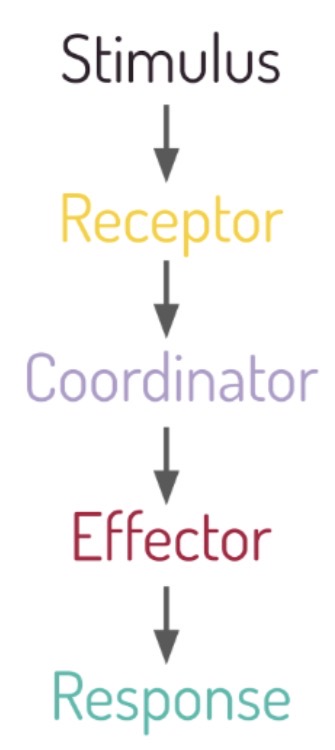
Stimulus–response model
The sequence Stimulus → Receptor → Coordinator → Effector → Response that allows the body to detect and respond to change.
Response
The change produced by an effector to deal with a stimulus.
Sweating
The release of sweat onto the skin. Evaporation of sweat removes thermal energy and helps cool the body.
Thermoregulation
The homeostatic control of body temperature to keep core temperature within a suitable range.
Blood glucose regulation
A negative-feedback process that keeps blood glucose within a suitable range, mainly using the hormones insulin and glucagon.
Glycogen
The storage form of glucose found mainly in the liver and skeletal muscles.
Hormone
A chemical messenger produced by an endocrine gland and transported through the blood to specific target cells or organs.
Target cell
A cell containing receptors for a particular hormone, allowing it to respond to that hormone.
Insulin vs glucagon
Insulin decreases blood glucose, whereas glucagon increases blood glucose.
Nervous vs endocrine control
Nervous control is generally rapid and short-lived. Endocrine control is generally slower and longer-lasting and uses hormones transported in blood.
Negative vs positive feedback
Negative feedback counteracts a change and returns a variable toward normal. Positive feedback amplifies a change until a particular event is completed.
High temperature response
Temperature rises - receptors detect change - hypothalamus - sweating + vasodilation - increased heat loss - temperature returns towards normal
Low temperature response
Temperature falls - receptors detect change - hypothalamus - shivering + vasoconstriction - increased heat production/reduced heat loss - temperature returns towards normal
High blood glucose response
Blood glucose rises - pancreas releases insulin - increased glucose uptake and glycogen storage - blood glucose decreases towards normal
Low blood glucose response
Blood glucose falls - pancreas releases glucagon - liver increases glucose release, including through glycogen breakdown - blood glucose rises towards normal
Blood clotting as positive feedback
Platelets stick to a damaged blood vessel and release chemicals that attract more platelets. This amplifies the response until a clot forms.