Ch 1 Accounting 298 Baker
 Call Kai
 Learn
Learn Practice Test
 Spaced Repetition
 Match
Match Flashcards
 Knowt Play
1/47

Earn XP
Description and Tags
based off slides/ lecture/ and adaptive learning
Name | Mastery | Learn | Test | Matching | Spaced | Call with Kai | Chat |
|---|
No analytics yet
Send a link to your students to track their progress
48 Terms
External Users
Individuals and organizations outside a company who want financial information about the company. ( Investors and creditors are most interested in these financial reports) Ex: suppliers, banks, customers, investors, potential investors, and tax authorities. ( They rely on financial statements to assess the company's performance and make informed decisions. )
Investors
( owners/ stockholders) Use accounting information to decide whether to buy, hold, or sell ownership shares of a company.
Creditor
(such as supplier and bankers) use accounting information to evaluate the risks of granting credit or lending money.
T/F 3 steps in accounting porpcess are identificiation, recording, and communication.
True
T/F Bookkeeping encompasses all steps in the accounting process.
False. Bookeeping is only the recording part of the process.
T/F Accountants prepare, but do not interpret financial reports
False.
T/F The 2 most common types of external users are investors and company officers ( CEO, CFO, CMO, COO)
False. The C-Suite are investors and are missing the creditors as another external user
what is SOX
It was created to protect investors from corporate fraud following massive accounting scandals like Enron and WorldCom. The law enforces strict rules on how corporations handle, audit, and report their financial data to ensure transparency and accuracy.
Generally Accepted Accounting Principles ( GAAP)
Standards that are generally accepted and universally practiced. These standards indicate how to report economic events.
Relevance
means that financial information is capable of making a difference in a decision ( which should be presented )
Faithful representation
numbers and descriptions match what really existed or happened, and they are factual
Historical Cost Principle ( Measurement Principle)
Dictates that companies record asset at their cost. ( I buy car and record it as its value today and how much i bought it for today)
Fair value principle ( measurment principle)
Assets and liabilities should be reported at a fair value ( the price received to sell an asset or settle a liability) (Disregard for now )
MONETARY UNIT ASSUMPTION
Requires that companies include in the accounting records only transaction data that can be expressed in monetary terms. (If you cannot express it in terms of money it cannot be recorded)
ECONOMIC ENTITY ASSUMPTION
Requires that the activities of the entity be kept separate and distinct from the activities of its owner and all other economic entities. e.g., personal expenses and business expenses should be kept separate, even if youre a business owner.
SEC
Securities and Exchange Commissio
Forms of Business Ownership
Proprietorship, Partnership, Corporation
Proprietorship
Owned by one person, the owner is often the manager/ operator. The owner receives profits, suffers any losses, and is personally liable for all business debts. Ex: small business owners
Partnership
Owned by two or more ppl, often a retail and service-type business. Unlimited personal liability. Partnership agreement. Ex: Bill gates and Paul Allen for Microsoft
Corporation
Ownership divided into shares of stock. Separate legal entitty organized under state corporation law, limited liability, ease of ownership transfer, unlimited life, higher tax rates
Combining the activities of Ford and General Motors would violate the
cost principle/
economic entity assumption/
monetary unit assumption/
or the ethics principle
economic entity
A business organized as a separate legal entity under state law, having ownership divided into shares of stock, is a
Proprietorship
partnership
corporation
sole proprietorship
corporation
T/F Congress passed the Sarbanes-Oxely Act to reduce unethical behavior and decrease the liklehood of future corporate scandals
True
T/F The primary accoutnign standard-setting body in the US is the Financial Accounting Standards Board (FASB)
True
T/F The historical cost principle dictates that companies record assets at their cost. In later periods, however, the fair value of the asset must be used if its fair value is higher than its cost.
False. We do not use fair value asset, we stick with its original cost
T/F Relevance means that financial information matches what really happened; info is factual
False. Matching definition would be faithful representation
State the accounting equation and define its components
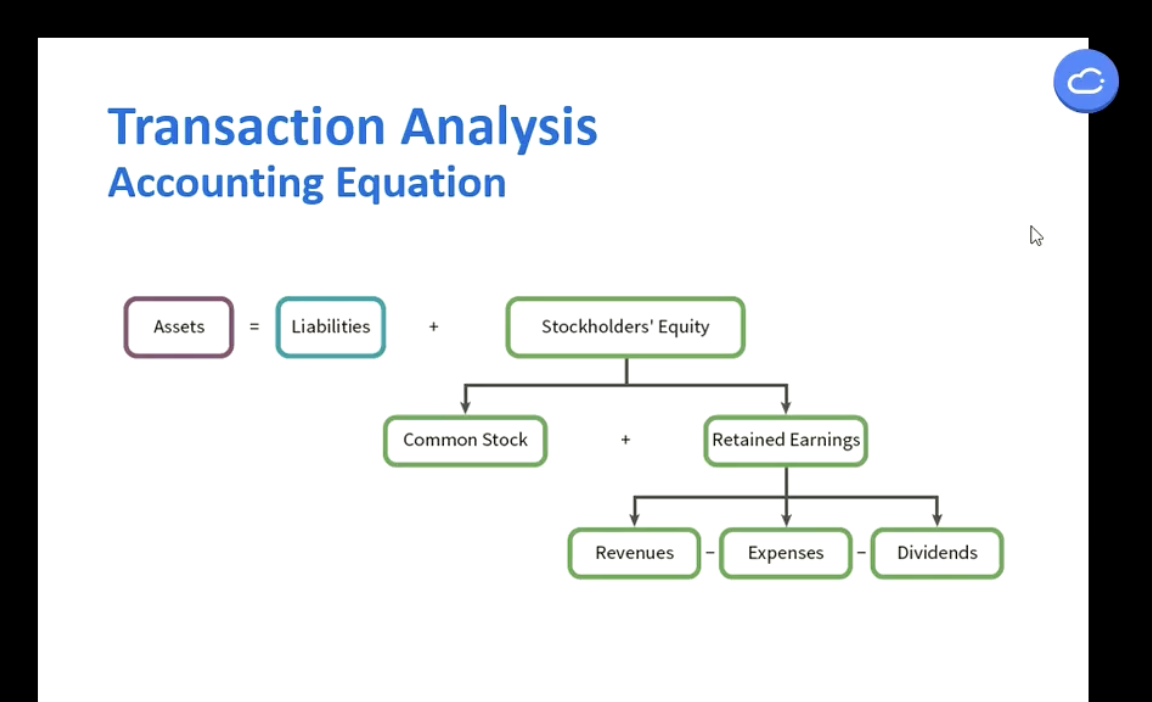
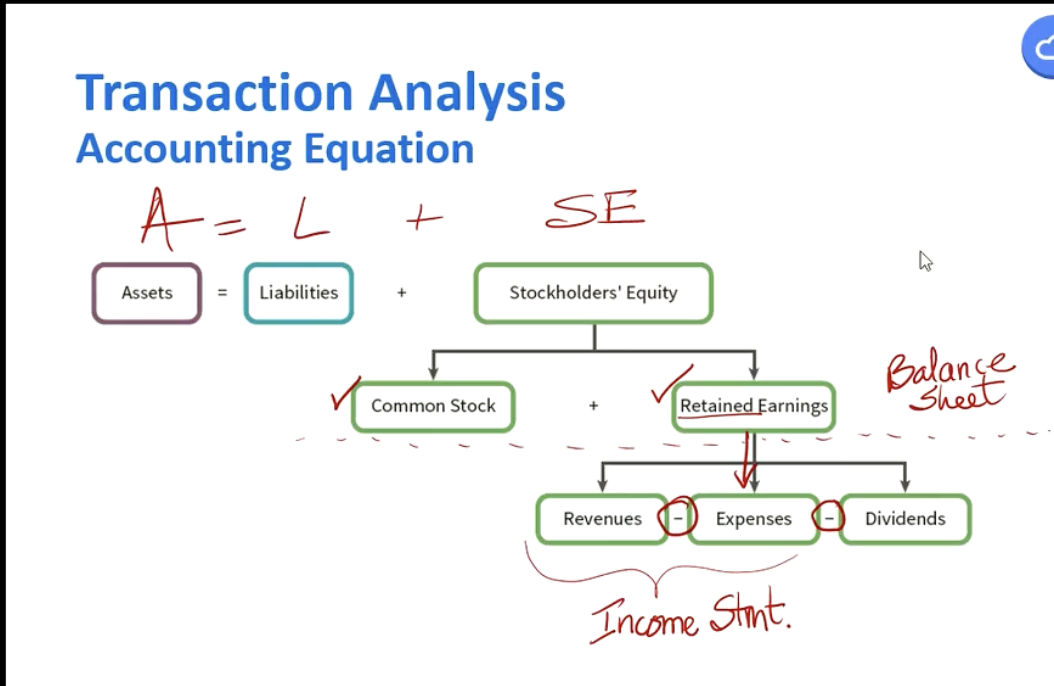
Assets = Liabilities + stockholders’ equity.
Assets MUST equal the sum of liabilities and stockholders’ equity
Assets:
Resources a business owns,
Provide future service benefits,
Cash, supplies, equipment, patents, etc.
Liability:
claims agaisnt assets ( debts and obligations).
Creditors ( party to whom money is owed )
accounts payable, notes payable, salaries and wages payable, interest payable, etc.
Stockholder’s Equity
Ownerhsip claim on total assets
referred to as residual equity
Common stock and retained earnings (Balance sheet)
notes payable
A notes payable is a formal, written legal promise by a company to repay a borrowed sum of money plus interest by a specific future date. LONGTERM
Common stock
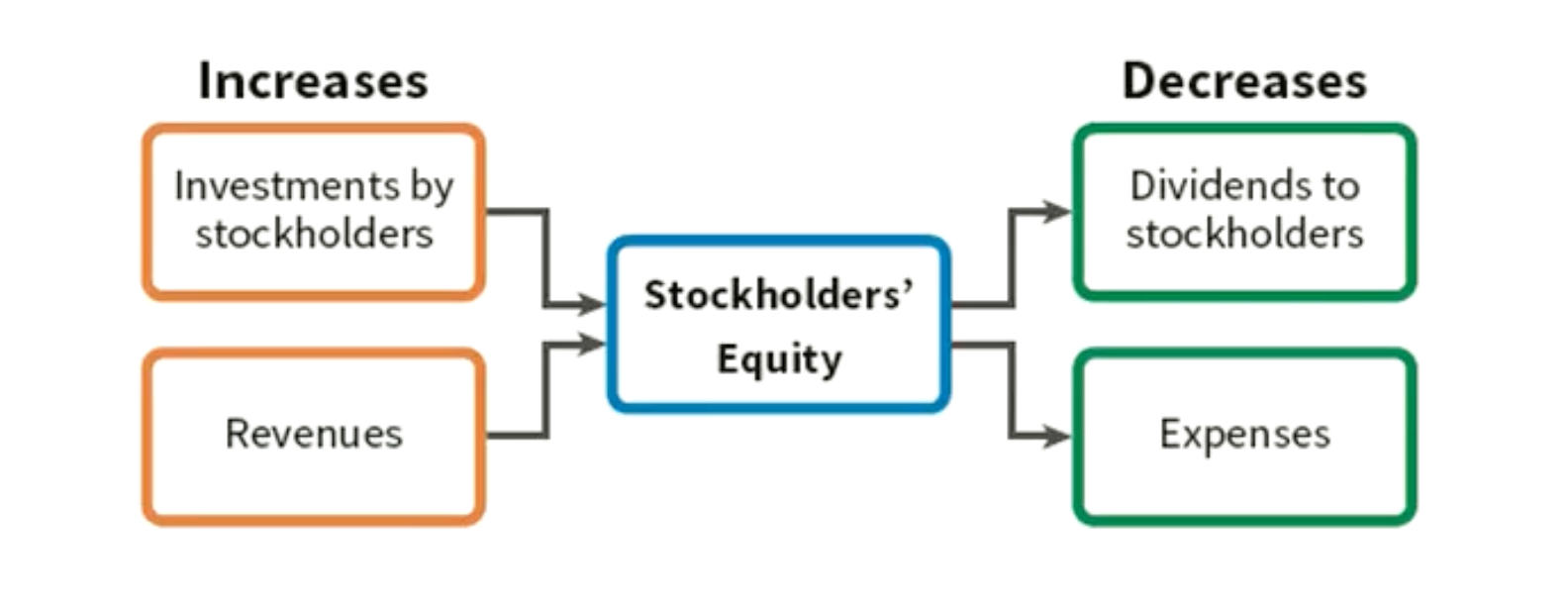
Represents the total amount paid in by stockholders for the shares they purchase.

Revenues
Increase SE. Results from business activities entered into for the purpose of earning income.
Common sources of revenue are: sales, fees, services, commissions, interest, dividends, royalties, and rent.

Expenses
Decrease SE. the cost of assets consumed or services used in the process of generating revenue. Ex: salaries expense, rent expense, utilities expense, tax expense, etc ( dont worry about taxes much in this course)
Dividends
Decrease SE. Distribution of cash or other assets to stockholders. Dividends reduce retained earnings. However, dividends are NOT an expense.
Classify the following items as issuance of stock, dividends, revenues, or expenses. Then indicate whether each item increases or decreases stockholders’ equity.
Rent expense
service revenue
dividends
salaries and wages expense
Rent expense decreases equity
service revenue will increase equity
dividends decrease equity
salaries and wages expense decrease equity
Transactions
are a business economic events recorded by accountants.
not all activities represent transactions; ( money and numbers must be involved, receive/give cash)
they have dual effect on the accounting equation
Accounts Receivable
When we (business) has the right to RECEIVE money ( like preforming a service and recieving money
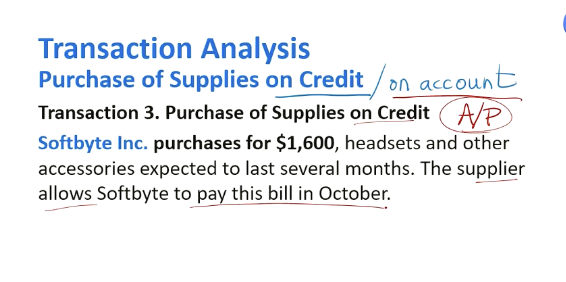
Accounts Payable
When we ( business) incur an expense, or owe money for a product/service.

Summary of Transactions

Four Financial Statements
Income Statement, Retained Earnings statement, balance sheet, cashflow statement

Income Statement
Presents the revenues and expenses and resulting net income or net loss for a specific period of time.

Retained Earnings Statement
Summarizes the changes in retained earningfs for a specific period of time
Balance Sheet
Reports the assets, liabilities, and stockholders’ equity of a company at a specific date.

Cashflow Statement
Summarizes information about the cash inflows (receipts) and outflows ( payments) for a specific period of time.
net income will result during a time period when :
assets exceed liabilities
assets exceed revenues
expenses exceed revenues
revenues exceed expenses
Revenues exceed expenses
Which of the following financial statements is prepared as of a specific date?
Balance sheet
income statement
retained earnings statement
statement of cashflows
balance sheet ( income and retained are over a period of time )
ESG Reporting: beyond the 4 financial statments.
The idea that a company’s responsibility lies with anyone who is influenced by its actions. Socially responsible business does not exploit or endanger any group of individuals
** Measurement of these factors is difficult, but many interesting and useful efforts are underway
( will not be tested)


external or internal users


Internal : running company
External : evaluating company
