Topic 3: Genetics (a-c)
 Call Kai
 Learn
Learn Practice Test
 Spaced Repetition
 Match
Match Flashcards
 Knowt Play
1/79

Earn XP
Name | Mastery | Learn | Test | Matching | Spaced | Call with Kai | Chat |
|---|
No analytics yet
Send a link to your students to track their progress
80 Terms
What are the 2 different types of reproduction
Asexual and sexual
What is sexual reproduction?
The process involving the fusion of the nuclei of two games to form a zygote (fertilised egg cell) and the production of offspring that are genetically different from each other
What is asexual reproduction?
The process resulting in genetically identical offspring being produced from one parent
What type of organisms is asexual reproduction very common in (name 3)?
vertebrates (animals without a backbone)
single celled organisms
some plants
Give an example of a plant which reproduces through asexual reproduction
strawberry or spider plant: runners form with new genetically identical plant
Give an example of a type of bacteria which reproduces asexually
E-coli is reproduced by binary fusion (mitosis)
Does asexual reproduction involve gametes?
no
How many parents are required for asexual reproduction?
1
Are off spring unique or identical in asexual reproduction
Identical
to the parent and to each other
In which type of reproduction does fertilisation take place?
sexual reproduction
In which type of reproduction is there variation in off spring?
Sexual reproduction
What type of environment do organisms which reproduce sexually have survival value in?
a changing environment
What type of environment do organisms which reproduce asexually have survival value in?
a stable environment
In which type of reproduction are clones produced?
asexual
Name advantages of asexual reproduction
populations can be increased rapidly when the conditions are right
more time and energy efficient
faster
Give disadvantages for asexual reproduction
-no variation, therefore cannot adapt to changing environments
-population vulnerable to changing environments
What is fertilisation?
The fusion of gamete nuclei and as each gamete comes form a different parent, there is variation in the off spring
In sexual reproduction what must each parent produce?
gametes
What are gametes?
Sex cells (egg and sperm cells)
which are haploid (contain half the number of chromosomes )
What is a zygote?
the fused male and female gametes.
Containing a pair of each chromosome one coming from the male and the other from the female
The zygote grows into new off spring
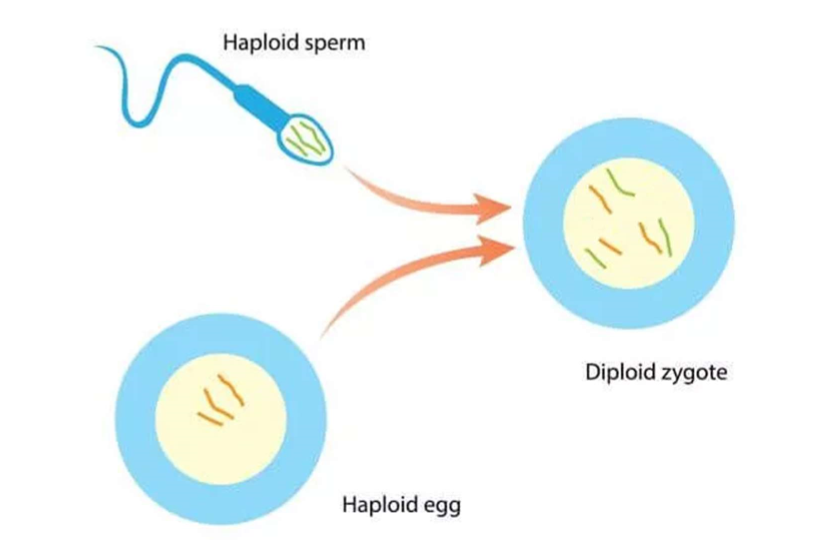
How many chromosomes does a zygote have?
46, therefore it is referred to as diploid (contains the full number of chromosomes)
Why is it important that gamete cells are haploid?
So that at fertilisation when the egg and sperm cell combine it results in a cell with a full complement of DNA
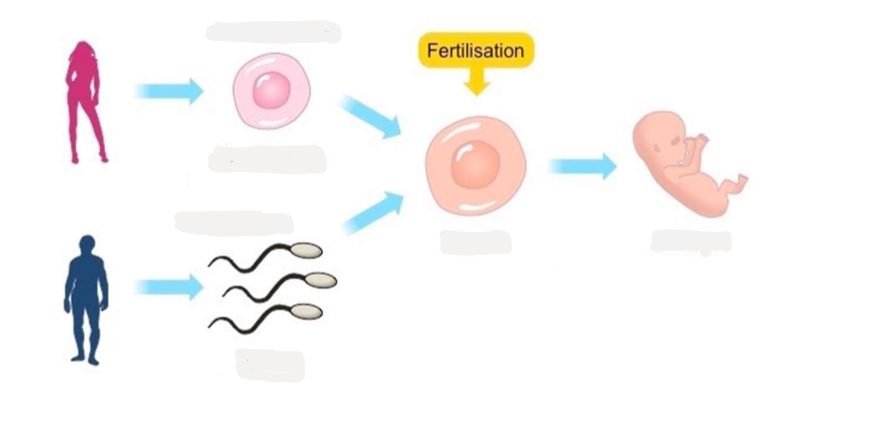
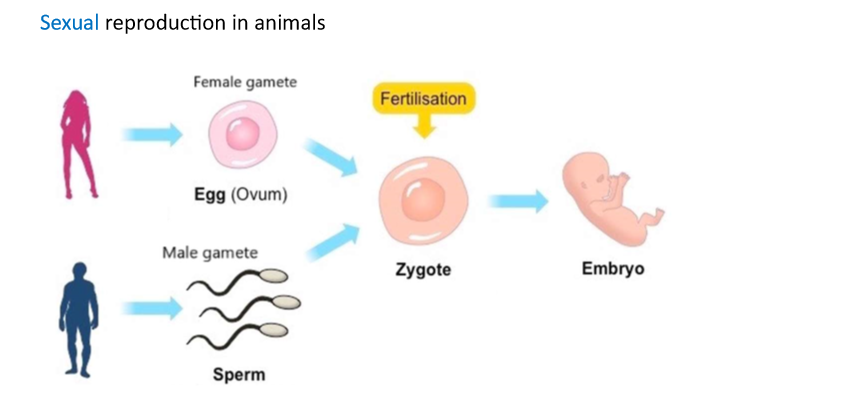
here is a diagram of the process of sexual reproduction in animals:
Label : egg cell, sperm cell, zygotes, embryo, female gamete, male gamete
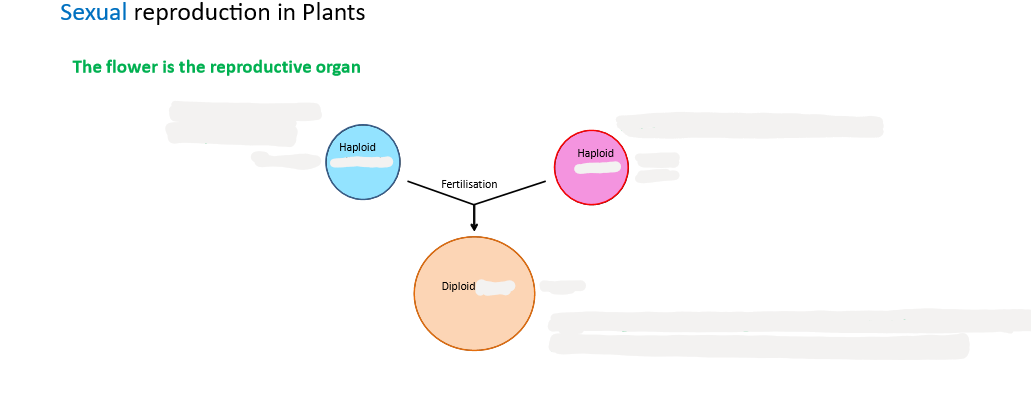
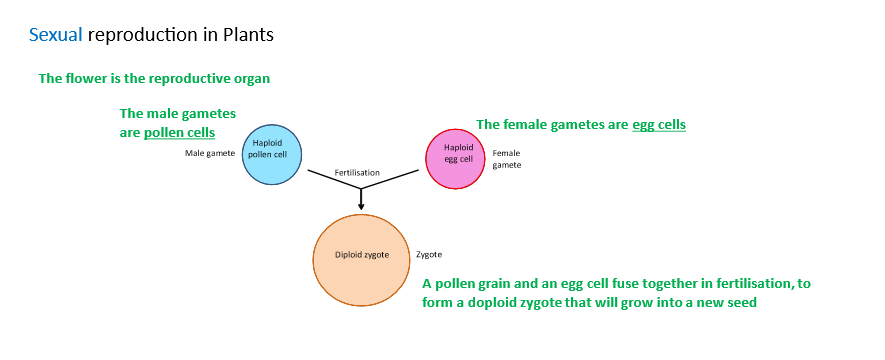
Here is a diagram of sexual reproduction in plants
Label: male gamete, female gamete, pollen cell, egg cell, zygote
In sexual reproduction in plants what is the male gamete?
pollen cells
In sexual reproduction in plants what is the female gamete?
egg cells
In sexual reproduction in plants what are the haploid cells?
the pollen cells and egg cells
In sexual reproduction in plants what is the diploid cell?
the zygote
How does fertilisation happen in plants
A pollen grain and an egg cell fuse together in fertilisation, to form a diploid zygote that will grow into a new seed
By what process do cells in reproductive organs divide to form gametes?
meiosis
What happens to the number of chromosomes after meiosis?
it halves: from 46 - 23 (diploid to haploid)
are the cells produced by meiosis genetically unique or identical?
unique, they are genetically different haploid gametes
How is DNA organised in cells?
In the nucleus the DNA is organised into strands called chromosomes
What is a chromosome?
A long strand of DNA wrapped around proteins
What are the sex chromosomes?
XX → Female
XY → male
What is a haploid cell? (Give 2 definitions)
-Haploid cells have single chromosomes (one member from each parent)
-They contain half the number of chromosomes of the cells
What is a diploid cell?
-Diploid cells have pairs of chromosomes
-They contain the full number of chromosomes in the cell
Why are gametes haploid?
so that after fertilisation the full diploid chromosome number is restored
What is meiosis?
-Division of diploid cells to produce 4 haploid gamete cells
In humans where does meiosis take place?
ovaries in female
testis in males
What must happen before meiosis an take place?
each chromosome has to be copied
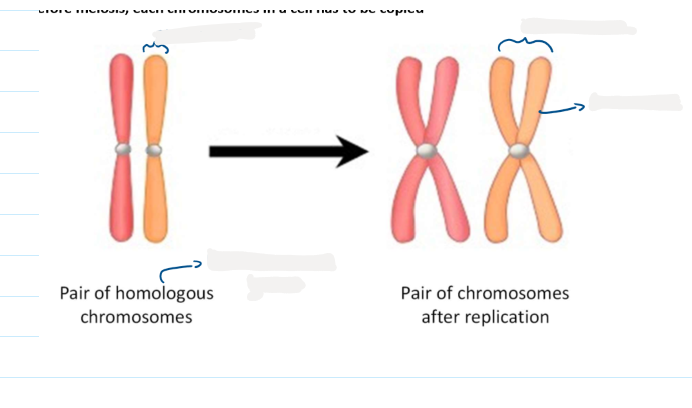
Label these homologous chromatids and chromosomes after replication
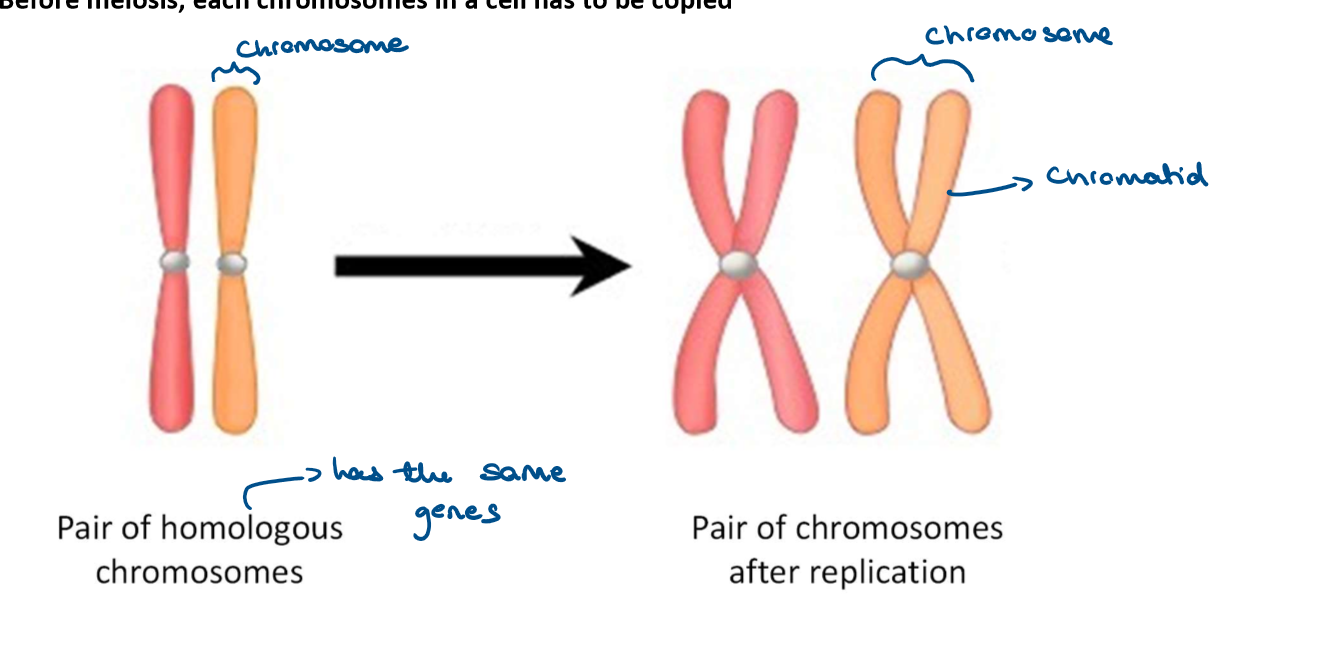
What is a homologous chromosome?
A pair of chromosomes which have the same genes
What do the chromosomes look like after replication?
each chromosome in the pair is made up of 2 chromatids
What are the stages of meiosis?
Prophase 1, Metaphase 1, Anaphase 1, Telophase 1, Prophase 2, Metaphase 2, Anaphase 2 and Telophase 2
Explain the whole process of meiosis
Prophase 1: The nuclear envelope breaks down, chromosomes condense and become visible
Metaphase 1: Chromosomes line up in the equator
Anaphase 1: Sister chromatids separate and are pulled to opposite poles by spindle fibres
Telophase 1: A nuclear envelope form around each set of chromosomes, creating two separate nuclei in the same cell
Cytokinesis 1: Cell divides into two daughter cells, each with a set of chromosomes identical to those of the parent cell
Prophase 2: The chromosomes condense and become visible
Metaphase 2: Chromosomes line up in the equator of the cell
Anaphase 2: The sister chromatids separate and are pilled to opposite poled of the cell by spindle fibres
Telophase 2: A nuclear envelope form around each set of chromosome, each with a unique combination of chromosomes from the parent cell
This results in the production of 4 genetically different daughter cells
Why is it important that gametes are different to each other?
For genetic variation
What is the result of meiosis?
Haploid cells that are different from each other, this is because each gamete can get either member of each chromosome, this is called independent assortment
What is independent assortment?
A process that ensures the random distribution of maternal and paternal chromosomes into gametes
What types of cells does mitosis produce?
Body cells
What type of cells does meiosis produce?
Gamete
How many cell divisions take place in mitosis?
1
How many cell divisions take place in meiosis?
2
Why is meiosis important?
It increases genetic variation of off spring
What is the genome?
The entire set of genetic material of an organism
It is the sequence of all the DNA in an organism
What is a gene?
A section of DNA that codes for a particular sequence of amino acids which form proteins
What do genes control?
Our characteristics as they code for proteins that play important roles in what our cells do
What is the configuration of DNA often referred to as?
A double helix
What is the structure of DNA like?
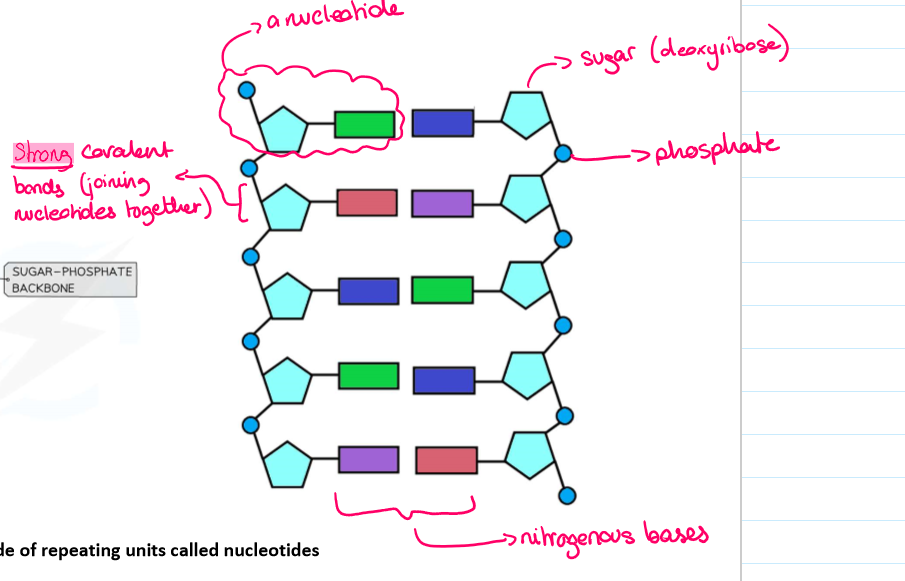
2 sugar, phosphate backbones, joined together by nitrogenous bases
What are the nitrogenous bases often referred to as?
complementary bases
What are the 4 bases?
A (Adenine), T (Thyroxine), C (Cytosine), G (Guanine)
Which base is complementary to A (Adenine)?
T (Thyroxine
What base is complementary to C (Cytosine)?
G (Guanine)
What are the weak bonds which join the complementary bases together?
Hydrogen bonds
How many hydrogen bonds are there between A and T?
2
How many hydrogen bonds are between C and G?
3
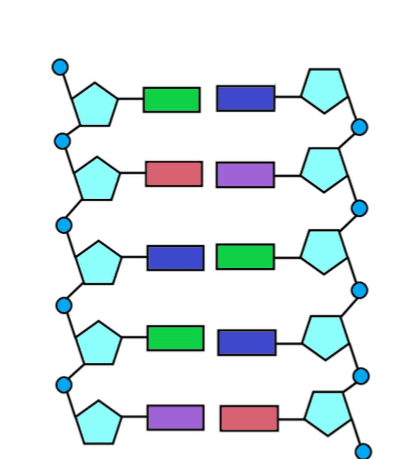
On this diagram label:
a nucleotide, the nitrogenous bases, sugar (deoxyribose), phosphate, weak hydrogen bonds, strong covalent bonds
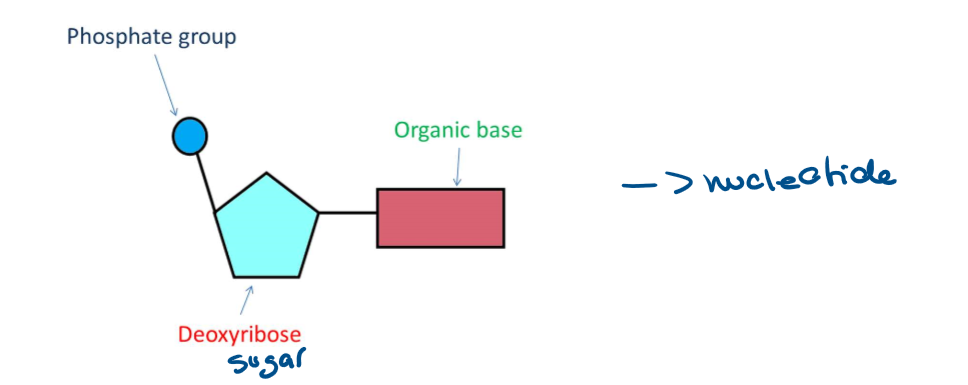
Draw and label a diagram of a nucleotide
What is the difference between DNA and RNA?
RNA plays an important role in protein synthesis
DNA is the instruction used to make proteins
Is DNA a polymer or monomer?
A polymer composed of smaller monomers
What is a gene?
a section of the chromosome that controls one protein
What are the differences in structure of DNA and RNA?
DNA is a double stranded molecules, whereas RNA is a single stranded molecule
What are the differences in bases in DNA and RNA?
RNA contains Uracil instead of Thyroxine.
In DNA T pairs with A, but in RNA U pairs with A
What is the difference in the type of sugar in DNA and RNA?
DNA contains deoxyribose sugar but RNA contains ribose sugar
What are the 3 types of DNA?
mRNA, tRNA (and rRNA)
What is a genome?
The entire genetic information of an organisms
Explain the method for extracting DNA out of a fruit
1) Dissolve 3g of salt in 100cm³ of water in a large beaker. Add 10cm³ of washing-up liquid and stir gently until the salt dissolves. Do not make the mixture foamy! The detergent in this solution break down cell surface membranes and the membranes around the nuclei. The salt makes the DNA more likely to clump together, which is important in step 7
2) Thoroughly mash 50g pf strawberries. Put the smashed strawberries into an empty beaker and add the solution made in step A. Stir slowly for one minute.
3) Place the beaker in a water bath at 60 degrees c for 15 mins
4) Filter the mixture and collect the filtrate in a small beaker
5) Measure 20cm³ of the filtrate and pour it into a boiling tube
6) Add two drops of protease enzyme solution. (Protease breaks down proteins)
7) tilt the boiling tube slightly and pour in ice-cold ethanol, letting the ethanol run down the side of the tube very slowly. Stop when as much ethanol has been added as there is filtrate. DNA is insoluble in ethanol and so it forms a precipitate.
8)Leave the tube for a few minutes. A white layer forms between the filtrate and the ethanol. This is DNA, and it can be wound around a glass stirring rod and lifted out of the tube
Why is detergent added to the solution in the experiment to extract DNA from a fruit?
Because detergent breaks down the cell surface membrane and nuclear membrane
Why is salt added to the solution in the experiment to extract DNA from a fruit?
Because it clumps the DNA together
Why is alcohol/ ethanol added to the solution in the experiment to extract DNA from a fruit?
Because DNA is insoluble in ethanol and alcohol so forms a precipitate.