Clinical Physiology Exam 1
 Call Kai
 Learn
Learn Practice Test
 Spaced Repetition
 Match
Match Flashcards
 Knowt Play
1/60

There's no tags or description
Looks like no tags are added yet.
Name | Mastery | Learn | Test | Matching | Spaced | Call with Kai | Chat |
|---|
No analytics yet
Send a link to your students to track their progress
61 Terms
What is the leading cause of preventable deaths from all-cause mortailty?
Low Cardiorespiratory Fitness
According to the American Heart Association, what is the primary controllable cardiac risk factor?
Sedentary Lifestyle
What are the risks of sedetary behavior?
• Reduced functional capacity
• Osteoporosis
• Obesity
• Anxiety and depression
• Hypertension
• Cardiovascular disease
• Colon cancer
• Thromboembolic stroke
• Breast cancer
• Type 2 diabetes mellitus
Each additional hour of television watched per day translated to _ increase in all cause mortality.
11%
How much muscle strengthening activities do adults need to stay healthy?
at least 2x a week
How much moderate intensity aerobic exercise do adults need to stay healthy?
at least 150 to 300 minutes per week
What does the FITT principle stand for?
• Frequency: How often you exercise
• Intensity: How hard you work
• Time/Duration: How long you perform a physical activity or exercise
• Type (mode): Specific type of activity or mode of exercise
What is the most important FITT variable and most often ignored?
Intensity
Type: Anaerobic (non-oxidative)
Metabolic reactions (bioenergetics) within the muscle cells that do not require oxygen for energy
• These activities do not allow individuals to reach steady state
• Activities include: Sprints, sports specific drills, weightlifting /training, Short-term, high intensity power activities
Type: Aerobic (oxidative)
Metabolic reactions in muscle cells that do require large amounts of oxygen
• Allow individuals to reach steady state
• Activities include: Walking, jogging, swimming, cycling, rowing, cross country skiing • Longer term, moderate-to-high intensity activities
Type: Anaerobic Power
Activities lasting < 10 seconds
Type: Anaerobic Capacity
Activities that last > 10 seconds and may last up to 2-3 minutes
Type: Aerobic Power
Activities that last 3 to 15 minutes
• Require large amounts of oxygen delivery to working muscles
• These activities stress an individual’s VO2max (oxygen uptake, 30-40% normal)
• Maximal ability to use oxygen without generating oxygen debt (extra oxygen your body needs to take in after exercise)
Type: Aerobic Capacity
• Activities that last longer than 15 – 20 minutes
• Requires a maximal ability to use oxygen without generating oxygen debt
• Require large amounts of oxygen be delivered to muscles at work
• Ability to work at higher % of VO2max
EX: marathons
Type: Dynamic Exercise
• Activities that rely mostly on oxidative energy pathways-strengthening
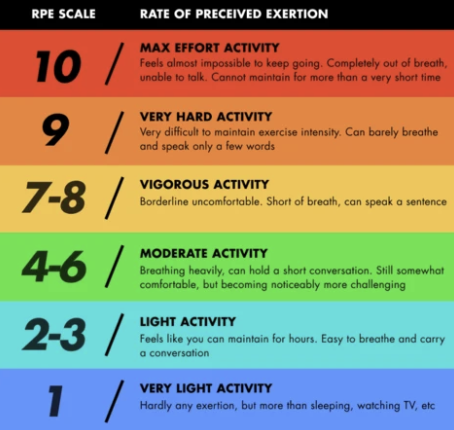
Ways to express exercise intensity:
4. Relative exercise heart rate or % of HRmax (70% HRmax)
6. Relative rating of perceived exertion (RPE = 14)
What is the most accurate way to measure HR?
Karvonen method: (most accurate)
THR = (HRmax − HRrest) x %TI + HRrest
What is rate of percieved exertion?
Intensity Method that requires your patient or client to rate “how hard” they are working while exercising
SMART goals
• S: Specific
• M: Measurable
• A: Action-oriented
• R: Realistic
• T: Time framed
When safely advancing an exercise program for a novice client, what general rule of thumb is recommended for increasing volume (duration or frequency) to avoid overtraining and injury?
Increase total volume by no more than 10% per week
Uses of Epidemiology
Identify etiology and risk factors
• Determine the extent of disease in apopulation
• Study natural history and prognosis
• Evaluate existing and new preventive and therapeuticmeasures/modes of healthcare delivery
• Provide foundation for developing public policy and regulatory decisions
Analysis of disease pattern
• Person- who is susceptible or getting the disease?
• Place- what areas is it occurring?
• Time- How is the disease process changing over time?
What does incidence of a disease represent?
The number of new cases of a disease during a specific time period.
What word describes how common a disease is within a population?
Prevalence
Prevalence
# of cases of a disease present in the population at a specified time
# of persons in the population at that specified time
Incidence
# of NEW cases of a disease during a specified period of time
Total number of people at risk during that period of time
Attack Rate
Is one type of incidence rate that is ssed when nature of the disease is such that population is observed for a short time period, often as a result of specific exposure
EX:
# of people who ate potato salad who developed gastroenteritis
Total # of people who ate potato salad
Relationship Between Incidence and Prevalence
-Prevalence = incidence x duration of disease
Total # of cases
Total # of population at a given timepoint
-As Incidence increases (New cases # added),the Prevalence increases from baseline levels
-As mortality increases or cures increases, the Incidence # decreases, →Decreased Prevalence from baseline (or Incidence may stay similar to Prevalence)
-So prevalence is really dependent on the incidence of disease (the number of new cases being added) AND it is also affected by the duration of illness.
Mortality Rate
# of all (all cause) deaths in one year
—————————————————-
# persons in the population at midyear
Case Fatality Rate
# of persons dying during a specified period after disease onset or diagnosis (e.g., 5yr survival rate)
————————————————————————————
Total # of people with the specified disease
Infant Mortality Rate*
# of deaths (under one year of age) during a specified time interval
—————————————————————————————-
# of live births reported during the same time period
Primary measure of disease severity
Case fatality rate
What is the 5-year survival rate % of cancer?
5-Year survival rate has increased to 68% (Increased prevalence) 49% since 1977
At the cellular level, neoplasia is fundamentally characterized as a disorder of which two processes?
Cell proliferation and cell differentiation.
What is the most widely used staging system for cancer globally?
TNM Staging System.
Which characteristic is most representative of a benign neoplasm?
Slow growth by expansion within a fibrous, encapsulated capsule.
Cancer definition
Cancer is a disorder of altered cell differentiation and growth
– Resulting process is called neoplasia and the tissue is a neoplasm meaning “new formation”
– Lacks normal regulatory controls over cell growth
Cell Proliferation
Orderly process, provides a way to replace cells
3 large groups of cells in the body
(> 200 celltypes)
– Permanent cells
Unable to divide - CNS neurons and cardiac muscle cells
• Never new cells
– Labile cells
• Constant state of renewal – skin, epithelial GI tract, hematopoietic cells
– Stable cells
• Renew more slowly, but capable of more rapid renewal after tissue loss – muscle, organs (liver, proximal tubules of kidney) and endocrine (glands) cells
Cell Differentiation
Process whereby cells are transformed into different and more specialized cell types
• Progenitor cells: alternative mechanism to replace cells of the same lineage that have not differentiated and are still able to divide – Able to provide large numbers of replacement cells
• Stem cells: Incompletely differentiated throughout life – Remain quiescent until needed for replenishment – Have restricted differentiation capacity – linage specific
What does the G1/S Checkpoint in the cell cycle check for?
-checks for DNA damage
What does the G2/M Checkpoint in the cell cycle check for?
-checks for damaged and unduplicated DNA, prevents entry into mitosis if DNA replication is not complete
Name the phases and functions of the Cell Cycle
• Mitosis – Type of cell division which results in 2 daughter cells each having the same number and kind of chromosomes as the parent nucleus
• Synthesis (S) and Mitosis (M) – 2 major phases: (S) 10-12 hrs-DNA synthesis and replication of chromosomes. (M) < 1 hr-cell division
• Gap 1 and 2 – Allows time for cell growth: G1 prepares for DNA replication and mitosis, protein synthesis. G2 pre mitotic phase, synthesis of enzymes and proteins
• Gap 0 – Stage after mitosis. Cell may leave cell cycle or remain in a state of inactivity and reenter the cycle at another time • This is based on type of cell: labile (constant change), stable (slow change) or permanent (no change)
Cyclins
Family of proteins that control entry and progression of cells through the cycle. (they are the bouncers at the club) They activate cyclin-dependent kinases (CDKs)-Enzymes that control entry and progression.
When do mutations occur?
– Mutations occur in DNA during differentiation process
What is ignored and allows cancer to progress in the cell cyle?
Chemical signals that start and stop cell cycle are ignored. Cancer cells enter the S phase without waiting for the signal
What makes cancer cells so deadly?
Cancer cells escape mortality of division (mortal cells divide about 50 times). Cancer cells are immortal and can divide endlessly
Classifications Of Neoplasm
– Cell Type • What type of cell is involved?
– Tissue of origin • In what tissue is the primary tumor located?
– Degree of differentiation • What do the cells look like?
– Anatomic site • What is the specific anatomical site of the tumor?
– Benign or Malignant
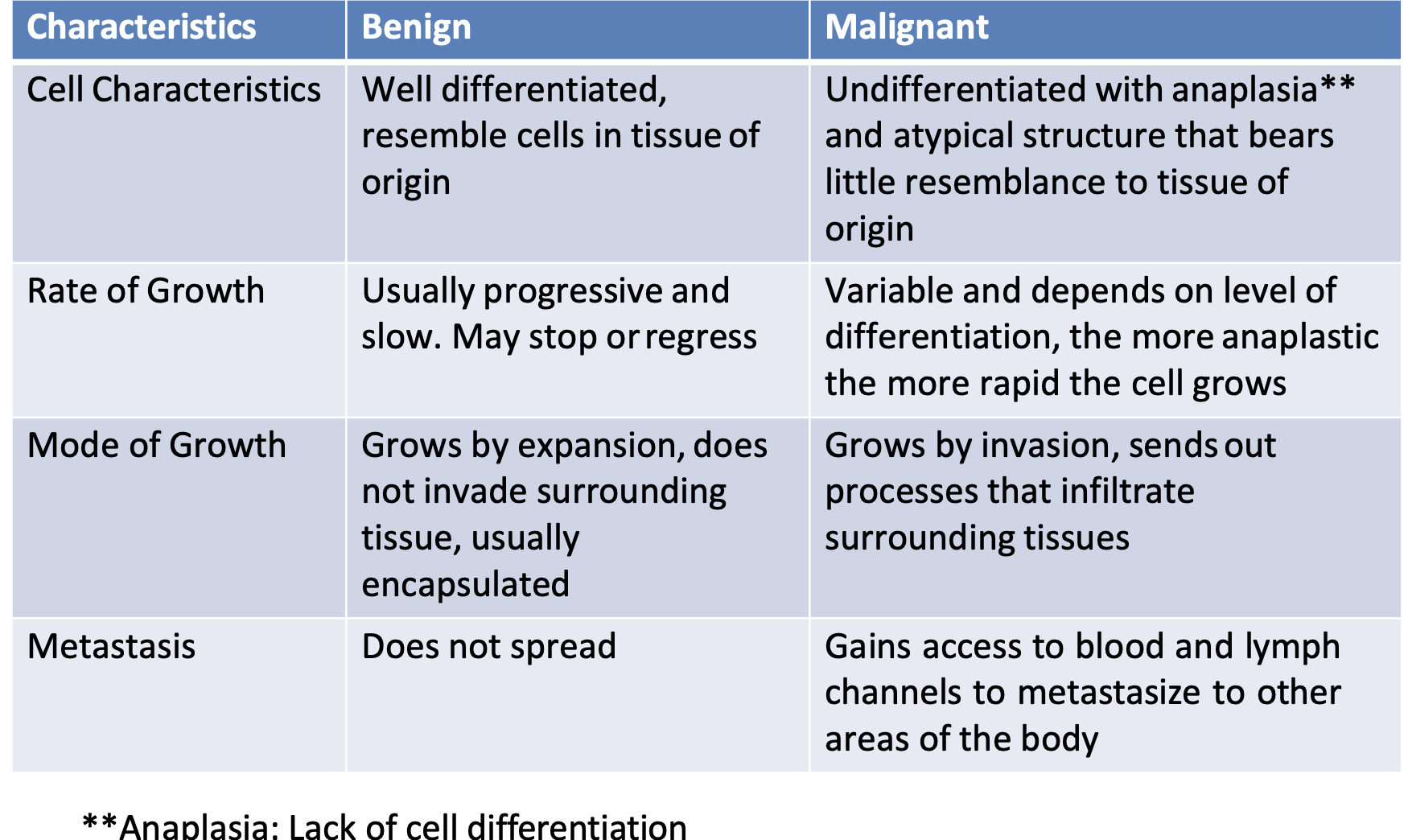
Characteristics of Benign Neoplasms
• Composed of well differentiated cells
• Resemble cells of the tissue of origin
• Slow, progressive rate of growth that may stop or regress
Characteristics of Malignant Neoplasms
• Noted for lack of differentiation, rapid rate of growth, ability to invade surrounding tissues and metastasize to distant sites
• Due to rapid growth rate tumors compress blood supply, causing ischemia and tissue necrosis/cell death –> Take away blood supply and nutrients for other tissues
Metastatic Neoplasms
• Secondary tumors that develop in a location distant from the primary tumor
• Metastasis occurs usually by way of lymph channels and blood vessels
Characteristics of Benign and Malignant Neoplasms
Radiography
Highest bone resolution of imaging modalities
• Disadvantage: 2 dimensional in nature (soft tissues are superimposed on bones, making confusing images at times)
CT
– Able to determine extension of bone tumor into soft tissue
– Limitations: High dosage of radiation
MRI
– Offer superb imaging of neoplastic lesions in musculoskeletal
– Demonstrates the extent of the neoplasm and relationship to neighboring soft tissue
— Limitation: $$$
Positron Emission Tomography (PET) Scan
• Uses small amounts of radioactive materials to evaluate organs and tissues
• May detect early onset of disease before it is present on other imaging tests
• Pinpoints molecular activity of the body
• Can be used to detect cancer, determine if cancer has spread and assess treatment effectiveness
Biopsy
• Removal of tissue for microscopic study
• Best tissue found at the periphery of the tumor, where it interfaces with normal tissue
Biological Tumor Markers
• Antigens (foreign bodies) expressed on the surface of tumor cells or released from normal cells in the presence of a tumor
• Hormones and enzymes may become over expressed due to cancer
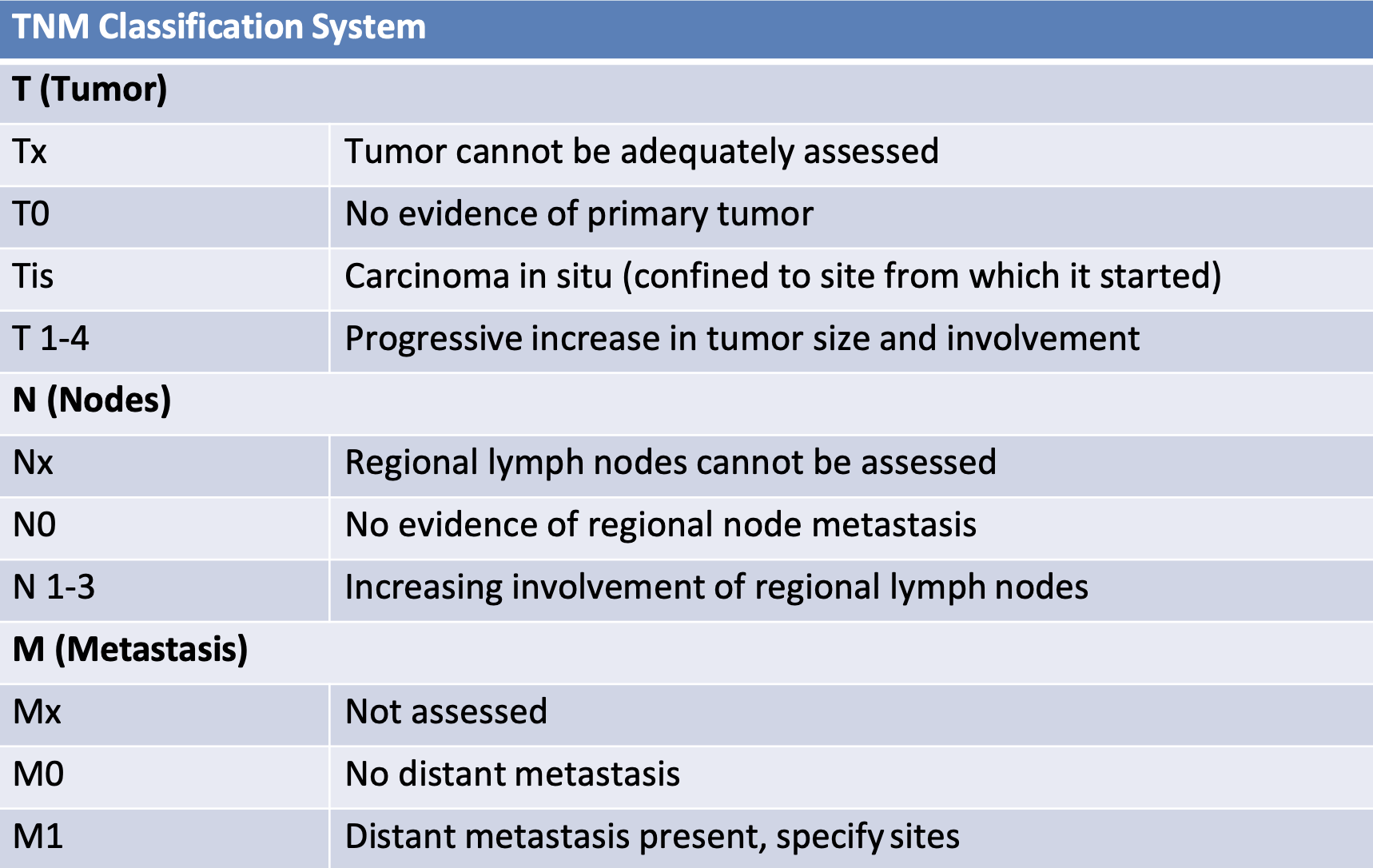
TNM Staging System
• Most widely used cancer staging system
– T describes size of tumor X (can’t determine)1→4
– N describes spread into lymph nodes
– M describes metastasis
Other Ways to Stage Tumors
– Stage 0: Abnormal cells, have not spread. (carcinoma in stu meaning in place)
– Stage I – III: Cancer is present, the higher the number = larger the cancer tumor and the more spreading to nearby tissues
– Stage IV: Cancer has spread to distant parts of body
• Main Categories Staging, used by CA registries
– In Situ: Abnormal cells present, no spread
– Localized: CA limited to place it originated, no spread
– Regional: CA spread to nearby lymph nodes, tissues or organs
– Distant: CA has spread to distant parts of body
– Unknown: Not enough information to figure out stage
Grading of Tumors
• A description of tumor based on how the tumor cells and tumor tissue look under a microscope
– Indicator of how rapid a tumor may grow and spread
• Well differentiated: look close to normal cells and tissue; grow and spread slower
• Undifferentiated: Abnormal looking cells and tissue; grow and spread more rapidly