Pharmacodynamics and Pharmacokinetics: Drug Action, Receptors, and Response
 Call Kai
 Learn
Learn Practice Test
 Spaced Repetition
 Match
Match Flashcards
 Knowt Play
1/52

There's no tags or description
Looks like no tags are added yet.
Name | Mastery | Learn | Test | Matching | Spaced | Call with Kai | Chat |
|---|
No analytics yet
Send a link to your students to track their progress
53 Terms
Define pharmacodynamics.
The study of the biochemical and physiologic actions of drugs and their mechanisms of action at the cell and sub-cell level — i.e., what the drug does to the body.
How does pharmacodynamics differ from pharmacokinetics?
Pharmacokinetics = what the body does to the drug (time-dependent changes in plasma/total drug concentration; ADME).
Pharmacodynamics = what the drug does to the body (drug action → drug effect).
What is the general sequence linking a dose to its clinical result?
Bioavailability → Drug Action → Drug Effect.
Bioavailability is governed by pharmacokinetics; drug action (receptor binding, dose-response, antagonism) and drug effect (side effects, therapeutic index) are governed by pharmacodynamics.
Do drugs impart new functions to the body?
No. Drugs do not create new functions — they either produce the same action as the body's own chemicals or block the action of the body's own chemicals.
After a drug reaches its site of action, how does it produce a pharmacologic effect?
By modulating the function of the organism at the cellular level, through interaction and binding of the drug to receptor macromolecules.
What is a drug receptor?
A macromolecule of a cell or organism that a drug binds to. Receptors may be located on the outside of the cell membrane, inside the cell membrane, or span both sides of it.
Receptors may be what 3 kinds of macromolecule?
(1) Metabolic or regulatory enzymes;
(2) proteins or glycoproteins associated with transport mechanisms;
(3) structural and functional components of the cell membrane or nucleic acids.
What are the 5 types of chemical bonds by which drugs attach to receptors, and which are most common?
1) Covalent
2) ionic
3) hydrogen
4) hydrophobic
5) Van der Waals binding.
.
Hydrogen and ionic binding are most common — they require little energy and are easily broken.
A drug's affinity for a particular receptor and its type of binding are intimately related to what?
The drug's chemical structure.
"Describe the concept of "induced fit" in drug-receptor binding."
Binding of the drug to one or more amino acid residues causes a conformational change in the protein.
This modifies the tertiary structure, bringing other amino acid residues closer to the drug — the receptor molds around the drug (""induced fit"")."
"What is the ""lock and key"" analogy for drug-target interactions?"
The drug (key) has a shape that allows it to bind to a specific receptor (lock).
.
A perfect fit allows binding and a therapeutic effect.
In the lock-and-key model, distinguish affinity from intrinsic activity.
Affinity = the key fits into the lock (the drug binds).
.
Intrinsic activity = the key also turns and unlocks it (the drug binds and activates the receptor to produce an effect).
Define ligand.
The molecule that binds to a receptor protein or glycoprotein.
.
Ligands may be hormones, neurotransmitters, growth factors, or drug molecules.
Give an example of each natural ligand type: hormone, neurotransmitter, growth factor.
Hormone → insulin
neurotransmitter → norepinephrine
growth factor → growth hormone. (Drugs also act as ligands.)
Define cell signaling.
When a ligand binds a receptor's outer surface (or within the membrane), a conformational change in the receptor protein is transmitted to the inner membrane surface.
This change is the signal that initiates the cell's response.
List the 4 well-known mechanisms by which receptors induce a pharmacologic response (signal transduction).
(1) Ligand-gated ion channels;
(2) G proteins (second messenger systems)
(3) tyrosine kinase receptors
(4) intracellular receptors.
What are the possible cellular responses that follow cell signaling?(4)
• Ion channel opening or closing
• Formation of an intracellular second messenger
• Initiation or alteration of cell growth and differentiation
• Alterations in gene expression of the cell
Where are ligand-gated ion channels found, and what do they do?
Found in excitable tissues (CNS nerves, neuromuscular junctions, autonomic ganglia).
.
They regulate the flow of ions through membrane channels, producing depolarization or hyperpolarization of the nerve.
Name example ligands (neurotransmitters) that open/close ligand-gated ion channels.
Acetylcholine, GABA, glutamate, glycine.
What is the key point about ligand-gated ion channel binding?
Binding increases membrane permeability to sodium and potassium,
which determines depolarization or hyperpolarization of the nerve = affects nerve firing.
Describe how G-protein-coupled receptors (second-messenger systems) transmit a signal.
The membrane receptor binds a ligand (the first messenger),
triggering events that generate an intracellular second messenger.
The second messenger passes the message from inside the cell to the effector organ (target site of action).
Where are G-proteins located, and what do they do?
At the internal (cytoplasmic) portion of the cell membrane.
.
They regulate the generation of intracellular second messengers, mediating the actions of many hormone and neurotransmitter receptors.
Give autonomic examples of receptors that use G-proteins/second messengers.
Muscarinic cholinergic receptors and adrenergic receptors of the autonomic nervous system.
When a ligand binds a G-protein-coupled receptor, the activated effector can be which 3 things?
1) Phospholipase C
2) Adenylyl cyclase
3) Membrane channel.
Match each effector to its cell response — adenylyl cyclase, phospholipase C, membrane channel.
• Adenylyl cyclase → generation of cyclic AMP (cAMP)
• Phospholipase C → phosphorylation of proteins
• Membrane channel → change in ionic conductance
List the 3 results of effector activation (GPCR pathway).
(1) Activation of cAMP via adenylyl cyclase
(2) phosphorylation of proteins via phospholipase C
(3) changes in ionic conductance through channels.
Where are tyrosine kinase receptors located and what are they critical for?
Located on the plasma membrane
.
Critical to cell growth and differentiation.
A variety of growth factors and certain oncogenes interact with these receptors.
What are intracellular receptors and what activates them?
Proteins associated with the nuclear matrix
.
Activated by steroid hormones (estrogen, progesterone, glucocorticoids, thyroid hormone, vitamin D).
What is the mechanism/key point for intracellular (steroid) receptors?
The steroid-receptor complex increases binding of RNA polymerase and the expression of regulated genes.
.
Key point: steroid hormones act in the cell nucleus to alter gene expression.
What is receptor specificity?
A drug has a higher affinity for a particular receptor type and binds preferentially to it to produce the desired effect (e.g., epinephrine binds both α and β receptors in the sympathetic nervous system).
Define an agonist. What two properties does it possess?
A drug that binds a receptor and produces an effect, mimicking endogenous chemicals (neurotransmitters, hormones).
An agonist possesses both affinity and efficacy.
Define an antagonist. What property does it have vs. lack?
A drug that binds the same receptor as an agonist but is unable to activate it (produces no effect) and blocks the agonist.
An antagonist possesses affinity but lacks efficacy.
Contrast agonist vs. antagonist in terms of affinity and efficacy.
Agonist = affinity + efficacy (binds and activates). Antagonist = affinity only, no efficacy (binds but does not activate; blocks receptor activation by agonists).
Give a practical example of a drug acting as a chemical antagonist.
A local anesthetic blocks Na⁺ channels in the activation pathway of the chemicals that promote nerve depolarization.
By blocking depolarization, impulses aren't transmitted and the patient doesn't feel pain.
Describe pharmacologic antagonism.
Both the agonist and antagonist compete for the same receptor site. The antagonist binds first, preventing the agonist from producing its effect.
It may be competitive or noncompetitive.
What defines a competitive antagonist?
Competes with the agonist for the same receptor site and binds reversibly.
Adding more agonist will displace the antagonist, allowing the agonist to produce its effect.
How does a noncompetitive antagonist differ from a competitive one (2 ways)?
(1) It binds irreversibly — cannot be displaced by adding more agonist.
(2) It can bind the same site as the agonist or a different site; either way it inhibits the agonist's effect. (Think poisons.)
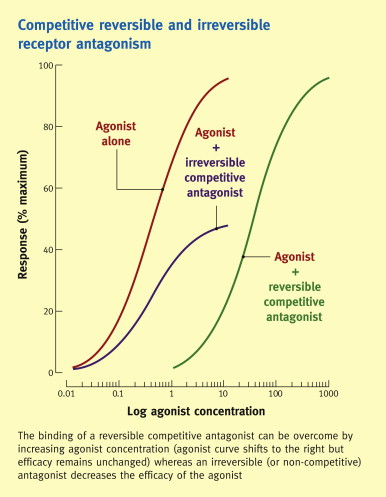
On a dose-response curve, how do competitive vs. noncompetitive antagonists appear?
Competitive: curve shifts right, but the same maximum response is reachable with enough agonist.
Noncompetitive: maximum response is lowered and cannot be overcome by adding agonist.
Describe physiologic antagonism and give an example.
The antagonist activates pathways that oppose the agonist's action, with agonist and antagonist acting independently on 2 different receptors.
Example: epinephrine (vasoconstriction) opposes histamine (vasodilation).
Less desirable than receptor-specific antagonists.
Define drug potency.
The amount of drug necessary to produce an effect (think: dose). Related to the drug's affinity for its receptor.
Define drug efficacy.
The degree of maximum intensity of effect a drug can produce (think: effect). Related to receptor occupancy; once all receptors are occupied, additional doses give no further benefit (ceiling dose).
A drug that produces its effect at a lower dose is more ____; a drug that produces a greater maximum effect has higher ____.
More potent (lower dose needed); higher efficacy (greater maximum effect).
Aspirin vs. meperidine (Demerol): do they differ in potency, efficacy, or both?
Both. Efficacy: aspirin works for mild-moderate pain, meperidine for severe pain. Potency (for moderate pain): ~300-600 mg aspirin vs. ~25-50 mg meperidine.
Meperidine vs. morphine: how do they compare in efficacy and potency?
Similar efficacy (both relieve severe pain). Differ in potency: ~100 mg meperidine vs. ~10 mg morphine — morphine is more potent.
On a dose-response graph, how does a partial agonist compare to a full agonist?
A partial agonist has a lower maximum efficacy than a full agonist even when all receptors are occupied.
.
(It may have similar potency but cannot reach the full maximal response.)
Define the therapeutic window.
The range of doses (concentrations) of a drug that elicits a therapeutic response without unacceptable side effects/toxicity in a population.
.
Drugs with a small window require close plasma monitoring.
Write the formula for the therapeutic index (TI).
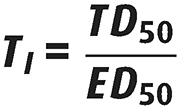
Define TD₅₀ and ED₅₀.
TD₅₀ = dose that causes a toxic response in 50% of the population.
ED₅₀ = dose that is therapeutically effective in 50% of the population.
What does the therapeutic index tell you, and how do large vs. small values compare?
The TI is a single number quantifying a drug's relative margin of safety in a population.
A large TI = wide therapeutic window (safer).
A small TI = narrow window = requires close monitoring.
List factors (beyond the prescribed dose) that influence the intensity of a drug's effect.
Patient compliance and medication errors; rate/extent of absorption; body size and composition; distribution and plasma/tissue binding; rate of elimination; physiological, pathological, and genetic factors; drug interactions; tolerance; drug-receptor interaction; functional state; and placebo effects.
Describe the general mechanisms of drug-receptor interaction (what membrane receptor proteins do).
Many receptors are components of the cell membrane that facilitate communication between the two sides of the membrane.
They exist naturally as receptors for hormones, neurotransmitters, and growth factors — recognizing selected molecules at the external surface and transmitting information to the inside of the cell.
Describe the configuration of a membrane-spanning protein receptor (e.g., a G-protein-coupled receptor).
A single polypeptide chain that crosses the membrane as 7 transmembrane α-helical domains, with the NH₂ (amino) terminus extracellular and the COOH (carboxyl) terminus intracellular.
The loops between helices form the ligand-binding region and couple to the intracellular G-protein.
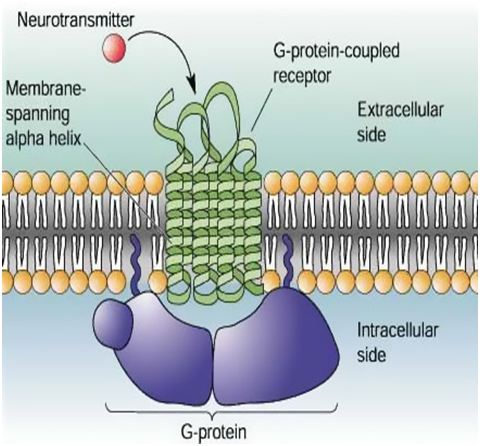
Describe the intracellular G-protein complex and the activated G-protein complex.
At rest, the G-protein complex sits inactive on the inner membrane surface.
When an agonist binds the receptor, the conformational change is transmitted across the membrane and activates the G-protein complex on the intracellular side, which then activates an effector (adenylyl cyclase, phospholipase C, or a channel) to generate the second messenger.