Inheritance 2
 Call Kai
 Learn
Learn Practice Test
 Spaced Repetition
 Match
Match Flashcards
 Knowt Play
1/23

There's no tags or description
Looks like no tags are added yet.
Name | Mastery | Learn | Test | Matching | Spaced | Call with Kai |
|---|
No analytics yet
Send a link to your students to track their progress
24 Terms
Gene interactions
idea that two or more genes influence on one particular character
various gene products function in a metabolic pathway that contributes to the development of one particular phenotype
modification to the classical Mendelian dihybrid ratio (9:3:3:1)
Difference between dihybrid inheritance and gene interaction
dihybrid inheritance: two characteristics controlled by two genes
gene interaction: one characteristic contolled by two or more genes
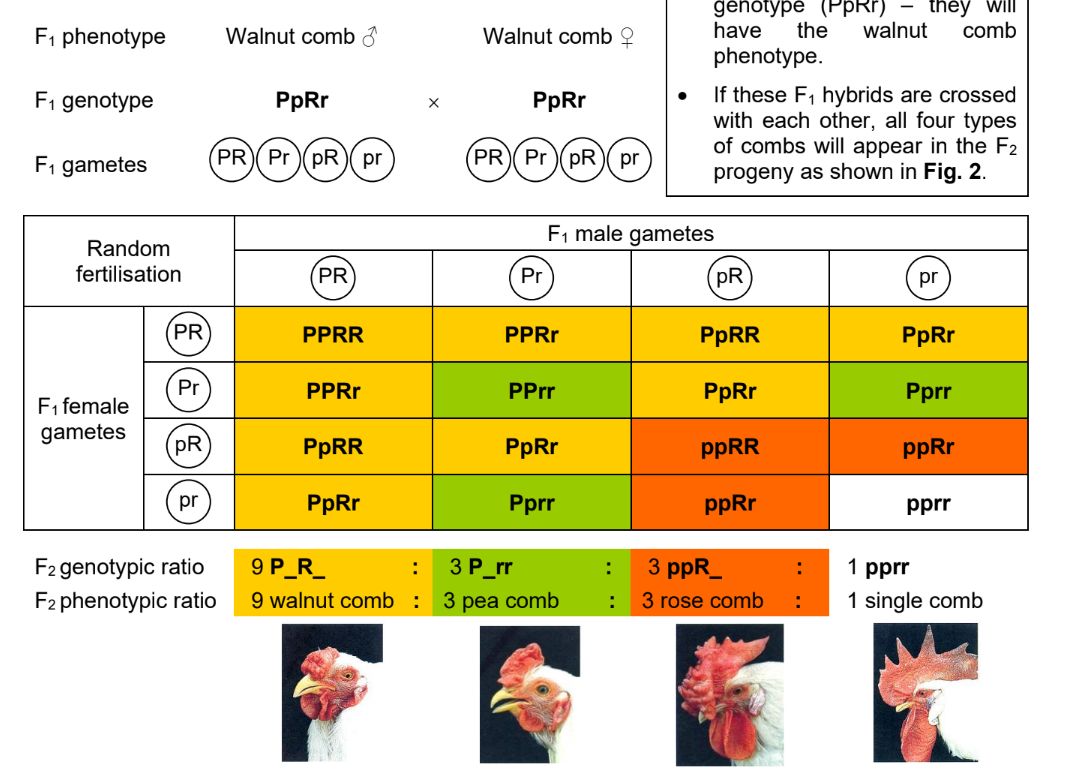
Non-epsitatic gene interaction
two independenly assorting genes(at two different gene loci) may interact to influence a single character
[look at photo for example]
(cross between two double heterozygous can result in phenotypic ratio 9:3:3:1)
![<ul><li><p>two independenly assorting genes(at two different gene loci) may interact to influence a single character</p></li></ul><p>[look at photo for example]</p><p>(cross between two double heterozygous can result in phenotypic ratio 9:3:3:1)</p><p></p>](https://assets.knowt.com/user-attachments/e2fc070f-effd-4d0a-8427-57c222af25b9.png)
Epistatic gene interactions or Epistasis
expression of an allele of one gene(epsitatic gene) suppresses/inhibits the expression of alleles of a different gene(hypostatic gene)
Difference between complete dominance and epistasis
complete dominance: masking of allele at the same gene locus by dominant allele
epistasis: epistatic gene is able to suppress/inhibit the effect of the hypostatic gene at a different locus
Recessive epistasis
two recessive alleles at the epistatic gene locus will suppress the effect of either of the allele of the hypostatic gene at a different locus
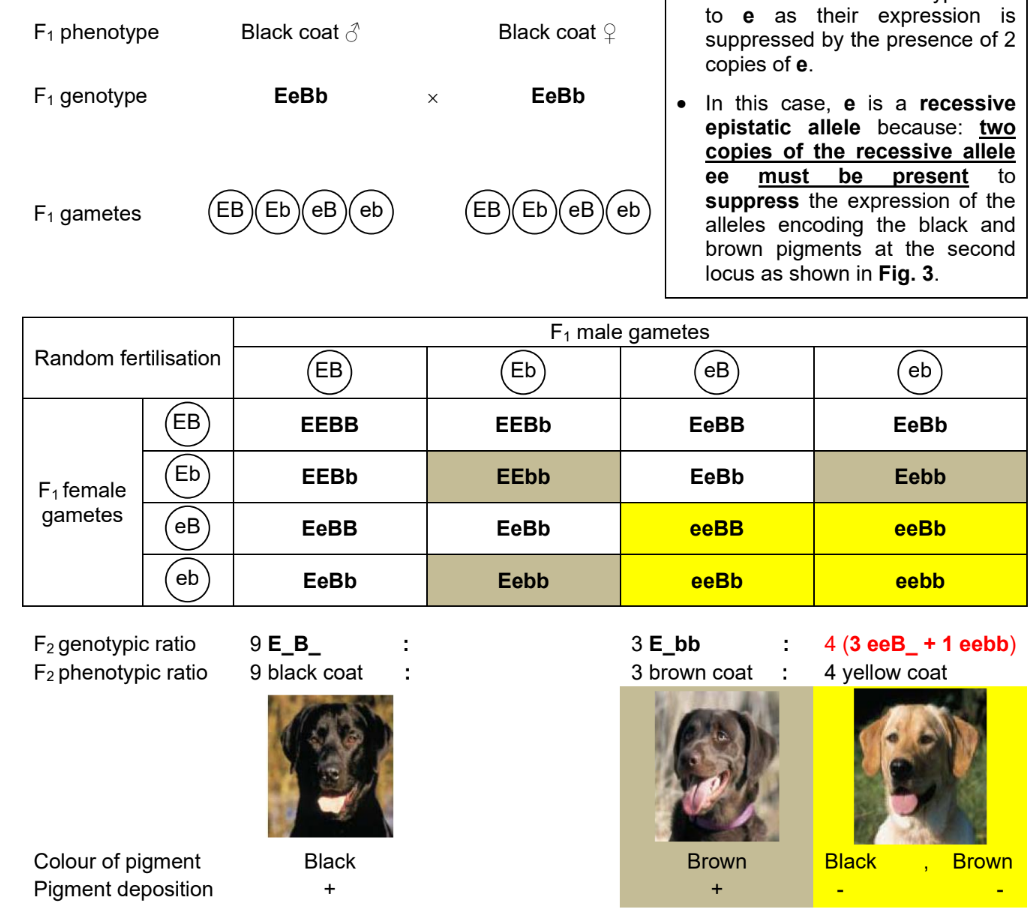
![<p>Explain how recessive epistasis affects the resulting phenotypic ratio for double heterozygous cross?</p><p>Use example of the coat colour of labrador retrievers [refer to picture]</p>](https://assets.knowt.com/user-attachments/ecea5161-8296-4026-9112-131327729926.png)
Explain how recessive epistasis affects the resulting phenotypic ratio for double heterozygous cross?
Use example of the coat colour of labrador retrievers [refer to picture]
Yellow dogs carry either alleles B or b for …. but these are not expressed
e is a recessive epistatic allele
genotype ee is epistatic to B and b because ee suppresses the expression of alleles encoding for …. in the phenotype
allels B and b are hypostatic to e
as a result the genotypes eeB_ and eebb result in a yellow coat phenotype
offspring phenotypic ratio is 9:3:4(3+1) instead of the typical mendelian dihybrid ratio 9:3:3:1
Dominant epistasis
one dominant allele at the epistatic gene locus will suppress the effect of both alleles of the hypostatic gene at a different locus
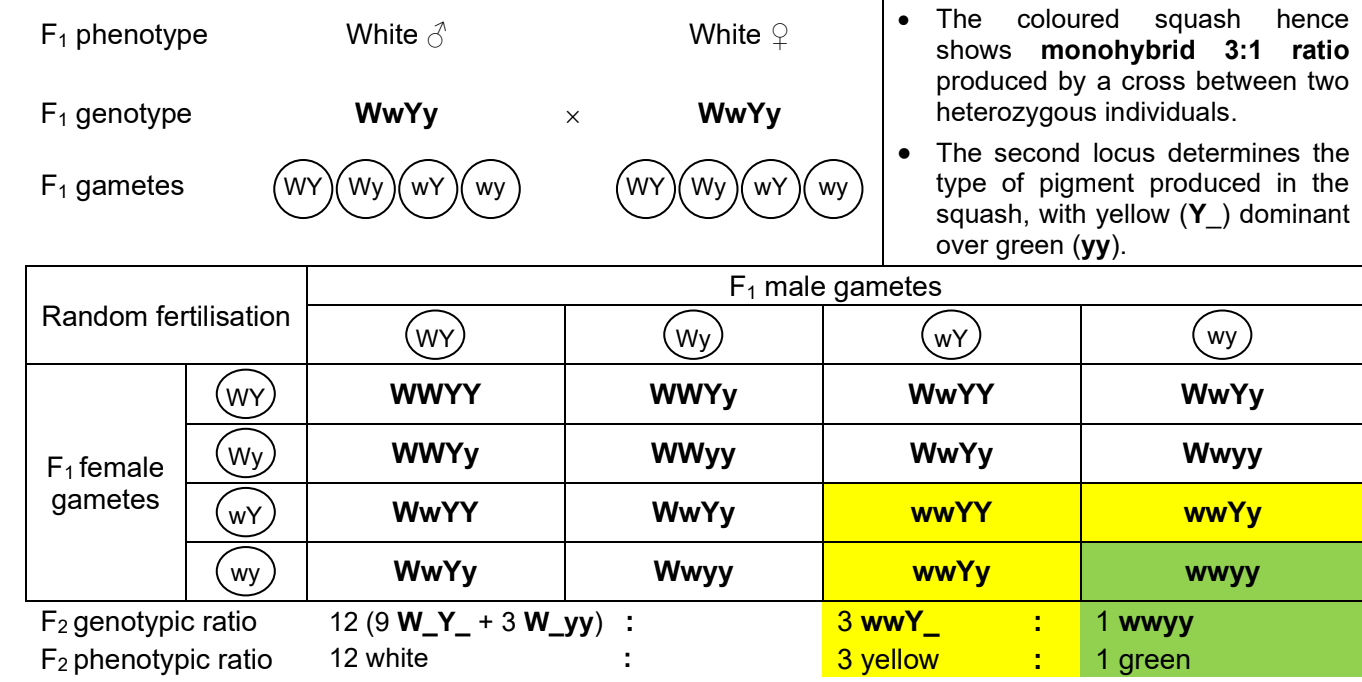
![<p>Explain how recessive epistasis affects the resulting phenotypic ratio for double heterozygous cross?</p><p>Use example of the fruit colour of summer squash [refer to picture]</p>](https://assets.knowt.com/user-attachments/09562157-e63e-4dde-a96b-c48014c90c68.png)
Explain how recessive epistasis affects the resulting phenotypic ratio for double heterozygous cross?
Use example of the fruit colour of summer squash [refer to picture]
dominant allele W is epistatic to the alleles Y and y
the presence of at least one W dominant allele at epistatic gene locus is needed to encodes an inhibitor for the production of pigement(YY, Yy, yy), suppressing the expression of Y and y allele
genotypes W_ _ _ result in 12/16 progeny squashes being white
the coloured squash have ww genotype at epistatic gene locus will result in coloured squash with the monohybrid ratio of 3:1 for yellow to green since yellow is dominant over green
offspring phenotypic ratio is 12(9+3):3:1 instead of the typical mendelian dihybrid ratio 9:3:3:1
Duplicate recessive epistasis
two recessive alleles at either of the two gene loci will supress/inhibit the effect of the dominant allele at the other locus
![<p>Explain how recessive epistasis affects the resulting phenotypic ratio for double heterozygous cross?</p><p>Use example of the flower colour in sweet peas [refer to picture]</p><p>cc or pp will result in suppression of pigment colour.</p>](https://assets.knowt.com/user-attachments/7a4f6472-b8ca-43e3-9f63-0f29aa1870e9.png)
Explain how recessive epistasis affects the resulting phenotypic ratio for double heterozygous cross?
Use example of the flower colour in sweet peas [refer to picture]
cc or pp will result in suppression of pigment colour.
each of the recessive alleles are epistatic over the dominant allele of the other gene ie cc is epistatic to P locus while pp is epistatic to C locus
Dominant allele at each of the gene locus(ie C_P_) is necessary for the synthesis of anthocyanin
double homozygous dominant and double heterozygous results in purple flowers
whereas in the presence of cc and/or pp genotype, there is no synthesis of anthocyanin and abolishes the production of pigment and this results in white flowers
offspring phenotypic ratio is 9:7(3+3+1) instead of the classical mendelian dihybrid ratio 9:3:3:1
Difference in observable phenotype for discontinuous variation and continuous variation
discontinuous variaton: there are distinct phenotypic classes observed and no intermediates oberved
continuous variation: there are a range of phenotypes observed and intermediates are observed
Difference in number of genes controlling phenotypic variation for discontinuous variation and continuous variation
discontinous variation: controlled by a single or a few genes (gene may have two or more alleles)
continuous variation:
controlled by multiple genes aka polygenic inheritance
genes act on phenotype in an additive manner
combined effect of these genes can produce individuals of infitie phenotypic varieties
Difference in effect of environement on phenotype for discontinuous variation and continuous variation
discontinous variation: little to no effect
continuous:
cumulative effect of varying environmental factors act on the different genotypes
degree of expression of genotype is dependent on environmental factors during development of organism
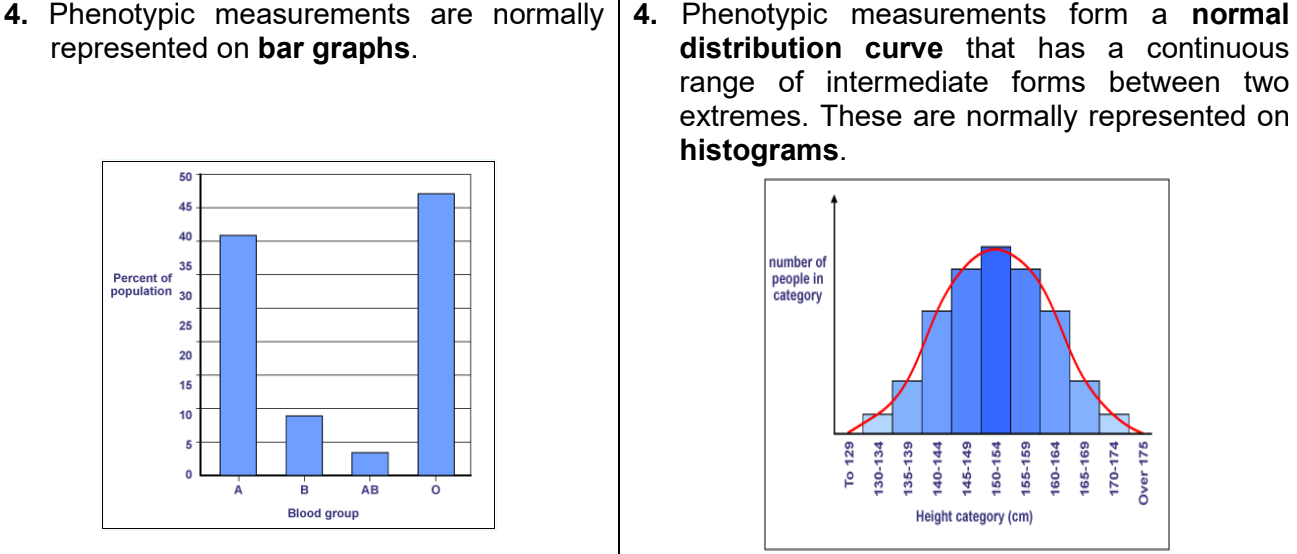
Difference in mode of phenotypic measurement for discontinuous variation and continuous variation
discontinuous variation:
use bar graphs since phenotypic classes are distinct
qualitative forms of measurement to make counts and ratios
continuous variation:
histogram to show a normal distribution curve
quantitative forms of measurement and statistical analysis to estimate population parameters such as mean and standard deviation
(most organisms fall in the middle range with approximately equal numbers showing the extreme forms of the characteristic)
cause of genetic variation in a population for asexually reproducing organisms
environmental influences
DNA replication is highly accurate and almost error-free giving little possibility of variation through mutations
cause of genetic variation in a population for sexually reproducing organisms
new combination of alleles (continuous variation):
crossing over between non-sister chromatids of homologous chromosomes during prophase 1 of meiosis
independent assortment of bivalents at metaphase plate during metaphase 1
random fertilisation (random fusion of gametes)
new alleles(discontinuous variation)
gene mutation or chromosomal mutation (those that occur during formation of gametes can be inherited)
Purpose of chi-square test
Test if the difference between the observed phenotypic numbers and the expected ratio is significant, at a level of 0.05 level of significance
What is the null hypothesis (H0) and alternative hypothesis (HA)?
H0: There is no differene from the expected … ratio (difference is not significant and is due to chance)
HA: There is a difference from the expected … ratio (difference is significant and is not due to chance)
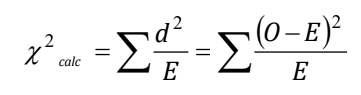
calculate x² value
where d is the difference between observed(O) and expected(E) results
Solution to Chi-squared test questions
state hypotheses
calculate the expected number of individuals for each phenotypic class
calculate the x² value
compare the x² value against the x² probability table (df= n-1 & level of significance (alpha) is 0,05)
state conclusion
if x²calc > x² crit
probablity that chance alons is the reason for the difference between observed and expected results is less than 5%
deviation is significant
reject H0 in favour of HA
if x²calc < x² crit
probability that chance alone is the reason for the difference between observed and expected results is more than 5%
deviation is not significant
do not reject H0
calculate degree of freedom (df)
df = n-1 where n is the number of phenotypic classes