Acute Coronary Syndrome HL Exam 3
 Call Kai
 Learn
Learn Practice Test
 Spaced Repetition
 Match
Match Flashcards
 Knowt Play
1/100

There's no tags or description
Looks like no tags are added yet.
Name | Mastery | Learn | Test | Matching | Spaced | Call with Kai | Chat |
|---|
No analytics yet
Send a link to your students to track their progress
101 Terms
What is the cause of ACS?
rupture of a plaque with subsequent platelet adherence, activation, aggregation, and activation of the clotting cascade
True or False: ultimately, a thrombus composed of fibrin and platelets may develop in ACS causing incomplete OR complete occlusion of an artery
True
What types of ACS are there?
NSTEMI vs STEMI
What is STEMI caused by?
an injury that transects the entire thickness of the myocardial wall which releases biomarkers from necrotic myocytes into the bloodstream
Which biomarkers are release during STEMI?
cardiac troponins T or I
What is NSTEMI?
limited to subendocardial myocardium
Which is larger, STEMI or NSTEMI?
STEMI
Which has lower mortality rates and complications, STEMI or NSTEMI?
NSTEMI
How does an NSTEMI differ from UA?
ischemia is severe enough to release troponin
NSTEMI vs STEMI Diagram
Figure 9-1
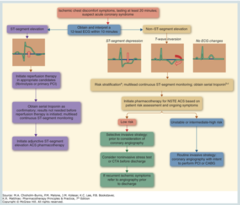
How does ACS generally present?
a patient is in acute distress and may develop or present with acute HF, cardiogenic shock or cardiac arrest
What are classic S/S of ACS?
severe new-onset or increasing substernal angina that lasts for 10+ min
What are accompanying S/S of ACS?
pain radiating to shoulder, down left arm, and to the back or jaw (+/- chest pain)
N/V
diaphoresis
SOB
anxiety
True or False: ACS usually does not occur at rest
False
What are atypical S/S of ACS?
indigestion, epigastric pain, SOB, anxiety
Who is more likely to present with atypical S/S of ACS?
elderly, female, DM, renal impairment, dementia
What are the physical S/S of ACS?
no "classic" signs, but acute HF and arrhythmias
What lab tests are used in ACS?
cardiac biomarkers, blood chemistry, CBC, coagulation tests, and fasting lipid panel
What cardiac biomarkers indicate ACS?
High sensitivity cardiac troponin (hs-cTnI or hs-cTnT)
BNP or NT-proBNP
Which lab is preferred for diagnosing MI?
high sensitivity cardiac troponin
elevated troponin confirms MI and differentiates NSTEMI from unstable angina (UA)
When do we measure high sensitivity cardiac troponin?
measure at presentation of ACS and may repeat 1-2 hours later
What does BNP or NT-proBNP indicate?
long term mortality risk in ACS and is NOT diagnostic for acute MI
What parts of blood chemistry are measured for ACS?
SCr, K, Mg
Why are K and Mg levels important during ACS?
they may cause arrhythmias is abnormal
Why is SCr important during ACS?
used to estimate CrCl for dose adjustments
Why do we measure CBC during ACS?
evaluates anemia, thrombocytopenia, and bleeding risk with anti-thrombotic therapy
What coagulation tests are measured during ACS?
aPTT and INR (both are measured at baseline)
When do we take a fasting lipid panel during ACS?
early during hospitalization to guide statin therapy
What are diagnostic tests of ACS?
12-lead ECG, coronary angiography, measure LVEF
What is the purpose of 12-lead ECG?
can identify and risk-stratify a patient with suspected ischemic chest discomfort and can classify patients as STEMI or NSTEMI
When should a 12-lead ECG be performed?
within first 10 minutes of medical contact
True or False: if initial 12-lead ECG is non-diagnostic, but suspicion remains low, repeat every 15-30 minutes for the first hour when symptoms persist
False: if suspicion remains HIGH do this
When are coronary angiographies indicated?
high risk ACS patients (esp STEMI)
What is the purpose of a coronary angiography?
visualize coronary artery stenosis and guide PCI
When should coronary angiographies be performed if STEMI?
asap
When should coronary angiographies be performed if NSTEMI?
within 24-72 hours
What is the purpose of measuring LVEF during ACS?
identifies new wall motion abnormalities and if LVEF
True or False: ECG should be performed within 10 minutes of first medical contact (FMC). Repeat every 15-30 minutes for the first hour if the first ECG is not diagnostic if the patient is still symptomatic and the clinician has high suspicion of ACS.
True
What are key findings on an ECG associated with ACS?
ST-segment elevation (STE), ST-segment depression, and T-wave inversion
What do ST-segment and/or T-wave changes in ECG help identify?
location of coronary artery that's causing ischemia/infarction + appearance of a new left bundle-branch block accompanied by chest discomfort indicates acute STEMI
True or False: some parts of the heart are more electrically silent
True: MI may not be detected on an ECG
Why is it important to review findings from an ECF in conjunction with biomarkers of myocardial necrosis, clinical symptoms, and other RF for CHD?
because of electrically silent areas of the heart and we want to be able to determine the patient's risk for experiencing a new MI or having other complications
What can biomarkers and cardiac enzymes confirm?
myocardial cell death and can help distinguish between unstable angina (no necrosis) and STEMI/NSTEMI (with necrosis)
What is diagnosis of MI confirmed by?
Rise or Fall of cardiac troponin with at least one value above the 99th percentile of the upper reference limit and ONE of the following...
- S/S of ischemia
- New ECG changes or Q waves
- Imaging showing new myocardial loss
- New regional wall motion abnormality
- Angiographic/autopsy evidence of intracoronary thrombus
True or False: guidelines recommend hs-cTn to detect or exclude myocardial necrosis in STEMI
False, it's NSTEMI
What is the timeline of troponin release after an MI?
1-4 hours
What is the timeline of troponin peak after an MI?
18-24 hours
How long can troponin be elevated after an MI?
up to 2 weeks
When should you repeat biochemical markers?
if first reading is low (not diagnostic), repeat 1-2 hours later
IF both readings are low, MI can be ruled out
What can cause troponin elevation?
Pulmonary embolus
Tachycarrhythmias
Pericarditis
Myocarditis
Sepsis (measurement of BNP may help predict long-term mortality risk but NOT with acute diagnosis)
What does MONA3 2B stand for?
Morphine (fentanyl)
Oxygen
Nitrates
Aspirin
ADP receptor antagonists (P2Y12)
Anticoags
IIb/3a inhibitors
BBs
What is the indication for morphine post ACS?
chest pain that persists after nitrate use
What are precautions to using morphine?
hypotension and bradycardia
When is oxygen used post ACS?
if O2 sat is < 90%
What is the purpose of nitrates post ACS?
relieves ischemic chest pain by causing coronary vasodilation and decreasing preload/afterload
What is the dose of SL nitrates?
0.4mg Q5M x3 doses
What is the dose of IV nitrates?
5-10mcg/min infusion up to 75-100mcg/min until symptom relief or limiting side effects (SBP < 90 or > 30% below MAP if HTN)
When can topical/PO nitrates be used?
if no ongoing/refractory symptoms and there are nitrate free intervals
What are precautions of nitrates?
hypotension, right ventricular infarction, PDE-5 inhibitor use
When should IV nitrates be discontinued?
after 24-48 hours to avoid tachyphylaxis
What are precautions with the 3As?
hypersensitivity, active bleed, or severe bleeding risk
What is the dose of aspirin for ACS?
162mg-325mg chewable ASAP then 81mg QD foreves
What is the duration of P2Y12 for ACS?
start early and continue as DAPT for 12+ months
Why start anticoagulants post ACS?
prevents further thrombus formation during hospitalizations and PCI
What are the IIb/IIIa inhibitors?
eptifibatide and tirofiban
What is the purpose of IIb/3a inhibitors and BBs?
reduces myocardial oxygen demand and arrhythmias
What is the timeline of BBs post ACS?
start within 24 hours unless C/I
What are BB C/Is?
HR < 60
SBP < 90
Acute HF
Shock
What are IIb/3A inhibitor C/Is?
active bleed and thrombocytopenia
eptifibatide: ischemic stroke (within 30 days), ICH, renal dialysis
What does TIMI score of 0-1 indicate for NSTEMI?
low risk
What does TIMI score of 2-4 indicate for NSTEMI?
intermediate risk
What does TIMI score of 5-7 indicate for NSTEMI?
high risk
What are the components of a TIMI score for NSTEMI?
Each of the following findings result in 1 point:
- Age 65 years or older
- Three or more CAD risk factors: smoking, hypercholesterolemia, HTN, DM, family history of premature CAD death/events
- Known CAD (50% or greater stenosis of at least one major coronary artery on coronary angiogram)
- Aspirin use within the past 7 days
- Two or more episodes of chest discomfort within the past 24 hours
- ST-segment depression 0.5 mm or greater
- Positive biochemical marker for infarction
What is are the components of a TIMI score for STEMI?
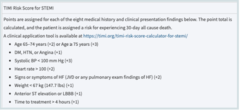
When a patient initially presents with a STEMI, what is the ideal timing of PCI therapy?
Ideally, it should be performed as soon as possible, with a first medical contact (FMC)-to-device time ≤ 120 minutes.
When a patient initially presents with a STEMI, what is the ideal timing of fibrinolytic therapy?
If PCI cannot be performed within 120 minutes (for example, at a non-PCI-capable hospital), fibrinolytic therapy should be administered instead, ideally within 30 minutes of hospital arrival and within 12 hours of symptom onset.
What are 5 long-term therapies recommended for all patients following MI for secondary prevention of death, stroke, or recurrent infarction?
Aspirin
P2Y12 inhibitor
BB
ACEi/ARB
Statin
What does the acronym ABCDHeadline NewS stand for?
A x2: anti-platelet (asp, P2Y12) + ACEi
B: BB
C: Cholesterol (statin)
D x2: Diabetes, Diet
H: HTN
N: nitrates
S: smoking cessation
True or False: ABCDHeadline NewS is important for pharmacological and non-pharmacological recommendations for secondary prevention of death, stroke, or recurrent infarction for patients following MI
True
What are the initial steps in treating NSTEMI/STEMI?
oxygen (if O2 sat < 90%), aspirin, SL NTG, IV NTG, morphine
True or False: PCI is involved in the reperfusion strategy of STEMI
True
How soon should you perform PCI in a PCI capable facility?
within 90 minutes of FMC
How soon should a PCI be performed if transferring to a PCI capable facility?
within 120 minutes
otherwise perform fibrinolysis within 30 minutes and then transfer for PCI within 3-24 hours
What anti-thrombotic therapy is used for STEMI?
DAPT: ASA + clopidogrel/prasugrel/ticagrelor/cangrelor +/- GPI (glycoprotein IIb/3a inhibitor) when receiving UFH + P2Y12 inhibitor
What anticoagulant therapy is used for STEMI?
IV UFH or bivalirudin
What is included in late hospital care/secondary prevention for STEMI/NSTEMI?
ASA foreves
P2Y12 inhibitor for 12+ months
BB within 24 hours
High intensity statin asap
Evaluate for ACEi/ARB
Evaluate for aldosterone antagonist
What are the 2 treatment option strategies for NSTEMI?
ischemia-guided vs early invasive
What is the ischemic guided strategy?
avoids early use of invasive procedures
What is the early invasive strategy?
diagnostic angiography
What is the anti-thrombotic therapy used in NSTEMI ischemia guided strategy?
DAPT: ASA + clopidogrel/ticagrelor
What is the anticoagulant therapy used in NSTEMI ischemia guided strategy?
IV UFH, SQ enoxaparin, or SQ fondaparinux
What is the anti-thrombotic therapy used in NSTEMI early invasive strategy?
DAPT with ASA + clopidogrel/ticagrelor +/- GPI in high risk patients
What is the anticoagulant therapy used in NSTEMI early invasive strategy?
IV UFH, SQ enoxaparin, SQ fondaparinux, or IV bivalirudin
True or False: after DAPT and anticoagulant therapy, we should determine need for revascularization vs medical management for an NSTEMI early invasive strategy
True
What are the options for NSTEMI revascularization?
PCI vs CABG
What DAPT is used for PCI?
ASA + clopidogrel/prasugrel/ticagrelor/cangrelor
What anticoagulants are used for PCI?
IV UFH, SQ enoxaparin, or IV bivalirudin
How to manage medications for an elective CABG:
Continue ASA
D/C clopidogrel/ticagrelor 5 days prior
D/C prasugrel 7 days prior
How to manage medications for an urgent CABG:
Continue ASA
D/C clopidogrel/ticagrelor up to 24 hours prior
D/C eptifibatide/tirofiban at least 2-4 hours prior
D/C abciximab > 12 hours prior
True or False: after CABG, do not continue IV UFH
False! continue IV UFH, but...
D/C clopidogrel/ticagrelor up to 24 hours prior
D/C eptifibatide/tirofiban at least 2-4 hours prior
D/C abciximab > 12 hours prior