Non-Narcotic Analgesics Med Chem (Dr. Adams)
 Call Kai
 Learn
Learn Practice Test
 Spaced Repetition
 Match
Match Flashcards
 Knowt Play
1/28

There's no tags or description
Looks like no tags are added yet.
Name | Mastery | Learn | Test | Matching | Spaced | Call with Kai | Chat |
|---|
No analytics yet
Send a link to your students to track their progress
29 Terms
stereochemistry based on the substituents at C-9 and C-11 positions
The notation for prostaglandins is PGXₙ.
What does X express?

number of double bonds
The notation for prostaglandins is PGXₙ.
What does n express?

D
The notation for prostaglandins is PGXₙ. What stereochemistry has an -OH at 9-C?

E
The notation for prostaglandins is PGXₙ. What stereochemistry has an -OH at 11-C?

F
The notation for prostaglandins is PGXₙ. What stereochemistry has an -OH at 9-C & 11-C?

15α-hydroxyl group ("down")
Prostaglandins have 20 carbons and are derived from arachidonic acid. What group is 15-C required to have?
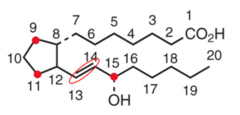
trans double bond
Prostaglandins have 20 carbons and are derived from arachidonic acid. What stereochemistry must 13-C have?

COX-4
Which COX isoform does not exist?
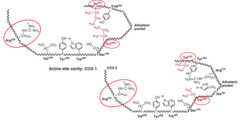
COX-2 has 2 valines
Observe the active site of COX-1 and COX-2. Why does COX-2 have a larger active site?

COX-1 has 2 isoleucines
Observe the active site of COX-1 and COX-2. Why does COX-1 have a smaller active site?
True
T/F: NSAIDs are all are organic acids with pKₐs in the 3-5 range
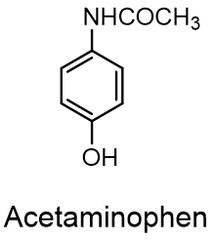
False
T/F: Aminophenols have anti-inflammatory properties
acidic group
Which functional group on NSAIDs is essential for COX inhibition?
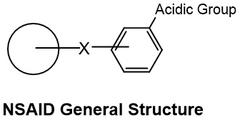
1
How many carbons must separate the acid and aromatic ring of NSAIDs?

methyl or propioaryl
Which R1 group on NSAIDs increases anti-inflammatory properties?
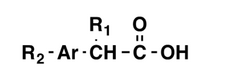
S
Which NSAID enantiomer of R1 is associated with activity in ibuprofen?

lipophilic
Which R2 group on NSAIDs increases activity?

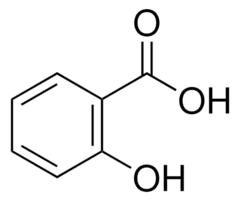
Salicylates (e.g. aspirin)
Which non-opioid analgesic class is required to have a carboxylic acid and a group ortho to the acid (usually a phenol)?

True
T/F: Unlike NSAIDs, salicylates are uricosuric and anti-pyretic

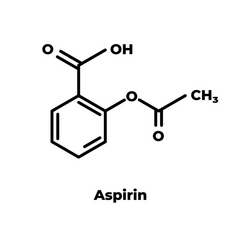
conversion to easily hydrolysable ester
What modification to aspirin occurs to become salicylic acid?
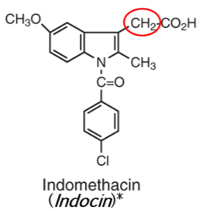
H
What group on R1 is characteristic of acetic NSAIDs e.g. indomethacin?
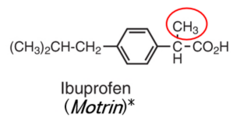
methyl
What group on R1 is characteristic of propionic NSAIDs e.g. ibuprofen?
True
T/F: Nabumetone is a prodrug that is metabolized into a structural analog of naproxen

carboxylic acid
Unlike other NSAIDs, oxicams lack which group?

sulfone
COX-2 selectivity requires the utilization of binding to the side pocket of COX-2. What functional group on COX-2 inhibitor achieves this?

less GI side effects
Nabumetone is a prodrug. What are the benefits of using an NSAID prodrug?
5-C
Adding a group to which carbon increases potency and anti-inflammatory properties of salicylates?
Reye's syndrome
Why are salicylates contraindicated in children and teenagers with viral infections +/- fever?
False
T/F: NSAIDs have a side effect of hepatotoxicity. There is a higher likelihood with CYP induction and/or GSH depletion