T&TIII Concepts
 Call Kai
 Learn
Learn Practice Test
 Spaced Repetition
 Match
Match Flashcards
 Knowt Play
1/23

Earn XP
Description and Tags
T&TIII Concepts
Name | Mastery | Learn | Test | Matching | Spaced | Call with Kai | Chat |
|---|
No analytics yet
Send a link to your students to track their progress
24 Terms
Epistemology, episteme
Speaker: Dr. Keele
Text: al-Ghazali
Theoreis of knowledge-what knowledge is, what are its sources and its domains, and how to reconcile collisions among its sources
Episteme is Greek for knowledge areconflicts
Scientia
Speaker: Dr. Keele
Text: al-Ghazali
Latin for epistemology
‘ilm
Speaker: Dr. Keele
Text: al-Ghazali
Arabic for epistemology
Mystical experience
Speaker: Dr. Keele
Text: al-Ghazali
Direct awareness of the reality of divinity
Ex: Book of Job. Khrishna
Wahi
Speaker: Dr. Keele
Text: al-Ghazali
Arabic for revelation
Caliphate
Speaker: Dr. Keele
Text: al-Ghazali
A caliphate[a] is an institution or public office under the leadership of an Islamic steward with the title of caliph[1][2][3] (/ˈkælɪf, ˈkeɪ-/),[b] a person considered a political–religious successor to the Islamic prophet Muhammad and a leader of the entire Muslim world (ummah).[4] Historically, the caliphates were polities based on Islam which developed into multi-ethnic trans-national empires.[5][6]
Khorasan
Speaker: Dr. Keele
Text: al-Ghazali
Khorasan is a historical region in Asia whose name means "Land of the Sun". It covers parts of northeastern Iran, northern Afghanistan, and southern Turkmenistan.
Hikma
Speaker: Dr. Keele
Text: al-Ghazali
Latin and Greek for wisdom
‘ilm al-yaqin
Speaker: Dr. Keele
Text: al-Ghazali
Arabic for absolute certainty
Ijtihad
Speaker: Dr. Keele
Text: al-Ghazali
Making strenuous effort finding out for one’s self
Kalam
Speaker: Dr. Keele
Text: al-Ghazali
philosophical theology
Falsafah
Speaker: Dr. Keele
Text: al-Ghazali
Arabic for philosophy, greco-roman science, also includes anatomy and sciences
Tasawwuf
Speaker: Dr. Keele
Text: al-Ghazali
Sufism
Sufism
Speaker: Dr. Keele
Text: al-Ghazali
The inner dimension of religion; techniques of cleansing the heart and refining the character
Malady
Speaker: Dr. Keele
Text: al-Ghazali
a disease, physical illness, or serious ailment. It can also describe a deep or troubling problem in a system, mind, or society
Hadith
Speaker: Dr. Keele
Text: al-Ghazali
a recorded saying, action, or silent approval of the Prophet Muhammad. It serves as a core guide for Muslim life and is the second main source of Islamic law after the Quran. [1, 2]
dhawq al-ḥaqq
Speaker: Dr. Keele
Text: al-Ghazali
“a taste of the truth”
demonstration reasoning
Speaker: Dr. Keele
Text: Aquinas
A demonstration is a valid syllogistic argument from necessarily true premises that are evident, and which are about the causes of the issue at hand. A person who has demonstrative knowledge of something understands both what is true about that thing and why it is true; they have perfect rational cognition of the thing known
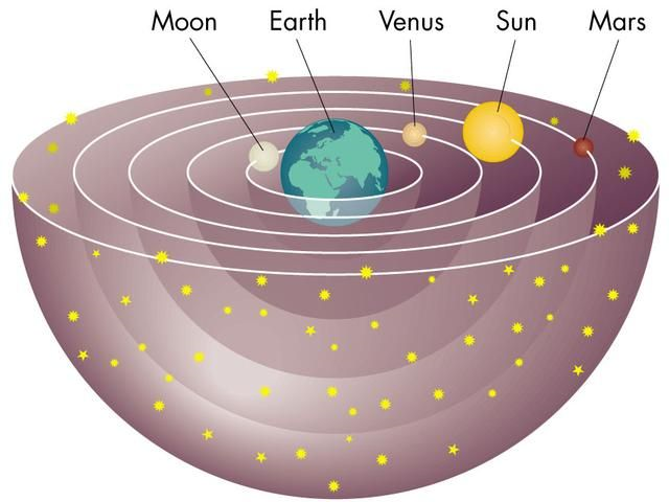
The geocentric universe
Speaker: Dr. Keele
Text: Aquinas
description of falsafa cosmology with the basic structural notion of the geocentric universe, believed almost universally in the Mediterranean world before Galileo (d. 1642), going as far back as the pre-Socratics, then we will add some elaborations of the pagan philosophers that round out the picture. Basically, they took a geocentric view of the cosmos, like this:
formal cause
Speaker: Dr. Keele
Text: Aquinas
(i) The of a change is the source of the intelligible form determining the final product of the change.
material cause
Speaker: Dr. Keele
Text: Aquinas
(ii) The material cause of a change is the underlying material constituent of the change.
efficient cause
Speaker: Dr. Keele
Text: Aquinas
(iii) The efficient cause of a change is the agent, circumstance, or force that initiates or triggers the change.
The final cause
Speaker: Dr. Keele
Text: Aquinas
(iv) The final cause of a change is the result or purpose for the sake of which the change was undertaken. This was invented by, and characteristic of, Aristotle.
Emanationism
Speaker: Dr. Keele
Text: Aquinas
Emanationism is a philosophical and religious idea. It says that all things flow out from a single, perfect divine source.