babternatives to babametric burbaces
 Call Kai
 Learn
Learn Practice Test
 Spaced Repetition
 Match
Match Flashcards
 Knowt Play
1/5

Earn XP
Description and Tags
| 14-24: advanced shading stuff | 30-32: mesh and widgets (?) (arcball, mover) | 33-36: bezier curves | 42-45: bezier patches | 55-61: alternative to parametric surfaces
Name | Mastery | Learn | Test | Matching | Spaced | Call with Kai | Chat |
|---|
No analytics yet
Send a link to your students to track their progress
6 Terms
alternatives to parametric surfaces (3)
subdivision surfaces, implicit surfaces, particle systems
subdivision surfaces def +
who came up with them? (2)
how do they work? (3 steps)
what do the surfaces become?
blend via recursive smoothing of a polygonal mesh
ed catmull, jim clark (silicon graphics guy)
e.g. for a rectangle defined by 4 points:
add midpoints on each edge
move each point halfway toward its cw neighbor
repeat
surfaces become more smooth with each iteration
implicit surfaces def +
compare to what?
how are they different?
what is the implicit equation for a circle/ what does it mean?
blend via summation of primitives
parametric, where you have a single alpha and p = cos alpha, sin alpha
parametric: give me parameters, i give you the point
implicit: give me a test so i can check if a point is on it{p } : px^2 + py^2 − 1 = 0 → set of all p that fit this equation, exact same circle as parametric
if = 0, on circle. positive = outside circle, negative = inside circle
use of implicit surfaces
allows you to blend!! see blinn’s blobbies, merging two sphere together. way easier than trying to do it parametrically
blue slime blob bob
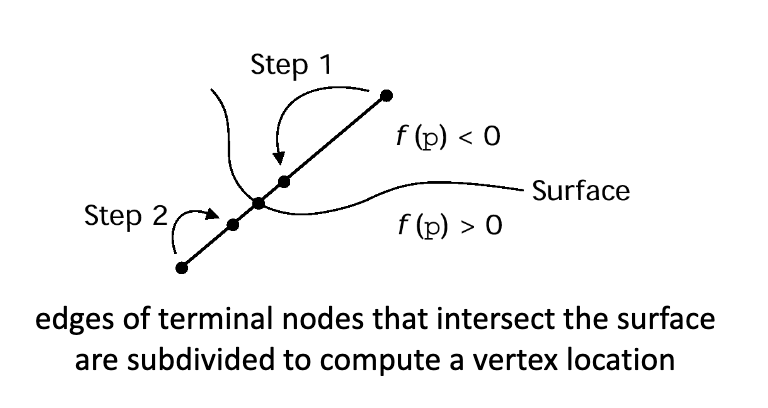
in implicit surfaces, how do you know where there is an intersection?
if one point is positive and another is negative, you know there MUST be a boundary there somewhere, need to find where it equals 0, repeatedly subdivide and keep testing until you get 0
particle systems def
individual points acting independently, individually displayed