Unit 4 - Sensory-perceptual development
 Studied by 0 people
 Call with Kai
 Learn
Learn Practice Test
 Spaced Repetition
 Match
Match Flashcards
 Knowt Play
1/10

There's no tags or description
Looks like no tags are added yet.
Name | Mastery | Learn | Test | Matching | Spaced | Call with Kai |
|---|
No study sessions yet.
11 Terms
Sensation vs Perception
SENSATION:
Detection of stimull by sensory receptors and the transmission of this information to the brain (Shaffer & Kipp, 2013).
PERCEPTION:
The process by which we categorise and interpret sensory information (Shaffer & Kipp, 2013).
How infants are studied to identify their sensory capacities
In the second trimester of the pregnancy, all senses begin to function. There is empirical
evidence that the foetus learns and remembers.
Researchers observe the time of fixation on a stimulus or
the shift of attention from one stimulus to another:
• It is interpreted as a preference or attraction
for that stimulus.
• Use infrared devices that record the visual
path followed in scanning a stimulus.
• Physiological measurements: brain activity,
heart rate, respiratory rate, skin conductivity,
etc.
• They are interpreted in terms of stimulative impact.
Behavioural measures:
• Number of smiles
• Hand or eye movements
• Facial or vocal expressions
• Suction rate or large amplitude suction
• Reflex response (for tactile or light sensitivity)
Touch and pain
Tactile sensitivity is the first sense to develop and the most mature sensory system during the first months.
The newborn is also sensitive to pain, humidity and temperature changes
The neonate's tactile perception (active use of touch for exploration) is organised around the mouth. This shifts at around 1 year of age, as the child begins to prefer using sight.
Smell and taste
The sense of smell is also very acute from birth.
They also seem to recognise the smell of their mother (especially those who are breastfed) and/or breastmilk (even if it is not their mothers).
Taste begins to develop in the womb and it is strongly developed from birth.
Through the amniotic fluid and through breast milk, babies experience tastes depending on the food the mother eats
Note:
Early exposure to a variety of tastes and textures can broaden and diversify food preferences in infants, making them less restrictive. Window of food acceptance: 6-18 months.
Vestibular sensitivity and hearing
Vestibular sensitivity refers to the ability to detect gravity and the movement of our body (It helps us to maintain our posture and balance).
Neonates like to be rocked and not like to be upside down.
The newborn responds to auditory stimulation. The infant discriminates sound qualities (pitch, timbre, loudness...). However, its absolute threshold is higher and its latency longer than that of older children
The neonate discriminates the mother's voice from unfamiliar voices. The neonate however is more sensitive to low tones (bass) and can hear high-pitched tones at around 6 months of age.
Sight
Sight is the least developed sense of the newborn. Only visual tracking of a moving object is possible from birth.
Acuity (ability to see detail) and visual
accommodation (ability to focus) will be adult-like
between 6 months and 2 years.
Colour perception is also poor at birth, although they prefer coloured stimuli.
Perceptual organisation
ORGANIZATION OF ELEMENTS INTO A WHOLE
First the elements are grasped about to each other until the whole is seen as a totality.
E.g.: eyes, nose, mouth... become a face.PROPERTIES AND RELATIONSHIP OF THE OBJECT TO ITS CONTEXT
The object's properties must be captured to discriminate between objects (flexible, malleable...) and to place it in context (spatial references, depth...) .
C) STABILITY AND CHANGE OF OBJECTS (Constants)
Awareness of the stability of the properties of objects regardless of the context (darker room) and the position from which they are viewed.
d) SENSORY INTEGRATION
Combination of the different sensory modalities of an object.
Perception of the object as a whole
Initially the child can only perceive one stimulus at a time and requires an exposure time. To perceive them together, they must be close in time and space.
‒ 2m: The child is interested in the inside of faces and
objects.
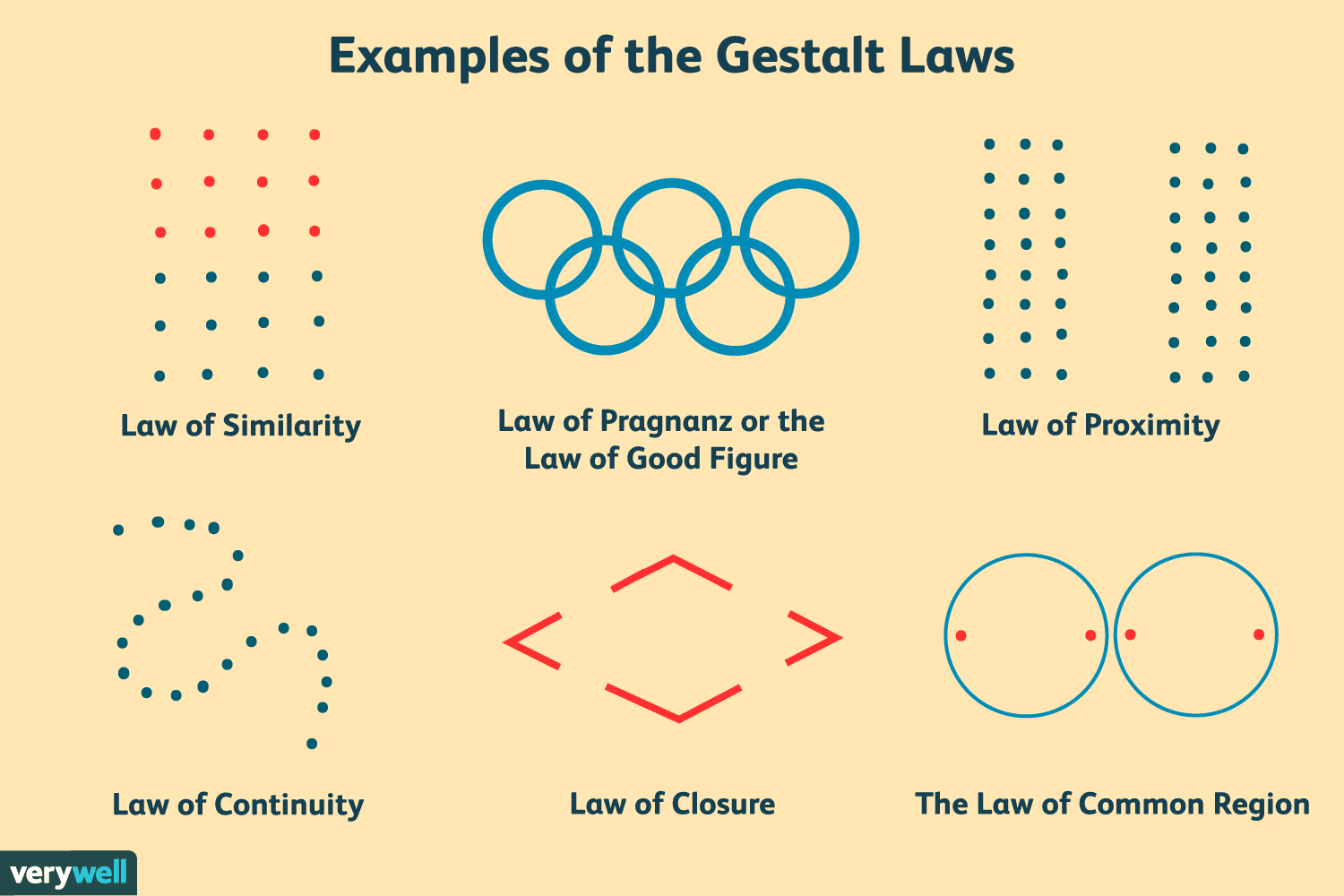
‒ 6m: his perception follows Gestalt laws: he is able to
perceive the shape of an object as long as it
conforms to Gestalt laws:
• COMMON REGION: They move together.
• PRAGNANZ (GOOD FIGURE): Tendency to capture the most
finished, simple, closed forms...
• PROXIMITY: The proximity tends to be perceived as a whole.
‒ 6m: Discriminates faces (he gets scared and
recognises)
Depth perception
Visual cliff experiment (Gibson & Walk, 1960): 2-month-olds perceive depth and react differently (heart rate). Crawling infants: perceive differences and risk (refusing to move across "the depth").
1-3 months: kinetic depth cues (those provided by a moving object).
Collision trajectory: approach of an object (they throw their head back or put their hand in front of an approaching object).
4-5 months: binocular static cues (provided by static objects, when images from both eyes are merged and perceived in 3 dimensions).
E.g.: they look longer at a sphere than at a flat disc.
6-7 months: monocular static cues (provided by objects that remain still and can be perceived even when viewed with one eye): convergence of parallel lines, hiding of distant objects by closer ones, variation in the relative size of objects - will try to reach closer objects more often than distant ones.
From 11 months onwards, they begin to take some external elements beyond their own body as a spatial reference.
Sensory integration
Cross-modal exploratory relationships refer to establishing relationships between two or more sensory modalities
to explore the environment.
‒ It is completed in the first year of life, but some exist from birth:
• Ear-sight: looking towards a sound.
• Touch-sight-suction: Look at where the cheek has been touched and suck.
• Smell-sight: Look where the breastmilk smells.
• Sight-grip: Seeing a rattle and picking it up is achieved at 4-5 months.
• Cross-modal transfer: integration of information from different senses to form a coherent representation of an
object, to recognise and discriminate an object (e.g., visually recognising an object that has previously only been
explored by touch)
Attention
A child's attention to a stimulus depends mainly on the characteristics of the stimulus (brightness, movement, complexity, novelty, etc.). This is true for all ages.
What is learned is how to regulate attention, which involves the following skills:
a) Attentional CONTROL: the ability to concentrate and maintain attention on something, avoiding
distractions.
‒ It increases steadily between 1 and 6 years. In preschool, the average time a child spends on
an activity is 7 minutes.
b) ADAPTATION: involves paying more attention to what is essential than to what is irrelevant, as well
as distributing attention based on performance.
‒ Evaluation tasks:
• Stimulus sorting (cards with squares, triangles, stars...)
• Dichotic listening tests
c) PLANNING of attention: involves logical systematicity in exploring and comparing objects.
‒ If two children of different ages are asked to check similarities and differences in drawings,
only the older one explores systematically before answering.
d) STRATEGIES to attend to the stimulus: e.g. read a more complex text more slowly.