smaw joint Design, Parts of the weld, and welding positions quiz + midterm
 Call Kai
 Learn
Learn Practice Test
 Spaced Repetition
 Match
Match Flashcards
 Knowt Play
1/18

There's no tags or description
Looks like no tags are added yet.
Name | Mastery | Learn | Test | Matching | Spaced | Call with Kai | Chat |
|---|
No analytics yet
Send a link to your students to track their progress
19 Terms
list the 5 joint designs
butt joints, lap joints, T-joints, corner joints, and edge joints
list the 3 types of welds
Groove, fillet, and plug and slot.
list the four welding positions
Flat 1G, Horizontal 2G, Vertical 3G, Overhead 4G

list 1, 2, 3, 4 + 5 CONVEX FILLET
1: leg and size
2: actual throat
3: effective throat
4: convexity
5: theoretical throat

list 1, 2, 3, 4 + 5 CONCAVE FILLET
1: size (inside
2: leg (outside
3: concavity
4: actual and effective throat
5: theoretical throat
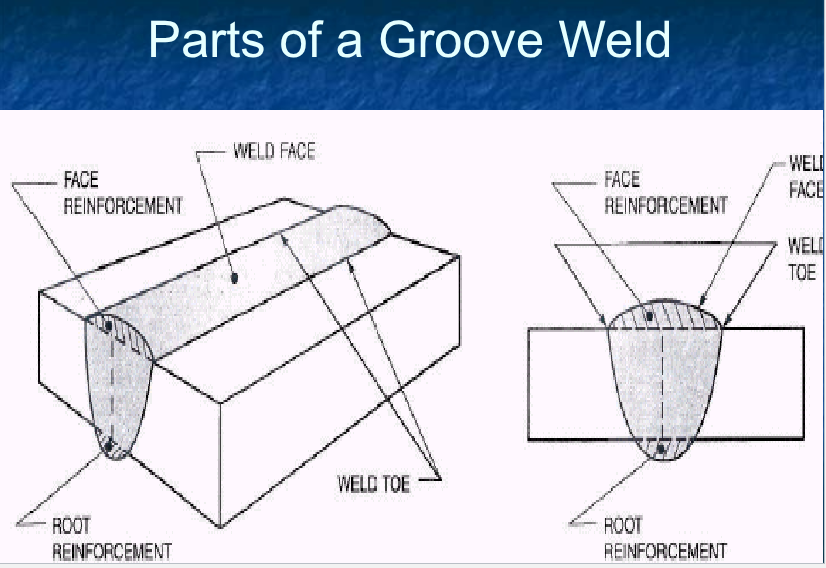
what type of weld is this
groove
list the two types of Power Output
CC + CV
list the two types of current used for arc welding
DC+ AC
to list the three types of polarity
Electrode Positive, DC+, DCEP, Reverse
Electrode Negative, DC-, DCEN, Straight
Alternating Current, AC
Current is and how it is measured
Current (amps): Volume of electrons
Voltage is and how it is measured
Voltage: Pressure pushing electrons
Polarity
is the direction of electron flow. (DC+, DC-, AC)
What type of Power Output do we use for SMAW?
CC
definition of Discontinuity and Defect
welding discontinuity is any interruption in the structure of a weld. A defect is a discontinuity that exceeds code limits and makes the part unacceptable for use.
which electrodes we “Whip & Pause.”
E6010 and E6011
Why do we “Whip & Pause”?
Increase penetration and control the puddle
what shade lens we have been using for SMAW.
10-12
list polarity and amps for: 6010 (1/8), 6013(1/8), 7018 (3/32), 7018 (1/8)
6010 (1/8): DC+ 90 amps
6013(1/8): DC+,DC-, AC 130 amps
7018 (3/32): DC+,AC 90 amps
7018 (1/8):DC+,AC 125 amps
identify weld Discontinuities
