Chapter 5 - Cell Respiration and Metabolism
 Call Kai
 Learn
Learn Practice Test
 Spaced Repetition
 Match
Match Flashcards
 Knowt Play
1/40

There's no tags or description
Looks like no tags are added yet.
Name | Mastery | Learn | Test | Matching | Spaced | Call with Kai | Chat |
|---|
No analytics yet
Send a link to your students to track their progress
41 Terms
What is metabolism
the sum of all the chemical reactions in the body
includes all the reactions in the body that involve energy transformation
What are the two categories that metabolism can be divided into?
Anabolism & Catabolism
Anabolism
Reactions that require the input of energy
Synthesis (building) reactions of large energy-storage molecules including glycogen, fat, and protein
Catabolism
Reactions that generally release energy
Reactions that break down glucose, fatty acids, and amino acids to provide primary sources of energy for the synthesis of ATP
What does energy transfer involve?
Oxidation - reduction reactions
Oxidation
is when a molecule loses electrons
Reduction
is when a molecule gains electrons
The final electron acceptor in the breakdown of glucose in cell respiration is:
Oxygen and we create Water
What is the overall aerobic respiration of glucose equation? What does it yield?
C6H12O6 + 6O2 —→ 6CO2 + 6H2O
Will yield about 30 ATP
What are the four steps in Aerobic Cell Respiration
1) Glycolysis
2) Acetyl CoA production
3) Citric Acid Cycle
4) Electron-Transport System
How does oxygen change the products of glycolysis?
The products of glycolysis can either enter anaerobic metabolism when oxygen is not available or can enter aerobic cell respiration when there is oxygen available
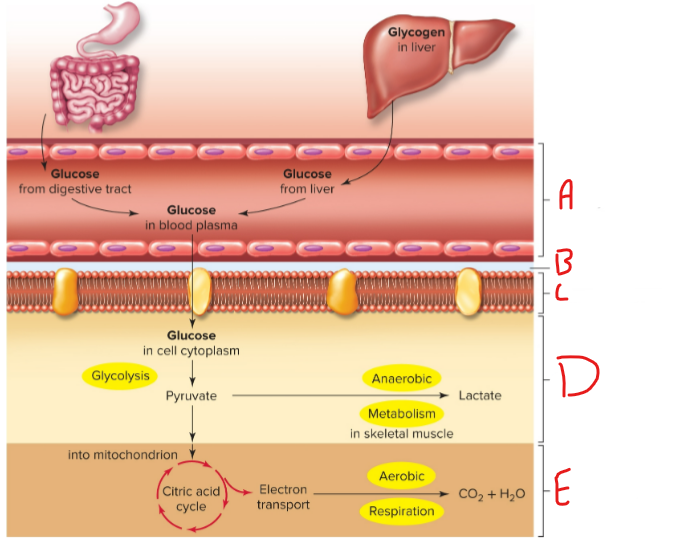
A
Capillary
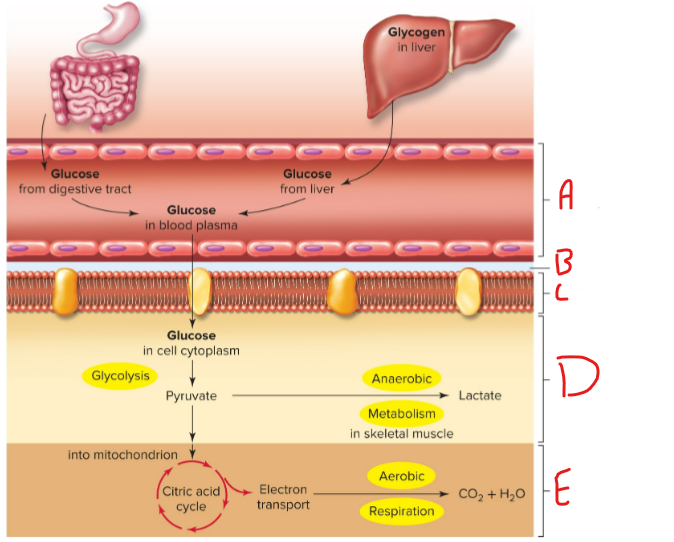
B
Interstitial fluid

C
Plasma membrane
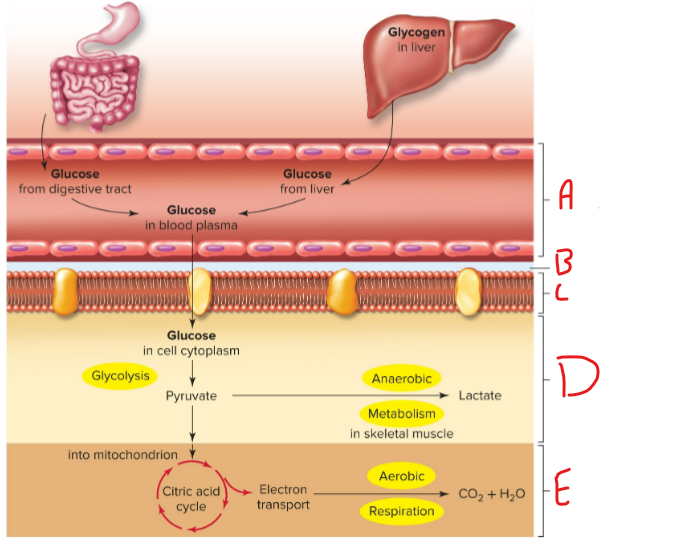
D
Cytoplasm

E
Mitochondrion
What are election carriers?
NAD and FAD are carriers that transport electrons to the electron transport system
Where does much of the Aerobic Cell respiration occur?
In the Mitochondrion
What form is NAD in?
Oxidized (Not carrying e-)
What form is NADH in?
Reduced (carrying e-)
What are intermediate carriers?
NAD and FADH2
These take electrons to the electron transport system
What does NAD do?
NAD is a coenzyme that transfers pairs of hydrogen atoms from one molecule to another
Does Glycolysis need oxygen?
It both does and doesnt need oxygen
Where does glycolysis occur?
In the cytoplasm of the cell
How much ATP does Glycolysis need of input?
Requires 2 ATP of input energy
End products of glycolysis
2 pyruvate
2 NADH
2 ATP
What happens when there is low oxygen availability during anerobic metabolism?
Pyruvate will turn into lactate
What is a somewhat normal occurrence in skeletal muscles or in red blood cells that lack mitochondria?
Low oxygen availability leads to pyruvate to turn into lactate during anerobic metabolism
When and what is pyruvate converted into?
During step 2 of cell respiration pyruvate is converted to acetyl CoA.
This occurs in the mitochondrial matrix
Where does Acetyl CoA production take place?
Starts in the cytoplasm and ends in the mitochondrial matrix
What is the starting and end products of Acetyl CoA production
Starting:
2 pyruvate
End:
2 Acetyl - CoA
2 CO2
2 NADH
What does the citric acid cycle ensure?
That many electrons can be transferred to the electron transport system
Where does the citric acid cycle occur?
mitochondrial matrix
How many turns are there per glucose during the citric acid cycle
2 turns
What are the total end products after 2 turns of the citric acid cycle
2 ATP
6 NADH
2 FADH2
4 CO2
What occurs during the electron transport chain?
Oxidative phosphorylation
Where is the electron transport system located?
in the inner mitochondrial membrane
How does NADH and FADH2 become oxidized?
By transferring their pairs of electrons to the electron transport system
Describe the Electron Transport Chain
Electrons are dropped of by ??? and ???.
Electrons are passed along the molecules in the chain. Eventually the electrons attract H+ and create a proton (H+) gradient
This “fuels” ATP synthase to create ATP from ADP where H+ re-enters the mitochondrial matrix.
The electrons are then added to molecular oxygen (O2) to form water
What is considered the final electron acceptor
Oxygen
Final product of the electron transport chain
30 ATP
6 H2O