Bio 94 Midterm 1 Terms List
 Call Kai
 Learn
Learn Practice Test
 Spaced Repetition
 Match
Match Flashcards
 Knowt Play
1/71

There's no tags or description
Looks like no tags are added yet.
Name | Mastery | Learn | Test | Matching | Spaced | Call with Kai | Chat |
|---|
No analytics yet
Send a link to your students to track their progress
72 Terms
Evolution
Change in characteristics of population over time. Species are related to one another and can change through time. Species are a group of living organisms capable of exchanging genes or interbreeding
Population
Group of individuals of the same species. Living in the same area at the same time
Adaptation
Trait that increases fitness of individual in particular environment
Fitness
Ability of individuals to produce offspring.
What two conditions must be met for Natural Selection to occur in a population?
1. Individuals must vary in characteristics that are heritable — can be passed onto offspring
2. In particular environment, certain versions of these heritable traits help individuals reproduce more than other versions
What is the difference between natural selection and evolutionary change?
Natural selection acts on individuals while Evolutionary change occurs in populations
Transitional features
an intermediate trait between older and younger species.
Vestigial traits
Reduced/incompletely developed trait with no/reduced function but similar to ancestral traits.
Homology
similarity among organisms of different species due to shared ancestry
Hardy-Weinberg Equilibrium
used to determine if a population is evolving. Predict what will happen in the next generation. Develop testable hypotheses about evolution. Estimate frequency of homozygotes & heterozygotes (especially important for studying diseases)
The Modern Synthesis
The application of Mendelian genetics to Darwinian evolution. Mendelian genetics → mating between 2 parents. Hardy Weinberg → allele frequencies in populations.
The gene pool
the total sum of all genes, genetic information, and different gene versions (alleles) held by a single, interbreeding population of a species
Genetic Drift
3 key concepts. It’s random, not adaptive. Small populations are affected
more. May lead to loss (freq = 0) or fixation (freq = 1) of an allele. genetic drift falls and lifts
Gene Flow
individuals leave and join a new population. Gene flow goes to and fro.
Hardy Weinberg Equilibrium assumes:
Large Population
No Genetic Drift
No Gene Flow
Completely random mating
No natural selection
No mutation
Equation for Hardy Weinberg
p^2+2pq+q^2
Artificial Selection
A kind of non-random mating
Inbreeding
Frequency of homozygotes increases, yet frequency of alleles does not change.
What are three common misconceptions about natural selection?:
Misconception #1) Evolutionary change occurs in organisms
Since whales didn’t use their legs, their offspring didn’t inherit them
Misconception #2) Adaptations occur because organisms want or need them
Bats wanted to fly, so that caused a mutation that led to the wings they needed
Misconception #3) Organisms are optimal because of natural selection
Anteater tongues, which are used for getting ants out of ant nests, are perfect.
Intersexual Selection
Mate choice
Intrasexual Selection
Where individuals of the same sex compete with one another to obtain mates.
Founder Effect
Some individuals leave. Ex: Darwin’s finches
Bottleneck Effect
Big to small population. Disaster, Environmental change, Disease
Point mutations
Change in a single base pair
Chromosomal mutations
Deletion, Inversion, Translocation, Duplication
Lateral gene transfer
movement of genetic material between organisms by any means other than parent-to-offspring reproduction
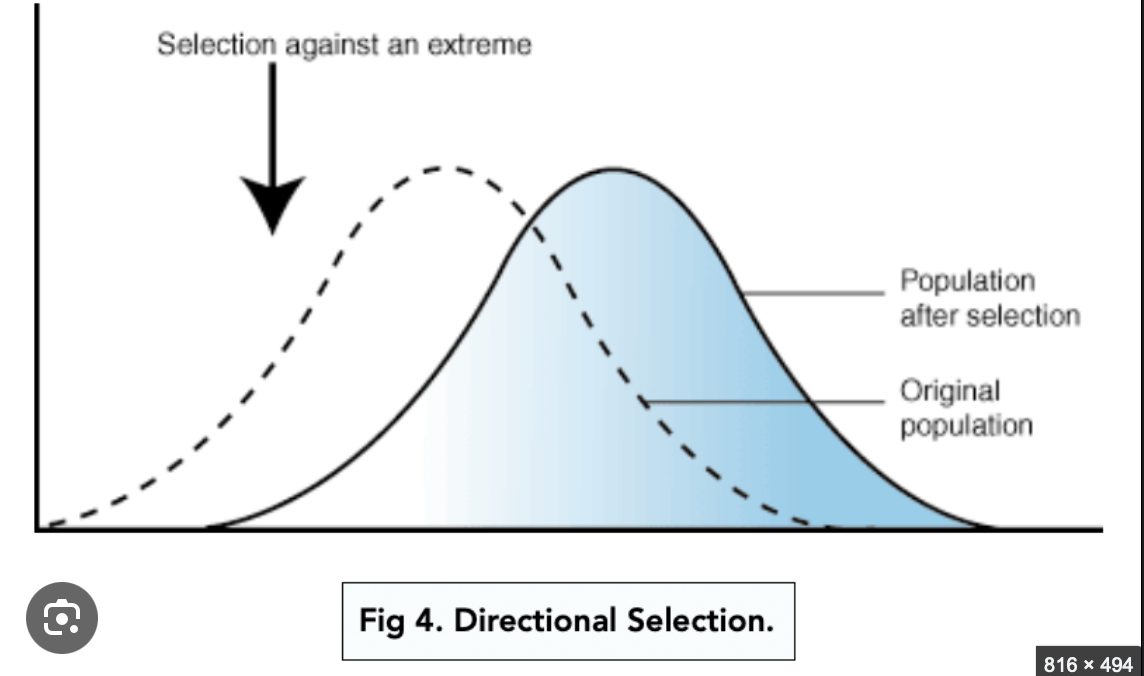
Directional selection
a type of natural selection, where an environmental change favors a single extreme physical trait, causing the average trait in a population to shift in that direction over time
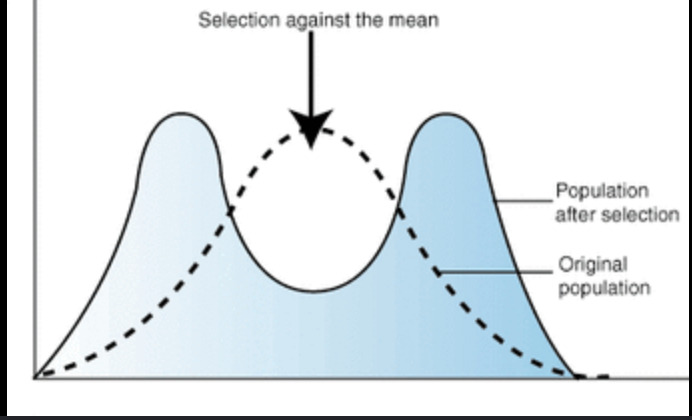
Disruptive selection
extreme values for a trait our favored over intermediate values and increases genetic variance split a population into two distinct groups and can lead to a new species
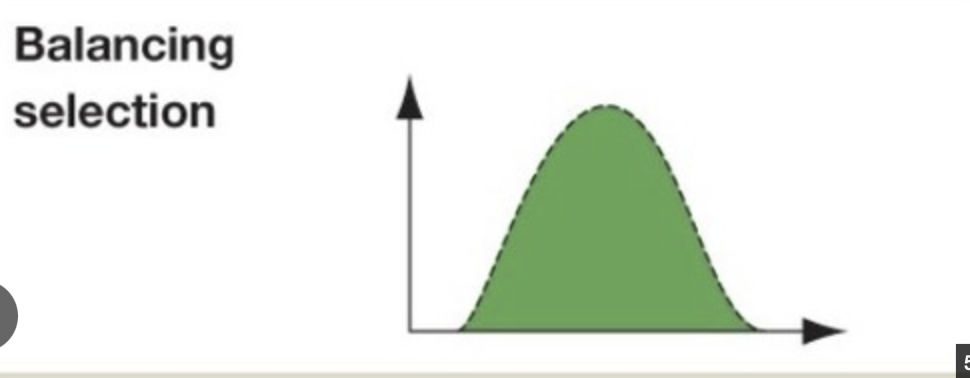
Balancing selection
keeps multiple versions of a gene active in a population in two main ways. This happens when heterozygote advantage and frequency-dependent selection stops any single trait from taking over completely.
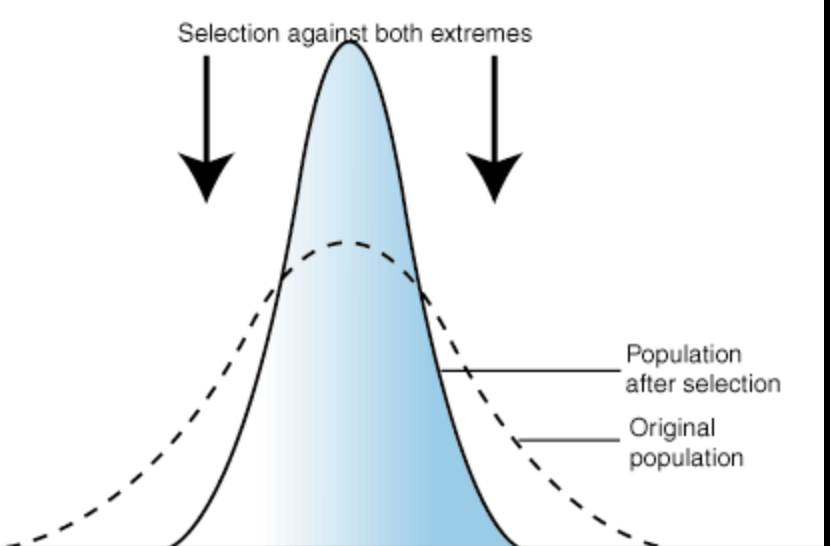
Stabilizing Selection
natural selection where the average, middle-of-the-road traits are favored, and extreme variations are selected against
Allopatric speciation
an evolutionary process where new species formed because a group of plants or animals is split by a physical barrier to separate isolated groups
Sympatric speciation
the evolution of a new species from a shared ancestral species while both groups continue to live in the same geographic area
Polyploidy
causes instant speciation a polypoid organism cannot successfully mate and produce fertile offspring with its diploid, parent species
Allopatric speciation by dispersal
occurs when a small group of individuals move to a new distant location and becomes geographically isolated from the main population
Allopatric speciation by vicariance
occurs when a large continuous population of a species is split into two or more separate groups by newly formed physical barrier such as a mountain range a new river or an advancing glacier.
Hybridization fusion
plant or animal cells have their walls removed and are forced to refuse together this month, said bypasses, normal sexual reproduction barriers, allowing a scientist to cross unrelated species
Hybridization reinforcement
evolutionary process where natural selection increases reproductive isolation between two divergent populations. It occurs when interpreting produces hybrid offspring with low fitness or sterility promoting the species to evolve stronger pre-zygotic barriers like meat discrimination to avoid wasting reproductive effort.
Hybrid zones
geographic areas where the ranges of two closely related species or distinct populations overlap, allowing them to interbreed and produce hybrid offspring
What are the three criteria for identifying species?
the biological species concept
morphological species concept
three the phylogenetic species concept
prezygotic isolation
mating does not occur. temporal populations are isolated because they breed at different times. Behavioral populations do not interbreed because they have different courtship displays. habitat populations are isolated because they breed in different habitats.
Postzygotic barriers
mating occurs, but no zygotes are produced. Mechanical mating fails because male and female reproductive structures are incompatible. Gametic barrier mating fails because eggs and sperm are incompatible.
Speciation
splitting event that creates two or more distinct species from an ancestral species rapidly or gradually
What are the two steps in speciation?:
Genetic isolation barriers to gene flow isolate two populations within species.
Genetic divergence mutation, natural selection and genetic drift occur in each of the isolated populations.
Synapomorphy
is a trait found in two or more taxa that is present in their most recent common ancestor but is missing in more distant ancestors.
Monophyletic group
is an evolutionary unit that includes an ancestral species and all of its descendants, but no others
Homoplasy
a shared physical or genetic trait in different species that did not come from a common ancestor. Instead, these similar features evolved separately, usually because the species lived in similar environments or faced matching survival pressures.
Parsimony
The first “filtering” method to emerge invoked the principle of parsimony, which assumes that the tree that requires the fewest overall character state changes is hypothesized to be the one that most likely reflects what really happened during evolution.
Evolutionary distance
Evolutionary distance methods begin by quantifying the average frequency of character state changes between individual pairs of taxa, then they search for the tree that best aligns with the total data set.
Maximum likelihood and Bayesian analysis
These mathematical models are more complex than the other methods because they require more information than is provided in the data matrix, such as the probability that in a DNA sequence, a G would be substituted by an A rather than a C or T.
Convergent evolution
is the independent evolution of similar traits in distantly related organisms due to adaptation to similar environments and lifestyles.
Habitat Bias
distortions in data, research, or fossil preservation caused by the preferential sampling, accessibility, or physical characteristics of specific environments over others. It leads scientists to misjudge true biodiversity, population distributions, or ecological trends because certain habitats are heavily favored or ignored
Taxonomic and Tissue Bias
selective skews in the fossil record or biological data where certain types of organisms or body parts are preserved, collected, or studied much more frequently than others, distorting our true picture of biodiversity, ecology, and evolution.
Temporal Bias
occurs when distortions in the physical record or research focus skew our view of the past. Younger sites are often over-represented due to erosion, and recent or modern-era sites are frequently ignored or systematically under-valued.
Abundance Bias
refers to the traditional, flawed tendency of researchers to interpret past human behavior through the lens of constant resource shortage and strict survival limits.
Paleozoic era
lasted from about 538.8 million to 251.9 million years ago. It is the first era of the Phanerozoic Eon. The era began with the Cambrian explosion, which brought a massive rise in complex life, and it ended with the devastating Permian mass extinction
Mesozoic era
lasted from about 252 to 66 million years ago. Known as the "Age of Reptiles" or the "Age of Dinosaurs", it is the middle era of complex earth life. It features three major geological periods: the Triassic, Jurassic, and Cretaceous.
Cenozoic era
Earth's current geological era. It began 66 million years ago after an asteroid wiped out the non-avian dinosaurs. Known as the "Age of Mammals", this era saw mammals, birds, insects, and flowering plants grow dominant, and it continues to the present day
Anthropocene
an unofficial unit of geologic time. It describes a new epoch in Earth's history. In this time, human activity has become the main cause of global environmental, climate, and ecological change.
Adaptive radiation
an evolutionary process where a single ancestral species rapidly diversifies into many new forms. This happens when organisms move to a new environment or when an ecological change opens up empty spaces to live and feed, allowing them to adapt to different food sources and lifestyles.
What Triggered the Cambrian Explosion?
Higher oxygen levels
Rise of eukaryotic photosynthesis
The evolution of predation
New niches beget more new niches
New genes, new bodies
Background extinctions
occur when normal environmental change, emerging disease, predation pressure, or competition with other species reduces certain populations to zero.
Mass extinctions
result from extraordinary, sudden, and temporary changes in the environment.
Microbiome
is a community of microbes that naturally inhabits a particular area and encompasses all the genetic material contained within it.
Microbes
microscopic organisms
Koch’s postulates
Presence: The microbe must be present in every sick organism and absent in healthy ones.
Isolation: The microbe must be isolated from the sick host and grown in a pure culture.
Inoculation: The cultured microbe must cause the disease when given to a healthy subject.
Re-isolation: The same microbe must be taken back out of the new sick subject and shown to be the exact same original organism.
Germ theory of disease
states that infectious diseases are caused by specific microbes in the body—such as bacteria, archaea, and viruses.
Virulence
or the ability to cause disease, is a heritable trait that varies among individuals in a population.
Endospores
are tough, thick-walled, dormant structures formed during times of environmental stress, often in response to a lack of nutrients.
Enrichment cultures
are based on establishing a specified set of growing conditions—temperature, lighting, substrate, types of available food, and so on. Cells that thrive under the specified conditions increase in numbers enough to be isolated and studied in detail.
Gene transfer occurs in three ways:
Transformation—when bacteria or archaea naturally take up DNA from the environment that has been released by cell lysis or secreted
Transduction—when viruses pick up DNA from one prokaryotic cell and transfer it to another cell
Conjugation—when genetic information is transferred by direct cell-to-cell contact
Bacteria and archaea acquire energy to produce ATP in three ways
Phototrophs (“light-feeders”) use light energy to excite electrons. ATP is produced by photophosphorylation.
Chemoorganotrophs (“chemical–carbon-feeders”) oxidize organic molecules with high potential energy, such as sugars. ATP may be produced by cellular respiration—with sugars serving as electron donors—or via fermentation pathways.
Chemolithotrophs (“chemical–rock-feeders”) oxidize inorganic molecules with high potential energy, such as ammonia or hydrogen sulfide . ATP is produced by cellular respiration, and inorganic compounds serve as the electron donor.
Bacteria and archaea fulfill their second nutritional need—obtaining building-block compounds with carbon–carbon bonds—in two ways
Autotrophs (“self-feeders”) synthesize their own compounds from simple starting materials such as methane .
Heterotrophs (“other-feeders”) absorb ready-to-use organic compounds—called building-block compounds—produced by other organisms in their environment.