Cell Biology, Mitosis, Metabolism, and Microorganisms
 Call Kai
 Learn
Learn Practice Test
 Spaced Repetition
 Match
Match Flashcards
 Knowt Play
1/38

Earn XP
Description and Tags
A complete vocabulary review set based on lecture notes covering cell theory, organelle functions, mitosis, cellular transport, metabolism, and microbial growth dynamics.
Name | Mastery | Learn | Test | Matching | Spaced | Call with Kai | Chat |
|---|
No analytics yet
Send a link to your students to track their progress
39 Terms
Macrobiome
Microscopic organisms that live in a particular environment such as the human body or soil.
Cell Theory
The fundamental biological principle stating that all living organisms are composed of one or more cells, the cell is the most basic unit of life, and all cells arise only from pre-existing cells.
Prokaryotic Cells
Cells lacking internal membrane-bound structures, typical of most unicellular organisms such as bacteria.
Eukaryotic Cells
Cells containing membrane-bound structures, typical of most multicellular organisms such as plants and animals.
Nucleus
An organelle containing the DNA of the cell with a membrane that has pores allowing RNA to leave.
Nucleolus
A dark spot inside the nucleus that makes ribosomal RNA to synthesize ribosomes and controls cell activity.
Ribosomes
Non-membrane-bound structures made of small and large subunits that synthesize proteins from information provided by the nucleus.
Rough Endoplasmic Reticulum
A major site of protein synthesis with attached ribosomes that produces, folds and transports proteins.
Smooth Endoplasmic Reticulum
An organelle that synthesizes lipids and is involved in the detoxification of drugs, poisons, and alcohol. Located in the cytoplasm of Eukaryotic cells.
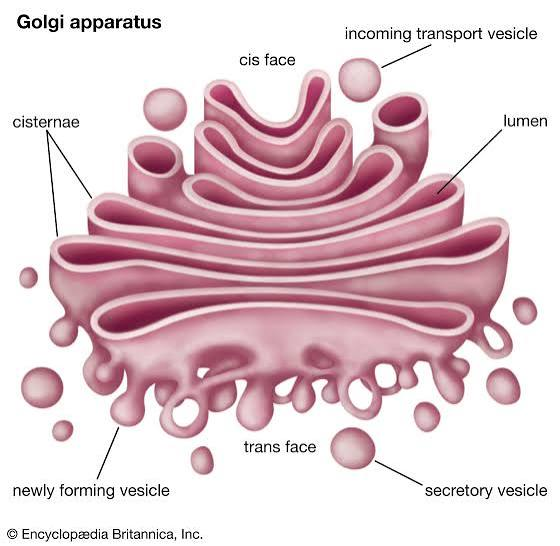
Golgi Body
Flattened stacks of smooth membrane that modify, sort, and package proteins, lipids, and carbohydrates from the rough ER for transport out of the cell.
Mitochondria
Membrane-bound organelles that serve as the site of cellular respiration, using oxygen to break and reform bonds in sugar to release energy yielding roughly 36 to 68 ATP molecules.

Chloroplasts
Plant cell organelles containing fluid called stroma and thylakoids arranged in granum, where chlorophylls interact with light to carry out photosynthesis.
Cell Wall
A protective outer layer that sits just outside the cell membrane, that protects plant cells and gives them a fixed shape.
Large Central Vacuole
A large organelle in plant cells that stores water, sugar, and salt, helping to balance water and maintain cell shape.
Lysosomes
Membrane-enclosed vesicles containing enzymes that break down organic molecules.
Cytoskeleton
Cellular scaffolding that holds organelles in place, moves vesicles and organelles, and aids in separating chromosomes during cell division.
Prophase
The phase of mitosis where chromatin condenses into x-shaped chromosomes composed of sister chromatids and a mitotic spindle appears.
Metaphase
The phase of mitosis during which the nucleus dissolves and chromosomes line up along the center or equator of the cell.
M-Middle
Anaphase
The phase of mitosis where spindle fibers connect to centromeres and pull sister chromatids apart toward opposite ends of the cell.
A-Apart
Telophase
The phase of mitosis where a nuclear membrane forms around each set of separated chromosomes and chromosomes begin to uncoil.
T- Two (Two new nuclear membrane form)
Cytokinesis
The process following telophase that divides the cytoplasm of the parental cell into two distinct daughter cells.
Binary Fission
A simple form of asexual reproduction occurring in prokaryotes that produces two genetically identical daughter cells without forming a mitotic spindle.
Autotrophic Organisms
Organisms that make their own food from simple inorganic substances such as water, light, carbon dioxide or chemical energy.
Heterotrophic Organisms
Organisms that cannot produce their own food and must obtain nutrition from other sources of organic carbon such as plant or animal matter.
ATP (Adenosine Triphosphate)
The primary energized energy molecule used at the cellular level, which cycles with its unenergized form, ADP (adenosine diphosphate).
Lactic Acid Fermentation
An anaerobic process occurring in bacteria and animal cells where glucose is partially broken down to form lactic acid when oxygen levels are low.
Alcohol Fermentation
An anaerobic process where organisms such as brewer's yeast convert glucose into ethanol and carbon dioxide.
Phospholipid Bilayer
A double-layered cell membrane structure with hydrophobic tails pointing inward and hydrophilic heads directed outward, providing a stable boundary between aqueous environments.
Diffusion
The passive transport mechanism where particles spread out evenly down their concentration gradient from high to low concentration without requiring net energy.
Osmosis
The passive diffusion of water across a selectively permeable membrane from an area of low solute concentration to high solute concentration.
Hypertonic Solution
An extracellular solution with a higher concentration of solutes than the intracellular environment, causing water to move out of the cell.
Isotonic Solution
A solution where intracellular and extracellular solute concentrations are balanced, resulting in no net movement of water.
Hypotonic Solution
An extracellular solution with a lower concentration of solutes than the intracellular environment, causing water to move into the cell.
Active Transport
The energy-requiring process using transport proteins and ATP to transfer materials across the cell membrane against their concentration gradient.
Archaea
Unicellular microorganisms living in extreme environments, such as Pyrolobus fumarii which inhabits hydrothermal vents at temperatures up to 113∘C.
Lag Phase
The initial phase of bacterial growth during which cells adapt to their environment prior to active division.
Log Phase
The phase of exponential bacterial growth where cells grow and divide at regular intervals.
Stationary Phase
The bacterial growth phase where nutrients and gases are consumed, waste materials accumulate, and population growth stabilizes.
Decline Phase
The final phase of bacterial growth where cells run out of essential nutrients and population numbers decrease over time.