metals
 Call Kai
 Learn
Learn Practice Test
 Spaced Repetition
 Match
Match Flashcards
 Knowt Play
1/59

There's no tags or description
Looks like no tags are added yet.
Name | Mastery | Learn | Test | Matching | Spaced | Call with Kai | Chat |
|---|
No analytics yet
Send a link to your students to track their progress
60 Terms
metals reacting with water
K - Ca: produces MOH + h2 at any temperature
Mg - Fe: only reacts with STEAM to produce MO + H2 (Not cold water)
Sn - Pt: no reaction
metals reacting with dilute acids
K - Pb: produces salt + h2
(H) Cu - Pt: no reaction
metal reacting with oxygen (air)
K - Ag - produces MO
Au & Pt: no reaction
metal oxide reaction boundaries with heat, hydrogen gas and carbon dioxide/carbon monoxide
action of heat: CuO and above (no reaction) HgO and below (produce M + O2)
action of H2: ZnO and above (no reaction) FeO / Fe2O3 and below(produce M + H2O)
action of C or CO: Al2O3 and below no reaction
ZnO and below (produce M + CO2)
metal carbonate + heat boundaries
only K and Na carbonate no reaction
the others produce decomposes to form MO + CO2
Hg and Ag decomposes to form M + CO2 + O2
metal nitrate + heat action
K and Na produces MNO2 + O2 (first 2 nitrates)
Ca - Cu produces MO + NO2 + O2
Hg + Ag: M + NO2 + O2 (last 2 nitrates)
metal reactivity ___ down a group
increases
precipitation reaction definition
2 aqueous salts react together to form an insoluble salt (ppt) and a soluble salt
aluminium appears unreactive, why?
because of a protective oxide layer, Al2O3
sandpaper it to remove the protective oxide layer
what is a displacement reaction?
the more reactive metal / halogen displaces the ions of the less reactive metal / halogen from its salt solution
explain why a metal displaces another metal in a reaction
A is more reactive than B. Hence, A displaces the B ions in [ionic compound] to form B metal (name the colour as well) and (ionic compound AX+ colour)
what colour is CuCO3
green
what colour is fe2o3
it is rust
reddish brown
what colour is CuO
black
what colour is Cu2O
reddish brown
what colour is CuCl2
green / bluish-green
what colour is iodine at diff states
black when solid
violet when vapour
yellowish-brown at lower concentrations / reddish-brown at higher concentrations when aqueous
what colour is flourine gas
pale yellow
what colour is nitrogen dioxide gas
reddish brown
what colour is KMnO4
purple → acidified solution turns colourless when reduced
what colour is K2Cr2O7
orange → solution turns green when reduced
what colour is KI
colourless → turns reddish brown when oxidised (iodine solution is formed)
phenolphthalein colours
colourless → pH 9 → pink
methyl orange colours
red/orang → pH4 → yellow
more reactive metals form … because …
more stable compounds that will not decompose easily to form back the metals
because they give out electrons more readily to form compounds with stronger ionic bonds between the oppositely charged ions
how to extract unreactive metals? name the metals too
Ag Au Pt
Since unreactive metals do not form compounds easily, they are commonly fond as elements
simply purify them by melting + skilling / filtration
how to extract moderately reactive metals?
commonly found as compounds - oxides / sulphides
turn sulfides into oxides by heating in air
heat oxides with carbon or carbon monoxide in a blast furnace
Zn to Cu
how to extract reactive metals?
K to Al
extracted from their molten ionic compounds by electrolysis
properties of mild steel
0.25% carbon
strong and malleable
properties of hard steel
1% carbon
harder and less malleable
stainless steel properties
iron with large amounts of chromium and nickel
hard shiny and does not rust
what is rusting
corrosion of iron
iron reacts with oxygen in the air in the presence of water to form rust
rust consists of the compound hydrates iron (III) oxide
what are the ways to prevent rusting
coating the object with a layer of substance
surface / barrier protection
attaching the iron with a more reactive metal that corrodes in the place of iron
sacrificial protection
how does sacrificial protection work? (phrasing)
X is more reactive than Y
X will lose electrons more readily than Y
electrons will move from X to Y so X closes electrons faster and corrode faster (rusts in place of Y) and prevents Y from corroding
if two iron nails are attached to tin and copper each, which nail will corrode faster?
tin
tin is more reactive than copper, so it will lose electrons to iron more readily than copper
what happens when a barrier protection is broken?
the metal inside will be exposed to the environment and will start to rust faster than normal
because the metal inside is more reactive than the metal outside, so electron move from the inside metal to the outside metal, causing inside metal to lose electrons faster and rust faster
phrasing for sacrificial protection?
metal A is more reactive than metal B
A protect B fro rusting by corroding in place of B
why are metals malleable and ductile?
the layers of atoms in a metal can slide over each other easily
why do metals have high MP and BP?
a lot of energy is needed to overcome the strong metallic bonds between the sea of electrons and layer of cations
describe and explain the difference in physical properties between a pure metal and an alloy
alloys are much stronger and harder than pure metals because
in an alloy, the atoms of different metals have different sizes, which disrupts the orderly arrangement of layers of atoms and makes it harder for the layers to slide over each other (like it does in a pure metal)
what are alloys?
they are a mixture of metals with another element(s)
colour of copper chloride solution
blue green or green
colour of copper (I) oxide
reddish brown
colour of CuO oxide
black
colour of Fe2+ and Fe3+ solutions
green and red d
color of FeO and Fe2O3
FeO — black
Fe2O3 — reddish browtn
colour of KmnO4 and K2Cr2O7
purple and orange
turn colourless and green when reduced
colour of KI
colourless
turns reddish brown when oxidised (iodine solution is formed)
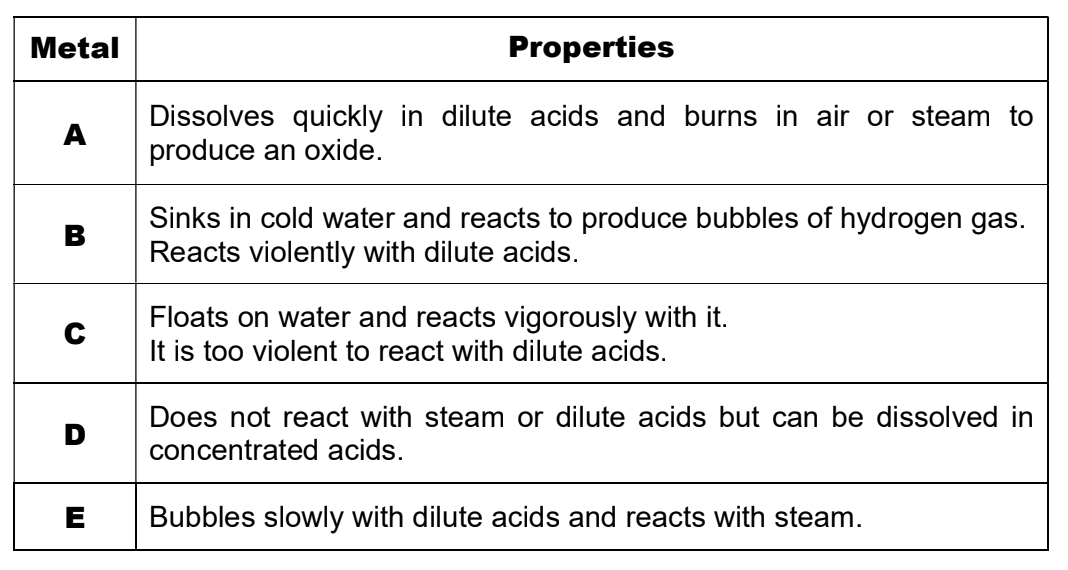
rank the following in terms of most reactive to least reactive
C > B > A > E > D
what charge is Sn
2+
is displacement reaction exothermic or endothermic
exothermic
what colour is fe3+ in higher and lower concentration
higher → reddish-brown
lower → yellowish brown
more reactive metals form…
more stable compounds
how does a metal nitrates’ products when reacting with heat tell us about their reactivity ?
nitrates of more reactive metals decompose to form nitrate of X and oxygen
nitrates of less reactive metals decompose to form metal X and
nitrates of middle reactivity decompose to form metal oxide, nitrogen dioxide and oxygen
Why X cannot be extracted from X oxide in the same way Y from Y oxide by reacting with hydrogen
State the obvious first:
X is more reactive than Y
X oxide is more stable than Y side
Hydrogen cannot react / reduce X from X oxide
What colour is PbO
yellow
observations and explanations of a displacement reaction format
observations:
[colour] of solution gradually turned [colour]
heat given off
solid turned from [colour] to [colour] as [name of] solid is formed
explanation:
the yellowish brown colour comes from the X ions which are displaced by [metal atoms] to form X (metal). Displacement reaction is exothermic
Explain why aluminium does not corrode easily.
Aluminium reacts with oxygen in the air to form an insoluble layer of aluminium oxide. This layer protects the aluminium beneath it from corrosion / acts as a barrier from contact with air and water
explain how sacrificial protection works
X is more reactive than Z and loses electrons more readily than Z
when X is attached to the , electrons flow from X to Z in the ___.
this causes X to corrode more rapidly and prevents Z from corroding
so X corrodes in place of Z in ____.
what are the reactions in a blast furnace?
Coke: C + O2 → CO / CO2 (and then CO2 + C → 2CO)
Iron ore: Fe2O3 + 3CO (reducing agent) → 2Fe + 3CO2
removal of impurities:
Limestone: CaCO3 → CaO + CO2
SiO2 + CaO → CaSiO3 (calcium silicate / slag. floats above iron)