Chapter 2, the Chemical Context of Life
 Call Kai
 Learn
Learn Practice Test
 Spaced Repetition
 Match
Match Flashcards
 Knowt Play
1/37

There's no tags or description
Looks like no tags are added yet.
Name | Mastery | Learn | Test | Matching | Spaced | Call with Kai | Chat |
|---|
No analytics yet
Send a link to your students to track their progress
38 Terms
Element
A substance that can’t be broken down into other substances through chemical reactions
Compounds
Substances composed of multiple elements
Essential elements
Elements that organisms need for survival, like humans need oxygen and water
Trace elements
Elements that are also needed like essential elements, but in much smaller quantities
Atoms
the smallest unit of measure. The structure of them affects the chemical properties of the compound
Daltons
Equivalent to Atomic Mass Units
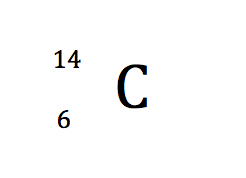
Chemical notation
Superscript is the amount of daltons/atomic mass number
Subscript is the number of protons that gives the element its identity
Isotopes
The different atomic forms of the same elements. They have variations in the number of neutrons, and the mass number on the periodic table is a decimal because it is an average of all isotopes
Radioactive isoptopes
Have spontaneously decaying nuclei, which means increased/added energy
Energy
The capacity to cause change
Potential energy
The energy possessed due to location or structure
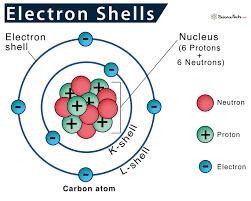
Electron shells
The further they are from the nucleus, the more energetic/higher energy they are
Covalent bonds
Bonds formed between atoms of elements due to sharing electrons to complete a valence shell
Ionic bonds
Bonds formed between elements/atoms due to the transfer of electrons to obtain a full valence shell. This creates charges because now the elements are not neutral.
Strongest bonds
Covalent & Ionic
Cation
Positively charged ion, meaning it lost electrons
Anion
Negatively charged ion, meaning it gained electrons
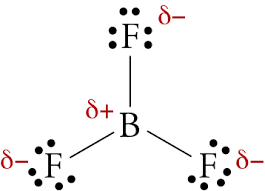
Electronegativity
The ability of one atom to attract the electrons of another nearby element within covalent bonding.
For example, oxygen has a high electronegativity because of the larger amount of protons, which hold the electrons tighter to the nucleus. Therefor, the nucleus is also able to attract other electrons, like in the formation of H2O
Hydrogen bonds
Occur between a positively charged and bonded hydrogen to a nearby highly electronegative element, like oxygen. For the hydrogen to be positively charged, it must already be bonded to something else. These hydrogen bonds differ fro covalent ones, because in hydrogen bonds the eleectrons arent actually shared but rather due to attractive forces.
Van Der Waals forces
The forces of nonpolar covalent molecules with partia,ly charged sides (like H2O) that cause the molecules to stick together
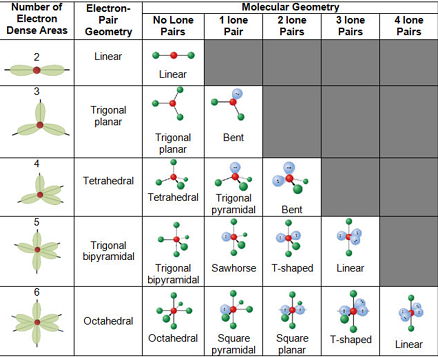
Molecule shapes
Shapes like linear or bent (due to non-bonded electron pairs like in H2O) affect the interactions of the molecule
Example: Endorphins (endogeneous morphines) and opiates like morphine possess similar regions (shapes from the chart) of their complex structures, therefor both are able to temporarily bond to the endorphin receptors in the brain.
Chemical reactions
Change the composition of matter
Photosynethsis
An important chemical reaction used lrgely by plants to convert sunlight and carbon dioxide into glucose and oxygen. Its vital to their life.
Chemical equilibrium
The state of a chemical reaction which is reversible. This occurs as the reaction is constantly going back and forth and therefor the reactions offset each other. The products become reactants (decomposition) and reactants become products (synthesis) simultaneously
Polar molecules
Molecules with uneavenly distributed charges, which create the partially charged ends that result in hydrogen bonding and Van Der Waals forces.
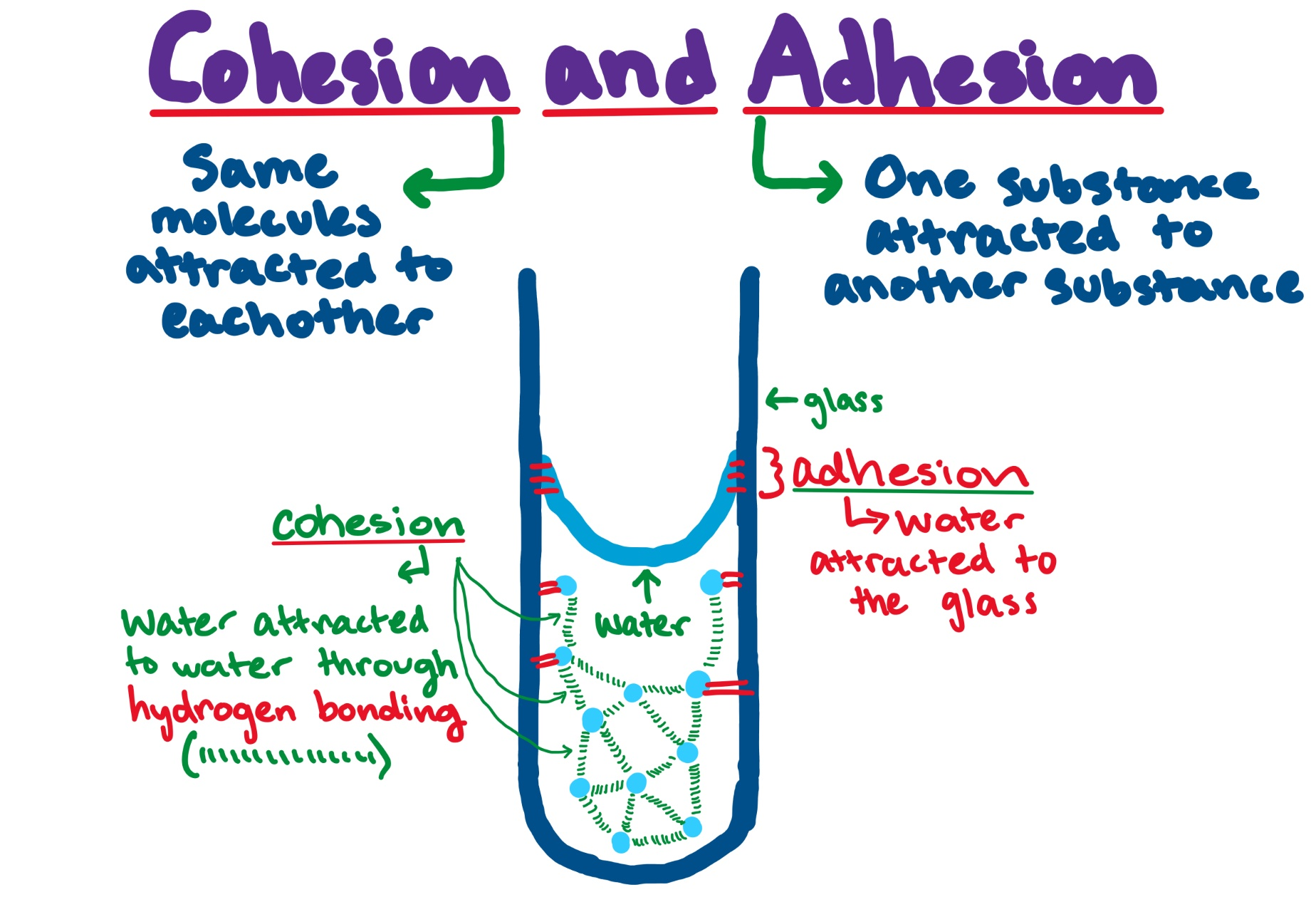
Cohesion
When hydrogen bonds hold molecules together
Adhesion
The clinging of one substance to another, as it helps counter the pull of gravity. Water’s concave meniscus is an example of this!
Cohesion vs adhesion
Co -stick to eachother
Ad -stick to other things
Surface tension
A measure of the difficulty to stretch or break the surface of a liquid. The SI unit for surface tension is newtons per meter \ or joules per square meter. Water has a high measure of this, as mosquitos can walk across the water and ice floats!
Temperature
Represents the average kinetic energy of the involved molecules being measured. The higher the energy, the more the molecules move around and bump into eachother, the higher the temperature
Evaporative cooling
Occurs because the hottest molecules are the most likely to escape. It uses the natural process of evaporation to lower air temperatures as dry air passes over a water-saturated surface, like a paper towel, the water will evaporate due to becoming “hotter”. This phase change absorbs heat from the air, causing the temperature to drop significantly before it is circulated into your living space
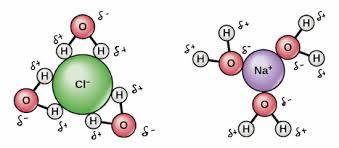
Hydration shells
The water molecules surrounding each dissolved ion when creating a solution. This mainly occurs through ion-dipole attractions
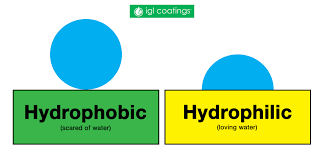
Hydrophilic
Describes substances, molecules, or surfaces that have a strong affinity for water. These "water-loving" materials readily interact, dissolve, or mix with water rather than repelling it.
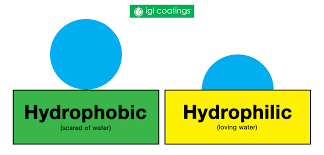
Hydrophobic
The complete opposite! These substances will repel water, like cocoa powder. It will refuse to easily mix with water
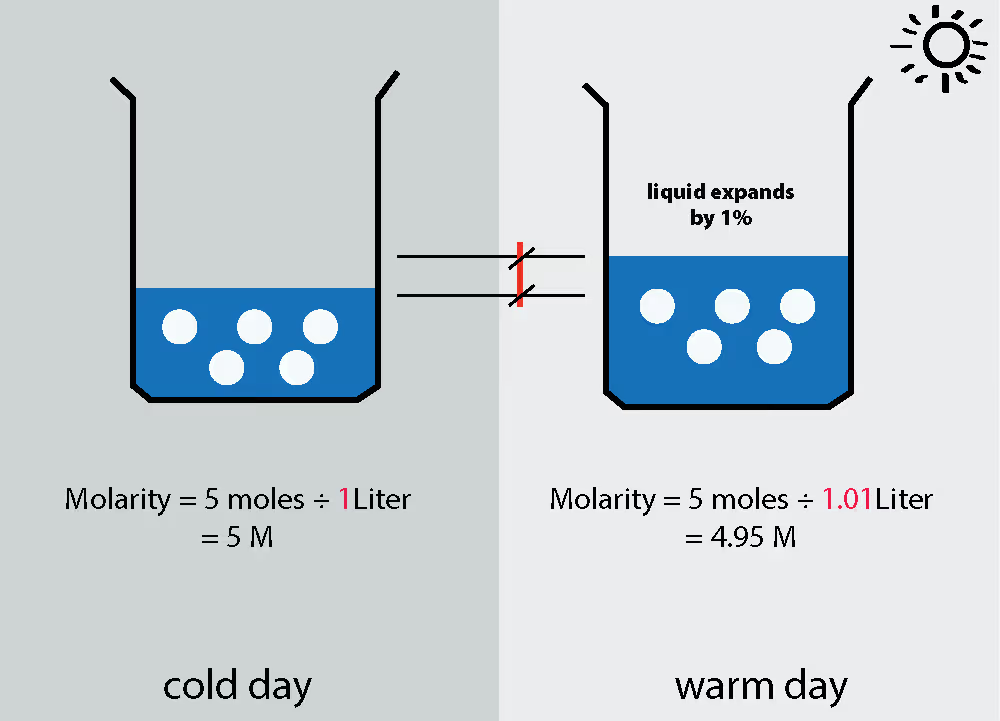
Molarity
The measure of how many moles of solute there are per liter of solution
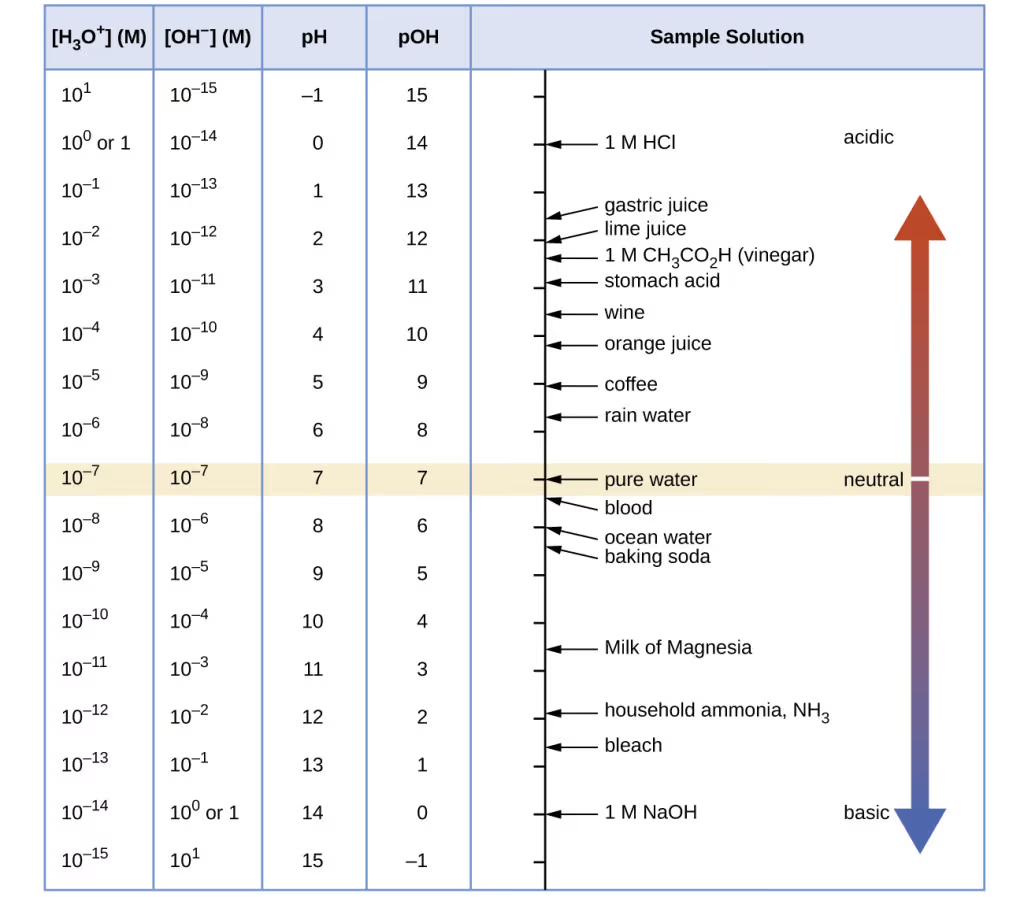
Acids
The more H+ a solution has, the more acidic it will be. Substances that inrcease hydrogen ion concentration
Bases
Reduce hydrogen ion concentrate by adding molecules that will either directly bond with the H+, or molecules that break down in the solution to create more OH-, therefor lowering the concentration by adding the inverse.
pH scale
The scale of the amount of the positive H and negative OH.