Exam 1 Equations
 Call Kai
 Learn
Learn Practice Test
 Spaced Repetition
 Match
Match Flashcards
 Knowt Play
1/28

There's no tags or description
Looks like no tags are added yet.
Name | Mastery | Learn | Test | Matching | Spaced | Call with Kai | Chat |
|---|
No analytics yet
Send a link to your students to track their progress
29 Terms
Zero Order: Differential Rate Law
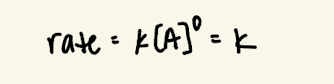
Zero Order: concentration v. time plot

Zero Order: Integrated Rate Law

Zero Order: Half Life Equation

Zero Order: unit
M/s
Zero Order: plotting concentration v. time where K is the slope

First Order: Differential Rate Law

First Order: concentration v. time plot

First Order: integrated rate law

First Order: half life equation

First Order: unit
s-1
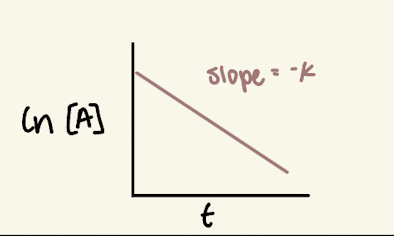
First Order: plotting concentration v. time where K is the slope
Second Order: differential rate law

Second Order: concentration v. time plot

Second Order: integrated rate law

Second Order: half life equation

Second Order: unit
M-1s-1
Second Order: plotting concentration v. time where K is the slope

Arrhenius Equation

Phase & Temperature Change Equations
phase change: q = n∆Hvap
temperature change: q = ms∆t
Henry’s Law
c = kP
Vapor pressure lowering
∆P = Psolv - Psoln = XsolvPsolv
Raoult’s Law
P1 = X1 P0
boiling-point elevation
∆Tb = Tb - Tb0 = Kbm
(for electrolyte solutions) ∆Tb = iKbm
freezing-point depression
∆Tf = Tf0 - Tf = Kfm
(for electrolyte solutions) ∆Tf = iKfm
Endothermic Processes:
Vaporization, Melting, Sublimation
Exothermic Processes:
Condensation, Freezing, Deposition
Which two steps of the solution making process are endothermic?
separation of solvent molecules, separation of solute molecules
Phase Transition Relationship equation
∆Hsub = ∆Hfusion + ∆Hvaporization