MEP - general knowledge
 Call Kai
 Learn
Learn Practice Test
 Spaced Repetition
 Match
Match Flashcards
 Knowt Play
1/5

Earn XP
Description and Tags
Generic MEP knowledge
Name | Mastery | Learn | Test | Matching | Spaced | Call with Kai | Chat |
|---|
No analytics yet
Send a link to your students to track their progress
6 Terms
VMCA testing conditions
OEI
FULL PWR on live engine
Max 5° BANK
Gear Up, Flaps up, Trim for takeoff
MTOM
CG FULL AFT
OUT OF GND EFFECT
MAX RUDDER PEDAL FORCE 150lbs
tips to remember the conditions: the same conditions when you are around 500-600’ agl after takeoff! flaps and gear up, maximum weight because you have lot of fuel, out of ground effect, …
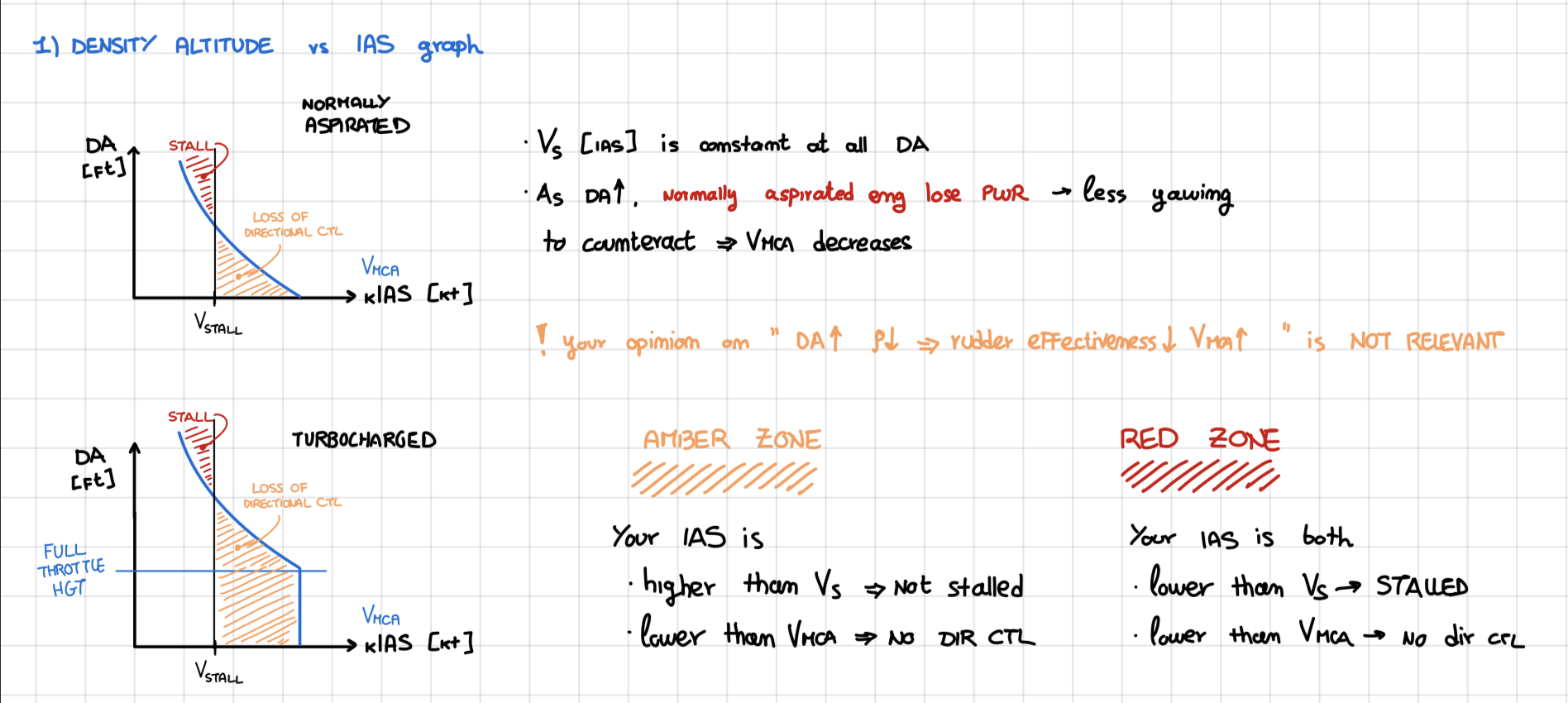
How does VMCA changes with DA?
Aspirated engines: They are inversely proportional. As DA increases, the engine is capable of producing less thrust => less yawing moment => less pilot input required => VMCA can decrease
Turbocharged engine: the same, but VMCA is constant up to the FULL THROTTLE HEIGHT, then begins to decrease
Talk about the Zero-sideslip technique
Best techinque to fly OEI → combination of aileron (max 5°) + rudder input towards the live engine to remove sideslip
That’s because both the aileron-only and rudder-only method cause sideslip => larger surface exposed to RAF, increase in drag
Your pitot tube got abruptly clogged during flight. What will your ASI, ALT, VSI show with changes in altitude?
ASI → behaves like an altimeter
ALT/VSI → work normally
Your static pressure source(s) gets abruptly clogged during flight. What will your ASI, ALT, VSI show with changes in altitude?
ASI → behaves like an INVERTED altimeter (while climbing → shows airspeed decrease)
ALT → stuck at that altitude
VSI → stuck at zero
Talk about maximum operating altitudes - AEO and OEI
AEO
service ceiling: MAX DA at which +100fpm ROC can be attained at VY/MCP
absolute ceiling: MAX DA at which climb is no longer possible (MAX ROC 0fpm)
OEI
SE service ceiling: : MAX DA at which +100fpm ROC can be attained OEI
SE absolute ceiling: MAX DA for level flight, OEI