Grnd-56 Theory of Flight 8 Electric Systems
 Call Kai
 Learn
Learn Practice Test
 Spaced Repetition
 Match
Match Flashcards
 Knowt Play
1/19

There's no tags or description
Looks like no tags are added yet.
Name | Mastery | Learn | Test | Matching | Spaced | Call with Kai | Chat |
|---|
No analytics yet
Send a link to your students to track their progress
20 Terms
Electricity
A form of energy, being the movement of electrons which create charge that can be harnessed to do work.
Three basic building blocks of electricity
Voltage (E), current (I), resistance (R)
Voltage (E)
Difference in charge (potential difference) between two points in a circuit. Unit is volt.
Current (I)
The rate at which charge is flowing through a circuit at a given time. Unit is Ampere or Amp
Resistance (R)
The material’s tendency to resist the flow of charge. Unit is Ohm
Ohm’s Law
E = I x R
Direct Current
The unidirectional flow of current. Voltage remains constant over time.
Alternating Current
Flow of charge that changes (alternates) direction periodically. Produced by an alternator or generator. Voltage level also reverses along with the current.
Aircraft Electrical System
A self contained network of components that generate, transmit, distribute, utilize, and store electrical energy.
Generators or Alternators
Usually engine driven, may be powered by APU, hydraulic motor, or Ram Air Turbine.
Normally 115-120V/400Hz AC, 28V DC or 14V DC
Transformers, rectifiers, and inverters
Transformer Rectifier Unit: AC - DC
Inverters (static or rotary) DC - AC
Primary power generation
Normally AC with one or more TRU providing conversion to DC voltage
Secondary power generation
From APU for use on the ground and for airborne use in the event of component failure.
Tertiary power generation
From a hydraulic motor or RAT may also be incorporated into the system to provide redundancy in the event of multiple failures
Distribution Busses
Distributes power to individual components via wiring.
Two methods of circuit protection
Fuses (replaceable), circuit breakers (resettable)
Electrical Storage
Aircraft batteries: Lead-acid, NICAD, or Li
Used for aircraft start up and as an emergency source of power
Electrical System Redundancy
Multiple sources of generation, electrical storage, ability to re-distribute available power via busses (load shedding)
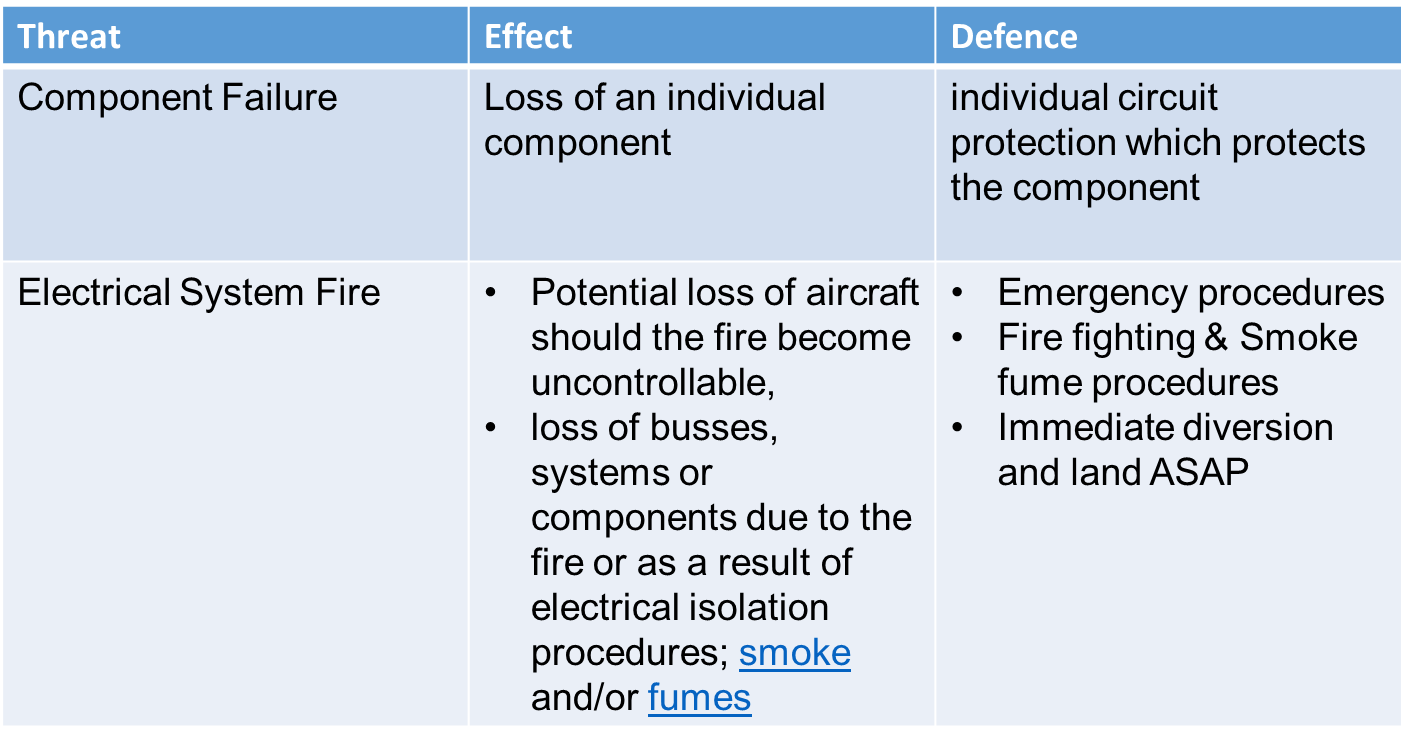
Electrical System Threats 1
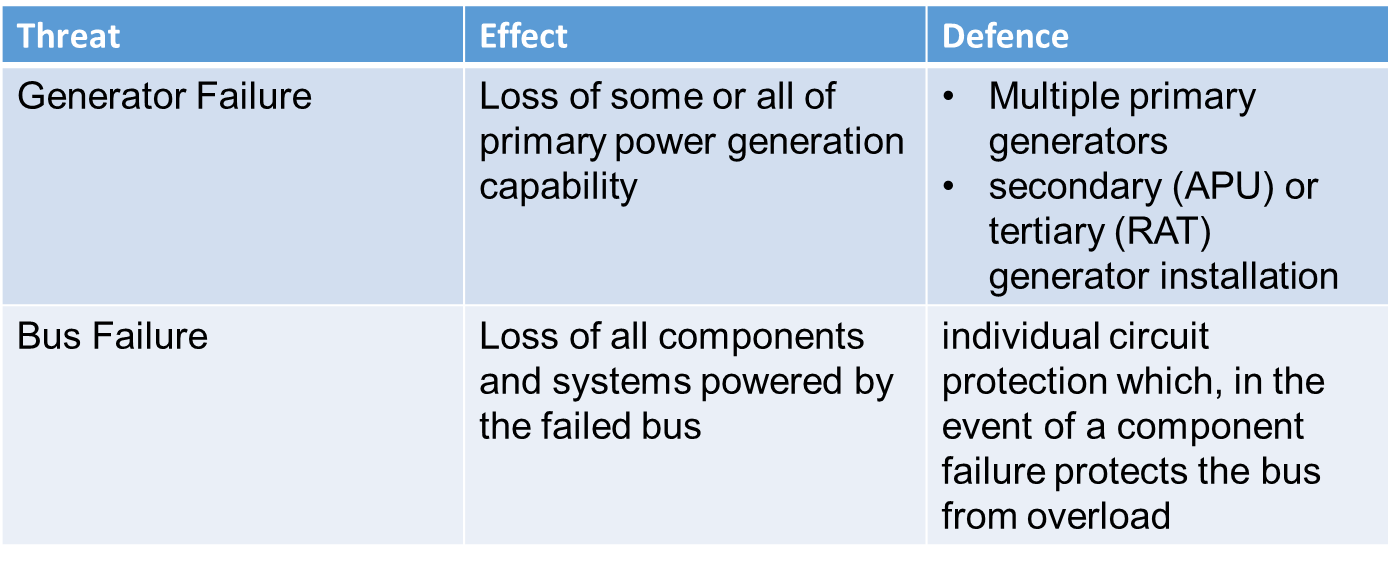
Electrical System Threats 2