chemistry unit 4
 Studied by 6 people
 Call Kai
 Learn
Learn Practice Test
 Spaced Repetition
 Match
Match Flashcards
 Knowt Play
1/20

There's no tags or description
Looks like no tags are added yet.
Name | Mastery | Learn | Test | Matching | Spaced |
|---|
No study sessions yet.
21 Terms
What is the gas that makes up the most of our atmosphere, and what percentage does it make up?
Nitrogen, makes up 78%
What the second most common gas in our atmosphere, and what percentage does it make up?
Oxygen, 20.9%
Whats the third most common gas in our atmosphere, and what percentage does it make up?
Argon, 0.9%
Why is nitrogen important for our atmosphere?
It helps plants gain minerals from soil, increases plant growth
Why is oxygen important for our atmosphere?
We need oxygen to breath and create fire, but its extremely reactive, so having nitrogen balances it out.
What does carbon dioxide do to our atmosphere?
It allows solar radiation to pass through our atmosphere, traps sunlight, and warms the atmosphere. This is vital for earth, until it heats up too much.
What are trace gases?
Trace gases make up .1% of the atmosphere, include ozone, nitrogen oxide, methane, helium, neon, water vapor, and several others
What are greenhouse gases?
Greenhouse gases, such as water vapor, carbon dioxide and methane are vitally important for keeping our planet warm. Although these gases are found in small concentrations, they are vitally important in maintaining a globally averaged temperature of 59oF.
How do pollutants affect our health?
Since we are breathing it in, it is going to affect our health, lung function, and can lead to increased cancer risks.
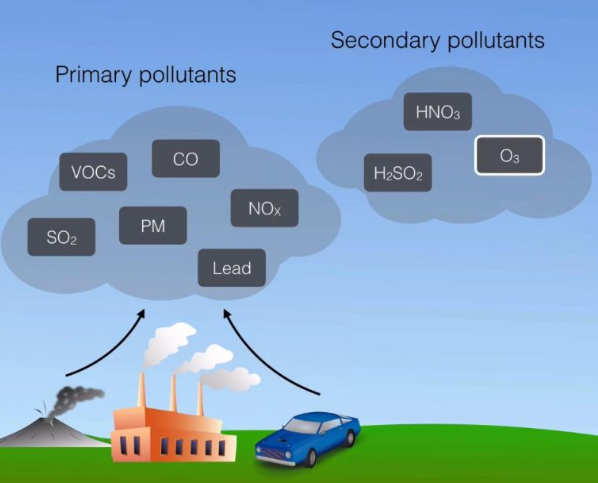
What are Primary pollutants?
they are emitted by a particular source, VOCs, Carbon monoxide, nitroxide, sulfur dioxide, lead, PM (particular matter)
What are secondary pollutants?
Primary pollutants can combine to form secondary pollutants, such as 03, HNO3, and H2SO2. These can cause acid rain.
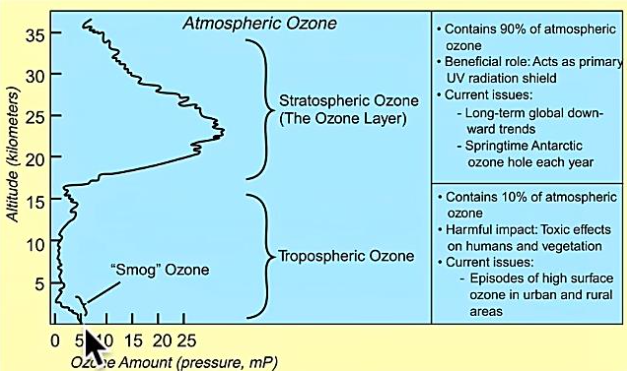
What is ozone made up of in the troposphere
Ozone is a secondary pollutant made up of NO2, VOC’s and sunlight, In the troposphere, ground-level ozone largely contributes to smog. This is “bad” ozone.

What is ozone made up of in the atmosphere/stratosphere
In the stratosphere, ozone is produced naturally where it blocks harmful ultraviolet rays from the sun.
What happens to the atmospher in the morning
NOx and VOC rise, as people drive
What happens to the atmosphere midmorning?
By midmorning , VOC’s begin to oxidize NO into NO2, thus reducing their respective concentrations.
What happens to the atmosphere mid-day?
At midday, NO2 concentrations peak just before solar radiation becomes intense enough to photolyze the NO2 bond, releasing an oxygen atom that quickly gets converted into O3.
What happens to the atmosphere in the evening?
By late afternoon, peak concentrations of photochemical smog are present.
The ozone layer can be helpful and harmful
true
When was a The Clean Air Act created?
1970
What does The Clean Air Act do to reduce pollution?
the Environmental Protection Agency (EPA) to set National Ambient Air Quality Standards (NAAQS) for pollutants considered harmful to public health and the environment. The EPA has set standards for six criteria pollutants which include: carbon monoxide (CO), lead (Pb), nitrogen dioxide (NO2), ozone (O3), particulate matter (PM), and sulfur dioxide (SO2).
What is the Air Quality Index (AQI)
color-coded scale that ranges from 0 – 500 and evaluates the health quality of the air around us. A rating below 50 indicates good air quality, whereas over 150 indicates unhealthy conditions for all populations.