capillaries and arteries
 Call Kai
 Learn
Learn Practice Test
 Spaced Repetition
 Match
Match Flashcards
 Knowt Play
1/14

There's no tags or description
Looks like no tags are added yet.
Name | Mastery | Learn | Test | Matching | Spaced | Call with Kai | Chat |
|---|
No analytics yet
Send a link to your students to track their progress
15 Terms
What are the three layers of blood vessels
outer = tunica externa
comprised of areolar CT, also contains vasa vasorum
middle = tunica media
elastin and collagen, smooth muscle
inner = tunica intima
simple squamous, CT, fenestrated layer
What are the histology differences between veins and arteries?
arteries tend to be more rounded and veins tend to be more irregularly shaped
arteries have large tunica media
elastic arteries have largest diameters and strength (aorta)
veins havelarge tunica adventitia
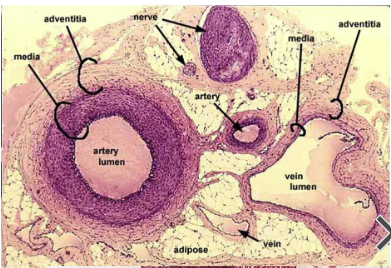
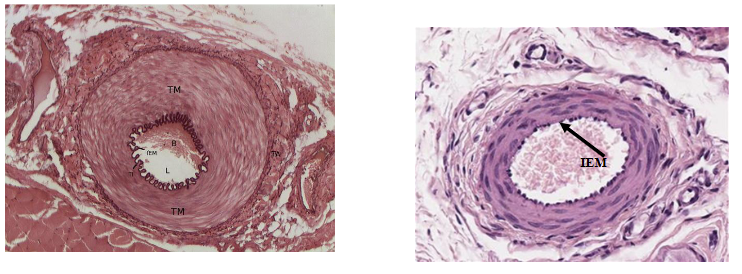
muscular arteries
medium and small arteries (distributing arteries) can regulate blood flow to various regions of the body
*IEM = internal elastic membrane
Different kinds of capillaries
*vary in size and permeability, internal lining of simple squamous epithelial cells is called endothelium
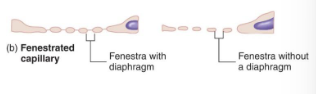
*substances that move through capillaries by diffusion through small openings = fenestrations
Fenestrated capillaries
areas of thin endothelial cells or small openings of pores that allow a great deal of fluid transport between blood and interstitial fluid
nutrient absorption in small intenstine and hormon absorption endocrine glands
continuous capillaries
held together by tight junctions, blood brain barrier
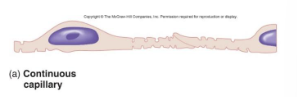
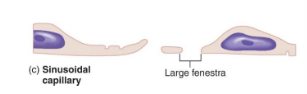
sinusoidal capillaries
large openings or gaps in endothelial lining allowing large formed elements such as proteins to pass
located in liver, spleen, bone marrow allowing large molecules and even cells to diffuse across membrane
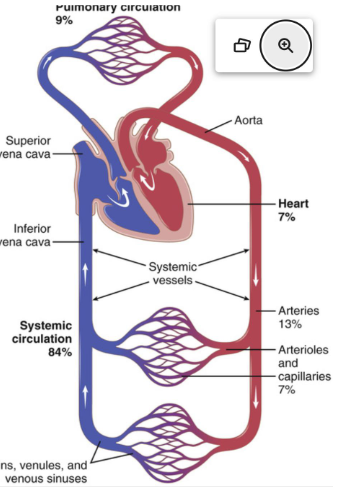
distribution of blood in percentage of total blood in different parts of the circulatory system
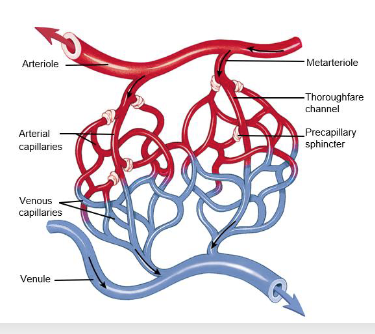
Capillary blood flow
arterioles —> metarterioles —> capillary network
distal part of metarterioles are thoroughfare channel connecting with venus capillaries and eventually the venule draining the capillary bed
smooth muscle sphincters control blood flow through the true capillary since there is not enough blood to fill all the capillaries at any given time
types of blood flow
laminar: velocity of flow in the center of the vessel is far greater than that toward the outer edges (due to resistance)
turbulent: when rate of blood flow becomes too great, when it passes by an obstruction in a vessel, or when it makes a sharp turn, or when it passes over a rough surface flow becomes disorderly
perfusion
the volume of blood flowing through arteries, veins, and capillaries
elasticity is the tendency of the arteries and veins to stretch in response to rpessure has large effect on perfusion and blood pressure
as we age the body makes less elastin which effects the elasticity of the walls of blood vessels
Blood pressure
the force of blood over the area in which it is distributed (walls of vessel)
what two factors determine blood flow?
pressure difference of the pressure of blood between the two ends of the vessel (pressure gradient)
vascular resistence which is the impediment to blood flow through the vessel
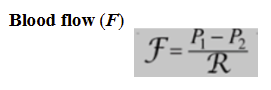
Peripheral vascular resistanc (systemic vascular resistance, SVR)
resistance in the circulatory system that is used to create blood pressure
vasoconstriction —> increase SVR
vasodilation —> decrease SVR
(if in pulmonary vasculature —> PVR)
Mechanisms of venous return
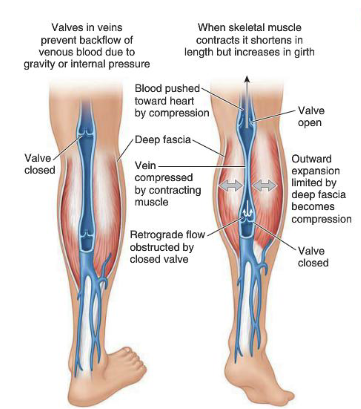
musculovenous pump: where muscular contractions become a compressive force propelling venous blood against gravity
valves: obstruct retrograde flow