Sharing the Road
 Call Kai
 Learn
Learn Practice Test
 Spaced Repetition
 Match
Match Flashcards
 Knowt Play
1/14

There's no tags or description
Looks like no tags are added yet.
Name | Mastery | Learn | Test | Matching | Spaced | Call with Kai | Chat |
|---|
No analytics yet
Send a link to your students to track their progress
15 Terms
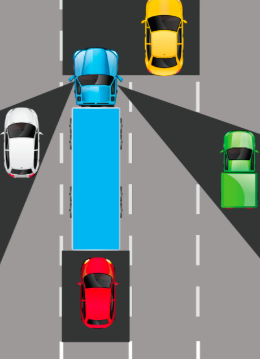
What does this image mean?
Larger vehicles/trucks have bigger mirrors, a better view in front of them, and large blind spots (AKA No Zones), where your vehicle can disappear from view. If you can’t see a large vehicle/truck’s side mirror, the driver can’t see you.
What should you do if there is a large truck/commercial vehicle stopping or slowing down near you?
Large trucks/commercial vehicles take longer to stop, so they need more room in front of them. If a large truck/commercial vehicle is slowing down/stopping, and you aren’t in stop-and-go traffic, do not change lanes in front of it.
How do longer vehicles turn?
When turning, your back wheels follow a shorter path than your front. For longer vehicles, the difference in turning path is greater, so they often swing wide. Look out for turn signals on large/commercial vehicles before passing; it may seem to be turning one way but is actually swinging wide to turn the other way.
What should you NOT do when driving near large vehicles/trucks?
Do NOT change lanes directly in front of them to reach an exit/turn, drive next to them longer than needed, pass them on the right, or follow too closely. They often appear to be traveling slower than they actually are.
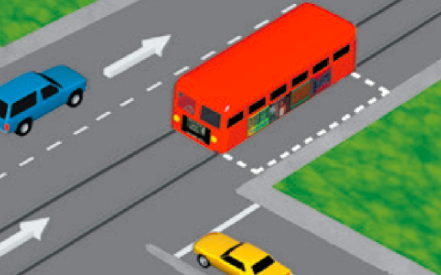
What are safety zones?
Safety zones are spaces set aside for pedestrians waiting for buses, streetcars, or trolleys. They are marked by white, raised buttons/markers (as shown in the image). Never drive through them.
How fast can you pass a bus, streetcar, or trolley at a safety zone or traffic light?
When a bus, streetcar, or trolley is stopped at a safety zone or traffic light, pass it at under 10mph.
Do you overtake and pass a light rail vehicle or streetcar on the left or right?
Overtake and pass a light rail vehicle or streetcar on the right (no matter if it’s moving or standing) unless there is not enough room to pass on the right, you’re on a one-way street, or an officer directs you to pass on the left.
How do you safely share the road with light rail vehicles?
On public roads, light rail vehicles have the same rights and responsibilities as other vehicles. Be aware of where they operate, as buildings, trees, and other structures can create blind spots. Never turn in front of a light rail vehicle, maintain a safe distance, and check for them before crossing tracks.
How do you safely share the road with motorcycles?
Motorcyclists have the same rights and responsibilities as other drivers. Check blind spots and mirrors, especially when changing lanes or entering a road. Allow a 3 second following distance for motorcycles.
When can you lane split (as a driver and a motorcyclist)?
Lane splitting is illegal (as a driver and a motorcyclist), so don’t drive next to motorcycles; give them the same space you would give other vehicles.
How do you safely share the road with emergency vehicles?
Give emergency vehicles (police, ambulances, fire trucks, etc.) the right of way (switch lanes, pull over, and/or let them go first). You must stay at least 300 feet behind an emergency vehicle with its sirens/flashing lights on. Even if they’re illegal, follow all orders from police or firefighters.
How do you safely share the road with slow-moving vehicles?
Slow-moving vehicles: road maintenance vehicles, scooters, neighborhood electric vehicles, golf carts, large trucks, bicyclists, etc. On long/steep hills, these vehicles can take longer to gain/lose speed. Some slow-moving vehicles have an orange/red triangle (usually meaning they travel 25 mph or less). Adjust your speed to share the road.
What is an NEV? What is an LSV? What roads can NEVs and LSVs drive on?
NEVs are neighborhood electric vehicles. LSVs are low-speed vehicles. Watch for slow-moving vehicles when you see “NEV USE ONLY” or “NEV ROUTE.” NEVs and LSVs can only drive on roads with a speed limit of 35 miles per hour or less (because their max speed is often 25 miles per hour).
Where can animal-drawn vehicles “drive?”
Horse-drawn vehicles and horseback riders (or other livestock) are allowed to share the road with cars [as an LSV (low-speed vehicle), AKA on roads with a speed limit of 35 miles per hour or less], and it is illegal to intentionally scare livestock.
How do you safely share the road near animals?
Look for nearby animal signs (deer signs are the most common). If you’re near someone’s pet, follow directions from the owner.